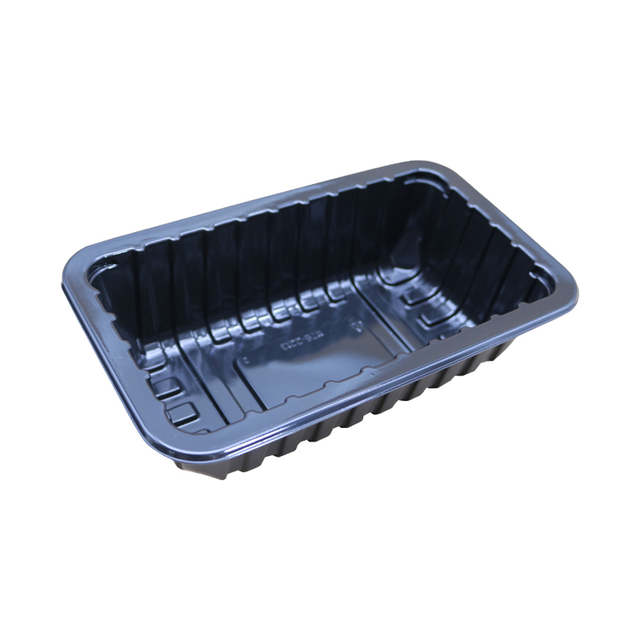
High Barrier VSP Trays for Vacuum Skin Packaging
HSQY PLASTIC supplies high barrier VSP trays for vacuum skin packaging of fresh meat, poultry, seafood, cheese, processed meat and premium chilled foods. Our VSP tray solutions are designed for food processors, meat packers, supermarkets, packaging distributors and industrial food packaging operations requiring reliable vacuum skin packaging performance.
Vacuum Skin Packaging, commonly called VSP, combines a rigid food tray or backing substrate with a specially designed skin film. During packaging, air is removed and the heated film conforms tightly around the food like a second skin before bonding to the tray's compatible sealing surface.
HSQY offers PP-based high-barrier trays in multiple sizes and can also discuss customized tray dimensions, colors, barrier structures, flange designs and matching vacuum skin films according to your food product and packaging equipment.
What Is a VSP Tray?
A VSP tray, or Vacuum Skin Packaging tray, is a rigid food packaging tray designed to work with a thermoformable vacuum skin film. The film is heated, softened and drawn tightly around the food under vacuum before sealing to the tray surface.
Unlike conventional tray lidding, the VSP film does not simply span across the top of the tray. Instead, it closely follows the shape and contours of the product, creating a clear three-dimensional presentation while helping immobilize the food inside the package.
VSP trays are particularly popular for premium fresh meat, steaks, pork cuts, lamb, poultry portions, fish fillets, seafood, cheese and other products where product visibility, leak control and tight package presentation are important.
How Does Vacuum Skin Packaging Work?
Vacuum skin packaging is a system involving the tray, food product, skin film and packaging machine. Each component must be compatible for reliable commercial production.
First, the food product is placed into or onto the VSP tray. The tray enters the vacuum skin packaging machine, where the top film is heated until it becomes sufficiently formable.
Air surrounding the product is then evacuated. The softened film is drawn closely around the product and down toward the tray, following the product contours before bonding to the compatible sealing surface.
The result is a tight, transparent skin pack with very little free space around the food.
Components of a Complete VSP Packaging System
| Component | Main Function | Key Selection Factors |
| VSP Tray | Supports the food and provides the rigid base for skin sealing. | Material, barrier structure, dimensions, flange, rigidity and sealing surface. |
| Vacuum Skin Film | Heats and conforms closely around the product. | Formability, barrier level, puncture resistance, clarity, peel performance and seal compatibility. |
| Food Product | Determines required packaging geometry and barrier performance. | Product height, shape, moisture, fat content, sharp edges, bones and storage requirements. |
| VSP Packaging Machine | Controls film heating, vacuum, forming and sealing. | Tooling dimensions, heating system, vacuum level, cycle time and forming capability. |
| Cold Chain | Maintains validated storage conditions after packaging. | Product temperature, refrigerated or frozen storage and distribution conditions. |
Why Use High Barrier VSP Trays?
Many VSP applications for meat, cheese and other oxygen-sensitive foods require controlled oxygen transmission through the complete packaging system.
High-barrier tray structures can incorporate materials such as EVOH together with PP, PE or other functional layers. The exact structure depends on the required barrier performance, sealing system and food application.
Buyers interested in the material structure itself can also review our High Barrier PP Trays, PP/EVOH/PE Trays and PP Coextruded Trays.
VSP Tray Material Options
Vacuum skin packaging can use different rigid substrates depending on the food, packaging film and machinery. HSQY's current VSP tray range is focused primarily on PP-based high-barrier food trays, while other tray structures can be evaluated for suitable projects.
| Tray Structure | Main Characteristics | Typical Consideration |
| PP-Based VSP Tray | Tough, rigid and suitable for many chilled food applications. | Skin film and tray sealing surfaces must be compatible. |
| PP / EVOH / PP | PP-dominant structure with EVOH oxygen-barrier layer. | Suitable for evaluation where improved oxygen-barrier performance is required. |
| PP / EVOH / PE | Multilayer barrier structure with functional sealing layer. | Film-to-tray seal compatibility should be confirmed before production. |
| PET / EVOH / PE | High-clarity multilayer structure with barrier and sealing functions. | Can be evaluated as a VSP base when matched with compatible skin film and equipment. |
The tray material alone does not determine whether a package will perform successfully in VSP. The substrate, sealant layer, skin film, heating profile, vacuum cycle and packaging machine must be tested together.
Vacuum Skin Film for VSP Trays
The vacuum skin film is one of the most important components of VSP packaging. A standard flat tray lidding film should not automatically be treated as a VSP skin film.
A dedicated VSP film needs sufficient thermoformability to stretch around the food while maintaining package integrity. It must also bond reliably to the selected tray or sealing layer after the vacuum-forming process.
Depending on the application, important skin film characteristics can include high clarity, oxygen barrier, puncture resistance, forming depth, elasticity, drip retention, anti-fog performance and easy-peel or lock-down sealing.
HSQY also supplies high-barrier flexible packaging materials including vacuum skin packaging films. Buyers can review our High Barrier Composite Films or contact us with the tray and packaging machine specifications for film recommendations.
Product Protrusion and VSP Forming Depth
One of the most important technical parameters in vacuum skin packaging is product protrusion, meaning how far the food extends above the tray flange or sealing plane.
A thick steak, fish fillet or poultry portion may sit significantly above the tray. The VSP film must therefore stretch vertically and laterally around the product without tearing, excessive thinning, bridging or losing its seal.
Maximum suitable protrusion cannot be determined from the tray alone. It depends on skin film formability, film thickness, heating temperature, vacuum conditions, machine design, tray geometry and the shape of the packaged product.
For high-profile products, send HSQY the maximum product height above the sealing flange together with your packaging-machine information before ordering production quantities.
Packaging Meat with Bones or Sharp Edges
Bone-in steaks, chops, shellfish and products with sharp edges place higher mechanical demands on VSP film.
For these applications, puncture resistance, film thickness, product orientation and sharp-edge protection should be evaluated carefully. A film that performs well for boneless meat may not necessarily provide sufficient puncture resistance for bone-in products.
Key Benefits of Vacuum Skin Packaging Trays
Premium Product Presentation: Clear skin film closely follows the product contours, creating an attractive three-dimensional display for retail food packaging.
Reduced Free Air: Vacuum removes most of the free air surrounding the product before the skin film is sealed.
Product Immobilization: The tight film can help hold meat, fish and other products securely against the tray during handling and transportation.
Leak Control: Properly designed VSP systems help contain meat juices, marinades and moisture within the package.
Excellent Visibility: High-clarity skin film allows consumers to see the shape, texture and appearance of the packaged product.
Efficient Retail Display: Secure product positioning and leak control can support different retail display formats when the complete package has been properly validated.
High Barrier Options: Barrier trays and films can be selected for products requiring reduced oxygen transmission.
VSP Trays for Fresh Meat Packaging
Fresh meat is one of the main applications for vacuum skin packaging trays. Typical products include beef steaks, pork chops, lamb, minced meat portions, premium cuts and marinated proteins.
The skin film closely conforms around the meat, helping keep the product in position while providing clear presentation and containing purge or meat juices.
For additional meat-packaging options, view our Fresh Meat Trays.
VSP Trays for Fish and Seafood
Vacuum skin packaging can also be used for fish fillets, salmon portions, shrimp, shellfish and other seafood products.
Seafood packaging requirements can differ substantially from red meat packaging. The appropriate tray, skin film barrier, permeability and storage conditions should therefore be selected for the specific seafood product rather than applying one universal VSP specification.
VSP Trays for Poultry
Chicken breast, turkey portions, duck and other poultry products can be packed using VSP systems when the tray, film and packaging process are appropriately designed.
Poultry applications should consider product moisture, bones, skin texture, puncture risk, barrier requirements and refrigerated storage conditions.
VSP Trays for Cheese and Processed Foods
Cheese, cured meat, charcuterie, sausages and selected prepared foods can also benefit from vacuum skin packaging when product characteristics are compatible with vacuum processing.
VSP is particularly useful for premium retail products where strong visual presentation and secure product positioning are important.
Common VSP Food Applications
| Food Product | Important Packaging Considerations |
| Beef & Steak | Barrier performance, product height, purge control and premium presentation. |
| Pork & Lamb | Product shape, bone puncture risk, skin-film forming depth and seal integrity. |
| Poultry | Moisture control, product geometry, film puncture resistance and cold chain. |
| Fish | Barrier requirement, product moisture, storage temperature and film characteristics. |
| Shrimp & Shellfish | Sharp edges, puncture resistance and product shape. |
| Cheese | Oxygen barrier, seal integrity and product appearance. |
| Sausage & Charcuterie | Portion positioning, barrier performance and premium retail display. |
| Prepared Foods | Product composition, sauces, temperature requirements and reheating process where applicable. |
VSP Tray Specifications and Custom Options
| Product | Vacuum Skin Packaging Tray / VSP Tray |
| Main Tray Material | PP-based high-barrier structures; other structures can be evaluated according to application. |
| Barrier Options | EVOH and other multilayer barrier structures available according to product requirements. |
| Colors | Black, clear, white and selected custom colors depending on tray structure and order requirements. |
| Shapes | Rectangular and customized tray designs according to packaging project. |
| Seal Options | Compatible VSP skin film with easy-peel or stronger seal options according to packaging system. |
| Main Applications | Fresh meat, poultry, fish, seafood, cheese, charcuterie and selected prepared foods. |
| Custom Options | Tray length, width, depth, flange, color, barrier structure and custom mold development. |
VSP Tray vs MAP Tray
Vacuum Skin Packaging and Modified Atmosphere Packaging are both widely used for chilled food, but they use different packaging principles.
| Feature | VSP | MAP |
| Packaging Principle | Removes air and forms the film tightly around the food. | Replaces or modifies the atmosphere inside a sealed tray. |
| Film Position | Film closely contacts the food surface. | Lidding film normally spans above the product with headspace. |
| Headspace | Very limited free headspace. | Defined headspace is normally required for the gas atmosphere. |
| Gas Mixture | Normally relies primarily on vacuum rather than introducing a MAP gas headspace. | Uses a selected mixture such as CO₂, N₂ and/or O₂ according to the food. |
| Product Presentation | Strong three-dimensional, skin-tight presentation. | Conventional sealed-tray presentation. |
| Product Movement | Film can help immobilize the product. | Product generally remains free inside the tray. |
Neither system is universally better. The correct choice depends on the food, desired presentation, production speed, shelf-life target, distribution process and available packaging machinery.
For gas-flush tray packaging, view our MAP Trays.
VSP Tray vs Traditional Vacuum Bag
| Feature | VSP Tray | Vacuum Bag |
| Support | Uses a rigid tray or substrate. | Flexible bag surrounds the product. |
| Retail Presentation | Designed for premium tray-based display. | More flexible pack appearance. |
| Product Positioning | Product can remain fixed to the tray surface. | Product position can move within the flexible package. |
| Typical Use | Case-ready retail meat, seafood, cheese and premium foods. | Bulk meat, cheese, processed food and general vacuum storage. |
VSP Packaging Machine Compatibility
A VSP tray must fit both the food product and the packaging machine. Tray dimensions alone are not enough to guarantee compatibility.
Important equipment parameters include tray length and width, flange dimensions, cavity depth, mold design, film width, film heating method, vacuum capability, maximum forming depth and cycle parameters.
If you already operate a VSP machine, provide the machine brand, model, existing tray drawing and current film specification so that compatibility can be evaluated.
Buyers developing a new packaging line can also review our Food Tray Sealing Machines.
How to Choose the Right VSP Tray
For B2B projects, HSQY recommends confirming the following information before selecting a vacuum skin packaging tray.
1. Food Type: Specify beef, pork, poultry, fish, seafood, cheese, prepared food or another product.
2. Product Dimensions: Provide product length, width, thickness and weight.
3. Product Protrusion: Confirm how far the food extends above the tray's sealing plane.
4. Sharp Edges or Bones: Identify bone-in meat, shells or other puncture risks.
5. Barrier Requirement: Define the intended storage conditions and target shelf life so the required barrier level can be evaluated.
6. Skin Film: Provide the existing film specification if you already use a VSP packaging system.
7. Packaging Machine: Provide machine brand, model and tooling dimensions.
8. Storage Temperature: Specify refrigerated, frozen or other distribution conditions.
9. Seal Preference: Confirm whether easy opening or stronger lock-down sealing is required.
10. Production Testing: Validate the final tray and film combination on the actual packaging line with the real food product before commercial-scale production.
Custom Vacuum Skin Packaging Trays
HSQY can discuss custom VSP tray development for suitable volume projects when existing standard tray dimensions do not match the food product or packaging equipment.
Customization can include tray length, width, depth, flange geometry, color, material structure, barrier level, wall thickness, stacking design and other packaging requirements.
For custom projects, sending an existing tray sample, CAD file, technical drawing or complete dimensions will help reduce development time and improve quotation accuracy.
Food Safety and Shelf-Life Validation
Vacuum Skin Packaging can reduce oxygen exposure, but vacuum packaging should not be treated as a substitute for food-safety controls.
Actual shelf life depends on the food formulation, initial microbial load, processing hygiene, oxygen-barrier performance, seal integrity, packaging process and storage temperature.
The packaged food should remain within its validated cold chain, and commercial shelf-life claims should be established through appropriate product and microbiological testing rather than estimated from the tray material alone.
Can VSP Trays Be Frozen?
Certain VSP tray and film combinations can be designed for chilled-to-frozen distribution, but freezer suitability depends on the exact tray formulation, skin film and package design.
Low-temperature impact resistance and seal performance should be validated at the actual storage temperature before commercial use.
Can VSP Trays Be Microwaved?
Microwave suitability depends on the specific tray structure, skin film, food load, microwave power, heating duration and package design.
PP-based packaging may offer microwave-capable options, but buyers should not assume that every VSP package can be microwaved without removing or venting the skin film. The complete packaging system and reheating instructions must be validated for the intended use.
Are VSP Trays Recyclable?
Recyclability depends on the exact tray structure and the collection, sorting and recycling infrastructure available in the destination market.
PP-dominant trays may be accepted by certain polypropylene recycling systems, while multilayer barrier structures and attached skin films may require different handling.
Packaging recyclability claims should therefore be evaluated according to the final material structure and local regulations rather than applied universally to all VSP trays.
Why Choose HSQY as Your VSP Tray Supplier?
HSQY supplies high-barrier food trays, multilayer PP packaging, vacuum packaging films and food tray-sealing solutions for international B2B food packaging customers.
Instead of evaluating the tray independently, buyers can discuss the complete VSP tray + skin film + sealing equipment combination with our team.
Standard trays can help shorten sourcing time, while custom tray dimensions, colors, material structures and molds can be evaluated for suitable volume projects.
VSP Tray FAQ
What does VSP mean in food packaging?
VSP means Vacuum Skin Packaging. It uses vacuum and a thermoformable skin film that conforms tightly around a food product and seals to a rigid tray or backing substrate.
How does a VSP tray work?
Food is placed onto the tray before the skin film is heated. Air is evacuated from around the product, and the softened film conforms closely around the food before sealing to the tray's compatible sealing surface.
What foods are suitable for VSP trays?
Common applications include beef, pork, lamb, poultry, fish, seafood, cheese, sausages, charcuterie and selected prepared foods. The packaging specification should be designed for the specific food.
What is the difference between VSP and MAP packaging?
VSP removes air and pulls a flexible film tightly around the food. MAP normally leaves headspace above the food and replaces the original atmosphere with a controlled gas mixture before sealing.
Does VSP packaging use gas?
Conventional VSP primarily relies on vacuum removal of air rather than maintaining the gas-filled headspace used in standard MAP packaging. Specialized hybrid packaging systems can differ, so the actual equipment process should always be confirmed.
What material is used for VSP trays?
VSP bases can be made from PP, PET and multilayer barrier structures such as PP/EVOH or PET/EVOH combinations. HSQY's VSP category primarily includes high-barrier PP tray options.
What is a high barrier VSP tray?
A high barrier VSP tray contains or incorporates materials designed to reduce oxygen transmission through the tray structure. EVOH is commonly used as an oxygen-barrier layer in multilayer food packaging.
Can ordinary lidding film be used for vacuum skin packaging?
Not automatically. VSP film must heat, soften and stretch around the product while maintaining its barrier and mechanical performance and bonding to the tray. Standard flat lidding film may not have the required formability.
What is product protrusion in vacuum skin packaging?
Product protrusion is the height that the food extends above the tray sealing surface. Greater protrusion requires greater film forming capability and must be considered together with film properties and machine settings.
Can VSP package bone-in meat?
Yes, certain VSP systems can package bone-in meat, but sharp bones increase puncture risk. Film puncture resistance, product orientation, film thickness and machine settings should be evaluated for the actual product.
Can VSP trays be displayed vertically?
Properly validated VSP packages can provide strong product immobilization and leak control that may support vertical or hanging retail presentation. Final performance depends on tray rigidity, seal integrity, food characteristics and skin-film performance.
Can VSP trays be frozen?
Certain tray and skin-film combinations can support frozen storage. Low-temperature performance should be confirmed for the specific material structure and actual storage conditions.
Are VSP trays microwave safe?
Some PP-based trays may be suitable for microwave applications, but the complete VSP package should be validated according to the tray, skin film, food load, heating power and heating duration. Microwave suitability should not be assumed for every VSP package.
Can HSQY customize VSP tray sizes?
Yes. HSQY can discuss custom length, width, depth, flange dimensions, color, barrier structure and mold development according to order quantity and packaging requirements.
How do I choose a VSP tray for my existing packaging machine?
Provide your machine brand and model, tooling dimensions, existing tray dimensions, skin-film specification, food dimensions and maximum product protrusion. This information helps determine whether an existing tray can be used or a custom design is required.
How can I request VSP tray samples?
Send HSQY your required tray dimensions, food type, product size and height, estimated order quantity, preferred color, packaging-machine information and destination market. If you already use VSP packaging, include your current tray and skin-film specifications.
Request a Quote for VSP Trays
Looking for a reliable VSP tray manufacturer, vacuum skin packaging tray supplier or complete tray-and-film solution for fresh meat, seafood, poultry or cheese?
Send HSQY your food application, tray dimensions, product protrusion, estimated quantity, skin-film requirements and packaging-machine information. Our team can help evaluate standard high-barrier VSP trays or customized packaging solutions.