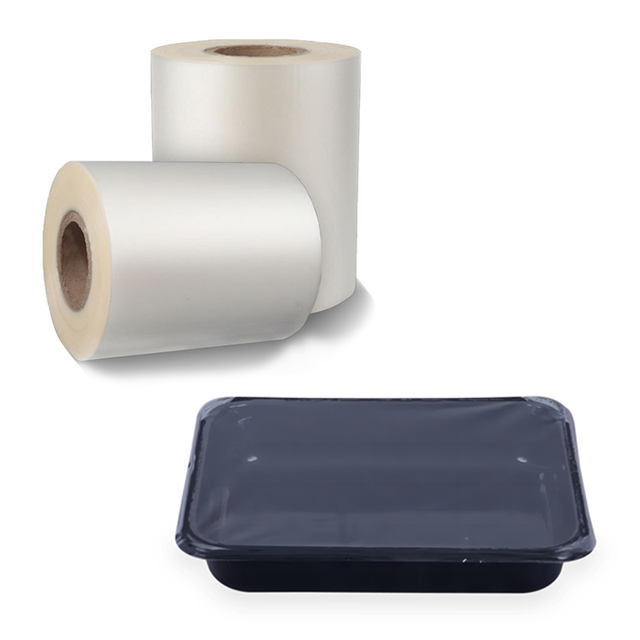
What Is Sealing Film for PET Trays?
Sealing film for PET trays, also known as PET tray lidding film or heat-seal top film, is a flexible packaging film used to close preformed PET food trays with heat and pressure.
The film is supplied in rolls and used on manual, semi-automatic or fully automatic tray sealing machines. Depending on the selected structure, it can provide easy-peel opening, lock-seal closure, anti-fog performance, oxygen barrier, moisture barrier, puncture resistance and printed branding.
HSQY supplies PET tray sealing films for fresh produce, salads, meat, poultry, fish, seafood, bakery products, desserts, dairy products, chilled ready meals and modified atmosphere packaging.
The correct film must be matched to the exact tray flange, sealing layer, food product, packaging machine and storage conditions. A film described as suitable for one PET tray may not seal correctly to another PET tray with a different surface structure.
Why the PET Tray Sealing Surface Matters
The term “PET tray” can refer to several different packaging structures. The main structural material may be PET, but the flange surface can be mono-PET, PE-coated, PETG-coated or specially treated for heat sealing.
Film compatibility is determined primarily by the material or coating present on the tray sealing flange.
| Tray Type | Typical Sealing Surface | Film Selection Guidance |
| Mono-APET Tray | APET or a PET-compatible surface treatment | Requires a film specifically designed to seal directly to mono-PET or APET |
| rPET Tray | Recycled PET surface or PET-compatible coating | Must be tested because recycled content and surface condition can affect seal performance |
| APET/PE or PET/PE Tray | PE-based sealing layer | Commonly matched with PET/PE or BOPET/PE easy-peel or lock-seal lidding film |
| CPET Tray | CPET surface or application-specific coating | Requires a compatible film validated for the intended microwave or oven temperature |
| PET/EVOH/PE Tray | PE or another specified sealant layer | Normally paired with a compatible high-barrier film for MAP or chilled food packaging |
Customers should provide an actual tray sample or detailed material structure before ordering sealing film. Testing only with a generic “PET tray” may produce misleading results.
PET Tray Sealing Film Specifications
The following table summarizes common HSQY supply options. Final specifications depend on the tray surface, sealing equipment, food application, required barrier and opening method.
| Product Name | Heat-Seal Lidding Film for PET Food Trays |
| Common Film Structures | PET/PE, BOPET/PE, coated BOPET, BOPET/PETG and EVOH-based high-barrier laminates |
| Common Thickness | Approximately 25–60 μm |
| Extended Thickness Options | Selected structures from approximately 23–100 μm, subject to application review |
| Roll Width | Standard and custom widths according to tray sealer and tooling |
| Available Standard Widths | Selected products are available in widths such as 150 mm, 200 mm, 230 mm, 250 mm and 280 mm |
| Roll Length | 500 m for selected standard products; custom roll length and diameter available |
| Core Size | Customized according to the tray sealing machine |
| Appearance | Clear, high-gloss, matte, printed or customized |
| Opening Options | Easy peel, controlled peel, lock seal or stronger permanent seal |
| Functional Options | Anti-fog, high barrier, puncture-resistant, matte, printed, microwave-grade and selected heat-resistant structures |
| Packaging Equipment | Manual, semi-automatic, rotary and fully automatic tray sealing lines after compatibility testing |
| Typical Applications | Produce, salads, meat, poultry, fish, seafood, bakery products, desserts, dairy foods and ready meals |
| Reference MOQ | Approximately 500 kg per specification; printed and specialty films may require a different MOQ |
| Reference Lead Time | Approximately 10–20 working days after final specification and order confirmation |
All dimensions and performance values should be confirmed in the final technical specification. Film thickness alone does not determine seal strength, puncture resistance, barrier or machine performance.
Types of Sealing Film for PET Trays
PET/PE Easy-Peel Lidding Film
PET/PE easy-peel film normally combines a strong PET or BOPET outer layer with a PE-based heat-seal layer. The outer layer provides clarity, stiffness, printing performance and mechanical strength, while the inner layer bonds to a compatible tray sealing surface.
Easy-peel films are designed to separate progressively when the consumer pulls the opening tab. The peel should be strong enough to protect the package during distribution but controlled enough to avoid film tearing, tray deformation or sudden opening.
See the related PET/PE easy-peel sealing film.
Lock-Seal Lidding Film
Lock-seal film creates a stronger bond and is selected when package security, liquid containment or resistance to rough handling is more important than easy manual opening.
A lock seal may require the film to be cut or punctured during opening. Excessive sealing energy should still be avoided because it can distort the tray flange, damage the film or reduce production efficiency.
Anti-Fog PET Tray Lidding Film
Anti-fog film contains a coating or additive that spreads condensed moisture into a thin transparent layer instead of allowing visible droplets to form.
It is commonly selected for chilled produce, salads, fresh food, meat, seafood and ready meals where condensation would otherwise obstruct product visibility.
Anti-fog performance depends on the food temperature, humidity, coating side, storage cycle and amount of moisture inside the package. Testing should reproduce actual filling, cooling, transportation and retail-display conditions.
See HSQY's anti-fog PET/PE sealing film.
BOPET Coated Sealing Film
Coated BOPET film uses a heat-sealable coating applied to the polyester substrate. The coating is selected to bond to a specific tray surface while the BOPET base provides strength, clarity and dimensional stability.
Coated-film performance depends on coating chemistry, coating weight, tray surface, sealing temperature and package conditioning.
Related products are available in the BOPET coated sealing film category.
BOPET/PETG Sealing Film
BOPET/PETG lidding film combines a BOPET outer layer with a PETG-based sealing layer. It can be developed for strong lock-seal performance on compatible PET-based trays.
Compatibility should be confirmed using the actual tray because different APET, rPET and PETG surfaces can produce different seal strengths.
See the related BOPET/PETG sealing film.
High-Barrier PET/EVOH/PE Lidding Film
High-barrier lidding film contains an EVOH or other barrier layer that reduces oxygen and gas transmission. It is used with a compatible high-barrier tray in modified atmosphere packaging and other applications requiring controlled gas retention.
The required barrier level should be selected according to food type, gas mixture, tray barrier, residual oxygen, storage temperature, distribution period and target shelf life.
See HSQY's EVOH-based high-barrier PET/PE film.
Easy Peel vs. Lock Seal
| Comparison | Easy-Peel Film | Lock-Seal Film |
| Opening Method | Designed for controlled manual peeling | Creates a stronger bond that may require cutting or puncturing |
| Consumer Convenience | High convenience and cleaner opening | Lower opening convenience but higher seal security |
| Typical Applications | Salads, produce, dairy, desserts and consumer-ready meals | Liquid foods, transport-sensitive packs and applications requiring stronger closure |
| Main Risk | Insufficient peel force can reduce package security | Excessive seal strength can tear the film or damage the tray |
Peel performance is affected by sealing temperature, dwell time, pressure, tray surface, film structure and the time elapsed after sealing. The final peel force should be evaluated after the package has reached its actual chilled or ambient storage condition.
How PET Tray Heat Sealing Works
Tray loading: Food is placed inside the PET tray without contaminating the sealing flange.
Film positioning: The lidding-film roll is indexed over the filled tray.
Heat and pressure: The sealing tool applies controlled heat, pressure and dwell time.
Sealant activation: The film's heat-seal layer softens and bonds to the compatible tray surface.
Cooling: The seal develops strength as it cools and conditions.
Film cutting: The machine cuts the film around the tray or rewinds the excess web.
Inspection: The package is checked for wrinkles, incomplete seals, contamination and leakage.
Using a higher sealing temperature does not always create a better seal. Excessive heat can shrink or distort the film, deform the tray, increase peel force or cause seal-through and material damage.
Applications of PET Tray Lidding Film
Fresh Fruit and Vegetable Packaging
Clear anti-fog sealing film can be used for berries, tomatoes, cut fruit, vegetables, mushrooms and other fresh produce packed in PET trays.
Produce packaging may require controlled perforation or gas transmission because fruits and vegetables continue to respire after packing. A fully high-barrier film is not automatically appropriate for every fresh-produce application.
Salad and Deli Food Packaging
PET tray sealing films are used for salads, prepared vegetables, dips, cold noodles, deli products and chilled side dishes. Easy-peel and anti-fog functions improve opening convenience and product visibility.
Meat, Poultry and Seafood Packaging
High-barrier and puncture-resistant films can be used for fresh meat, poultry, fish, seafood and processed protein products packed in compatible PET or PET/PE trays.
Sharp bones, shell edges, liquid contamination and absorbent pads should be considered when selecting film thickness and puncture resistance.
Bakery and Dessert Packaging
Cakes, pastries, cookies, confectionery, puddings and chilled desserts can use high-clarity sealing films for product protection and retail presentation.
Dairy and Cheese Packaging
Sealing films can be used for cheese portions, yogurt-based products, dairy desserts, butter products and chilled dairy foods.
Aroma barrier, oxygen barrier, seal integrity and easy opening should be selected according to the product.
Chilled Ready Meals
Ready meals, meal-prep foods, pasta, rice dishes and prepared food can be sealed in compatible APET, PET/PE or CPET trays.
The film structure should be selected according to whether the package will only be refrigerated or will also be frozen, microwaved or heated in an oven.
Sealing Film for Modified Atmosphere Packaging
Modified atmosphere packaging replaces most of the air inside a sealed package with a food-specific gas mixture.
A MAP lidding film must provide the appropriate gas barrier and form a reliable hermetic seal with the tray. The film cannot compensate for a low-barrier tray, damaged flange or incorrect gas-flushing process.
Film selection should consider:
Food product and microbial risks
Oxygen, carbon dioxide and nitrogen mixture
Tray oxygen transmission rate
Required film oxygen transmission rate
Residual oxygen after sealing
Gas-to-product volume
Target shelf life
Storage and distribution temperature
Seal strength and leak rate
Puncture resistance
Commercial shelf-life claims should be supported by gas-retention, package-integrity, microbiological and sensory testing using the actual tray, film, food and packaging equipment.
Tray Sealing Machine Compatibility
Roll dimensions and film performance must be matched to the tray sealing machine. Important machine information includes:
Machine manufacturer and model
Manual, semi-automatic or automatic operation
Maximum film width
Maximum roll diameter
Core diameter
Unwind direction
Printed side and sealing side
Seal-plate temperature range
Dwell time
Sealing pressure
Line speed and trays per minute
Film-cutting method
Registration mark sensor
MAP or gas-flush function
HSQY also supplies food tray sealing machines for manual, semi-automatic and automatic food packaging lines.
Roll Width, Winding Direction and Print Registration
Supplying only the film width is not sufficient for an accurate roll-film order. Buyers should also specify:
Finished roll width
Film thickness
Roll length
Core inside diameter
Maximum outside diameter
Maximum roll weight
Sealing layer wound inside or outside
Print orientation
Artwork repeat length
Eye-mark position
Number of lanes or tray cavities
Splice and joint requirements
Incorrect winding direction can place the sealant or printed surface on the wrong side, making the roll unusable on the customer's line.
Microwave, Freezer and Oven Performance
Can PET Tray Sealing Film Be Microwaved?
Selected film structures can be developed for microwave reheating, but standard PET tray film should not automatically be described as microwave-safe.
Microwave suitability depends on the complete tray-and-film package, food composition, heating time, microwave power and whether the film must be removed, pierced or vented.
Can the Film Be Used for Frozen Food?
Selected films can be used for frozen packaging when their flexibility, impact resistance and seal integrity remain acceptable at the required temperature.
Testing should include freezing, handling, stacking, transportation and thawing conditions. The film should not become brittle or separate from the tray during the cold-chain cycle.
Can Standard PET Sealing Film Be Used in an Oven?
Standard PET/PE food tray film should not be assumed to withstand conventional oven temperatures.
Oven applications require a specifically developed heat-resistant or ovenable film matched to a suitable tray, such as a validated CPET tray. The film, ink, adhesive and seal must be tested throughout the complete heating cycle.
Custom-Printed PET Tray Lidding Film
PET tray sealing film can be printed with logos, product names, preparation instructions, nutritional information, barcodes, QR codes and promotional graphics.
Printed-film projects normally require:
Editable artwork files
Finished roll width
Printing repeat length
Number of colors
Pantone or color references
Print direction
Registration-mark position
Tray orientation in the sealing tool
Printing side and sealant side
Required surface finish
Applicable food-packaging ink requirements
Printing inks and adhesives must be selected according to the food-contact design, heating conditions and destination-market requirements.
How to Choose the Right PET Tray Sealing Film
Confirm the Exact Tray Structure
Identify whether the tray is mono-APET, rPET, APET/PE, PET/PE, PET/EVOH/PE, CPET or another coated structure.
Choose Easy Peel or Lock Seal
Select easy peel for consumer convenience or a stronger lock seal where leakage resistance and package security are the priority.
Define the Barrier Requirement
Standard chilled foods may not require the same oxygen barrier as meat or seafood packed under modified atmosphere.
Determine Whether Anti-Fog Is Needed
Anti-fog film is recommended when condensation is likely to obstruct visibility during refrigerated storage or retail display.
Review Puncture and Mechanical Strength
Bone-in meat, seafood shells and sharp product edges may require greater film thickness or puncture resistance.
Confirm the Use Temperature
State whether the package will be ambient, chilled, frozen, microwaved or heated in an oven.
Match the Machine and Line Speed
A film designed for a slow manual sealer may not provide the same performance on a high-speed automatic line. Machine speed influences the available sealing dwell time.
Common PET Tray Sealing Problems
| Problem | Possible Causes | Items to Check |
| Film Does Not Seal | Wrong sealant layer, low temperature, insufficient pressure or short dwell time | Tray material, film sealing side, temperature, pressure and tool contact |
| Seal Is Too Weak | Insufficient sealing energy, contamination, uneven flange or incompatible film | Seal window, tray cleanliness, flange flatness and film grade |
| Peel Force Is Too High | Excessive temperature, dwell time or pressure, or unsuitable easy-peel formulation | Reduce sealing energy within the validated window and verify film compatibility |
| Film Tears During Opening | Seal strength exceeds film strength, film is too thin or the opening tab is poorly designed | Film gauge, peel force, tray edge, tab design and storage conditions |
| Wrinkles in the Seal | Uneven web tension, incorrect tracking, distorted tray or uneven sealing tool | Film alignment, unwind tension, tray positioning and seal-plate flatness |
| Package Leaks | Product contamination, channel leaks, punctures, incomplete seal or damaged tray | Flange cleanliness, film punctures, tray cracks and seal continuity |
| Poor Anti-Fog Performance | Anti-fog side is reversed, excessive condensation or unsuitable anti-fog grade | Film orientation, food temperature, moisture level and storage cycle |
| Film Shrinks or Distorts | Excessive sealing temperature or unsuitable film structure | Heat exposure, dwell time, film orientation and material grade |
Food-Contact Compliance
Food-contact suitability depends on the film resin, coating, adhesive, printing ink, food type, contact time, use temperature and destination market.
Buyers should specify:
Target country or region
Direct food-contact requirements
Food type
Contact duration
Ambient, chilled, frozen or heated use
Microwave or oven conditions
Printed or unprinted film
Required declaration or migration testing
Restricted-substance requirements
Applicable declarations and test reports should be confirmed for the exact film structure and end-use conditions. Documentation for one film should not automatically be applied to every thickness, coating, ink or adhesive system.
Is PET Tray Sealing Film Recyclable?
Recyclability depends on the complete tray-and-film combination, not only on the presence of PET in the film.
A PET/PE laminated film contains more than one polymer and is not universally accepted in recycling systems. A mono-PET-compatible lidding solution may support PET tray recycling in certain markets, but acceptance still depends on package design and local infrastructure.
Important factors include:
Film polymer structure
Tray material and recycled content
Ability to separate the film from the tray
Adhesives and heat-seal coatings
Printing inks
Labels and absorbent pads
Food contamination
Local collection and sorting systems
Environmental claims such as “fully recyclable” or “mono-material” should only be used after the complete package has been reviewed against the destination market's recycling guidelines.
Quality Control for PET Tray Sealing Film
Consistent film quality helps reduce leaks, line stoppages, film waste and customer complaints.
Relevant quality-control items may include:
Film structure and raw material verification
Total thickness and layer distribution
Roll width tolerance
Roll length and weight
Core size and roll diameter
Winding tension and roll alignment
Transparency, haze and gloss
Surface scratches, gels and contamination
Seal-initiation temperature
Seal-strength and peel-force testing
Anti-fog testing when required
Oxygen and moisture transmission testing when specified
Puncture and tensile performance
Print color and registration accuracy
Ink and lamination bond performance
Packaging and pallet protection
Custom PET Tray Sealing Film Options
HSQY supports customized tray lidding-film projects for food manufacturers, tray producers, packaging converters, distributors and private-label customers.
Custom film structure
Custom thickness
Custom roll width and length
Custom core and roll diameter
Easy-peel or lock-seal performance
Customized peel strength
Anti-fog treatment
High oxygen and gas barrier
Puncture-resistant structure
Microwave or selected heat-resistant grade
Clear, matte or specialty finish
Custom logo and graphics printing
Registration marks
Custom winding direction
Perforation or breathable-film design
Custom labels, cartons and pallet packaging
Packaging and International Shipping
Sealing-film rolls are normally wrapped to protect them from dust, moisture, impact and edge damage. Rolls can be packed in cartons and secured on export pallets.
Packaging options may include:
Protective inner bags
Roll-end protection
Individual cartons
Batch and specification labels
Pallet stretch wrapping
Corner and edge protection
Fumigation-free export pallets
Customer-specific pallet height and markings
Film should be stored in its original packaging in a clean, dry environment away from direct sunlight, excessive heat and physical damage.
Why Choose HSQY as Your PET Tray Sealing Film Supplier?
Multiple film technologies: PET/PE, coated BOPET, BOPET/PETG and high-barrier EVOH-based options are available.
Easy-peel and lock-seal solutions: Opening performance can be matched to package requirements.
Anti-fog films: Chilled-food grades are available for improved product visibility.
MAP film options: High-barrier structures can be evaluated for modified atmosphere packaging.
Custom roll specifications: Width, length, core, diameter and winding direction can be adjusted.
Printed-film support: Logos, graphics, eye marks and private-label designs can be developed.
Tray-and-film matching: Film recommendations can be based on actual tray samples and sealing surfaces.
Machine compatibility support: Film can be reviewed according to manual, semi-automatic or automatic tray sealers.
Sample testing: Trial rolls can be discussed before commercial production.
Complete packaging supply: HSQY also supplies PET trays, CPET trays, high-barrier trays and tray sealing machines.
International shipping: Custom cartons, pallets and export documentation can be arranged.
Information Required for a PET Tray Sealing Film Quote
To receive an accurate sealing-film recommendation and quotation, please provide as much of the following information as possible:
Tray material and complete layer structure
Tray sealing-flange material or coating
Actual tray samples
Tray length, width, depth and flange width
Food type
Filling temperature
Ambient, chilled, frozen, microwave or oven conditions
Easy-peel or lock-seal requirement
Target peel force or existing film sample
Anti-fog requirement
MAP and gas-barrier requirement
Target shelf life
Required oxygen or moisture barrier
Film thickness
Finished roll width and length
Core diameter and maximum roll diameter
Winding direction
Packaging-machine manufacturer and model
Current sealing temperature, pressure and dwell time
Production speed
Printed or unprinted film
Artwork, color count and repeat length
Required food-contact documentation
Order quantity and annual demand
Destination country, port or delivery address
Frequently Asked Questions About PET Tray Sealing Film
Can one sealing film be used for all PET trays?
No. Mono-APET, rPET, APET/PE, PET/PE, CPET and coated PET trays can have different sealing surfaces. The film must be tested with the exact tray flange.
What is the difference between PET/PE film and coated BOPET film?
PET/PE film is normally a laminated structure with a PET outer layer and PE sealant layer. Coated BOPET uses a heat-sealable coating applied directly to the BOPET surface.
What thickness of PET tray sealing film is commonly used?
Common thicknesses are approximately 25–60 μm. Thicker structures up to approximately 100 μm may be selected for stronger mechanical, barrier or heat-resistant requirements.
What roll widths can HSQY supply?
Standard and custom widths are available. Selected current products include 150 mm, 200 mm, 230 mm, 250 mm and 280 mm options. The final width should match the sealing machine and tooling.
How does easy-peel sealing film work?
The heat-seal layer bonds to the tray within a controlled sealing window and then separates at a designed interface when the consumer pulls the opening tab.
Why is the easy-peel film difficult to open?
Excessive temperature, dwell time or pressure can increase peel force. The film may also be incompatible with the tray surface or may have been selected for lock-seal rather than easy-peel performance.
Why does the sealing film tear instead of peeling?
Film tearing can occur when seal strength exceeds film strength, the film is too thin, the opening tab is too small or the film has been damaged during storage or sealing.
Is anti-fog film required for chilled food?
Anti-fog film is recommended when condensation is likely to obscure the packaged product. It is commonly used for produce, salads, chilled meat, seafood and ready meals.
Can PET tray sealing film be used for MAP packaging?
Yes, when a high-barrier film is matched with a compatible high-barrier tray. The film should be selected according to the food, gas mixture, tray barrier and target shelf life.
Can PET/PE sealing film seal directly to mono-APET trays?
Not every PET/PE film will seal directly to mono-APET. A PET-compatible coating or a film formulated for direct APET sealing may be required.
Can the same film seal PET, PP and PS trays?
Some universal-seal formulations can bond to multiple materials, but compatibility should not be assumed. Peel strength and seal integrity must be tested separately on each tray surface.
Can PET tray lidding film be microwaved?
Only a film grade developed and validated for microwave reheating should be used. The complete film, tray, food and heating cycle must be tested.
Can standard PET sealing film be used in an oven?
Standard PET/PE film should not be used in a conventional oven unless it has been specifically designed and tested for ovenable packaging.
Can sealing film be used for frozen food?
Selected films are suitable for frozen applications when low-temperature flexibility and seal integrity have been validated under the actual freezing and transport conditions.
Why does a sealed package leak?
Common causes include food or liquid on the tray flange, wrinkles, incorrect temperature, insufficient pressure, damaged trays, film punctures or an incompatible sealant layer.
Can HSQY customize peel strength?
Easy-peel and controlled-peel performance can be developed around the customer's tray and production conditions. An existing film sample or target peel-force reference is helpful.
Can the film be custom printed?
Yes. Logos, graphics, product information, barcodes, QR codes and registration marks can be printed. Artwork and winding specifications are required before production.
Is PET/PE lidding film recyclable?
PET/PE is a multi-polymer laminate and is not universally accepted in recycling systems. Recyclability depends on the complete package and local collection and processing infrastructure.
What is the MOQ for PET tray sealing film?
The reference MOQ is approximately 500 kg per specification. Printed films, specialty coatings and custom high-barrier structures may require a different minimum quantity.
What is the production lead time?
The reference lead time is approximately 10–20 working days after the film structure, dimensions, printing and order details are confirmed.
Can HSQY provide trial rolls?
Trial samples or rolls can be discussed for sealing, easy-peel, anti-fog, MAP and machine-compatibility testing. Please provide tray samples and packaging-line information.
Request a PET Tray Sealing Film Quote
Looking for a PET tray sealing film manufacturer, easy-peel lidding-film supplier, anti-fog film producer or high-barrier MAP film solution?
Contact HSQY to request film recommendations, trial rolls, technical specifications, printed-film support, compatible trays, tray sealing machines, factory pricing and international shipping information.
Request a Quote