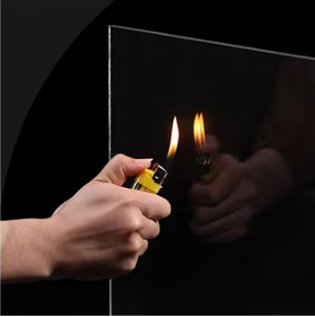
Flame Retardant PP Sheet Manufacturer and Custom Supplier
HSQY supplies flame retardant PP sheets for electronics, battery packaging, electrical insulation, industrial equipment, chemical processing, water treatment systems, mechanical panels and custom fabricated polypropylene components. The material combines the lightweight structure, chemical resistance and processability of polypropylene with improved flame-retardant performance.
Our fire retardant polypropylene sheets are available in thicknesses from 0.1 mm to 3 mm, with customized widths, lengths, colors and surface textures. Available options include clear, black and customized colors, as well as matte, glossy, line-textured and other specified finishes.
Selected HSQY flame retardant PP sheet grades are designed to meet UL 94 V-0 flame-class requirements. Because flammability ratings depend on the material grade, color, thickness and test method, buyers should confirm the applicable test report for the exact specification before approving the material for production.
Request a Flame Retardant PP Sheet Quote
What Is a Flame Retardant PP Sheet?
A flame retardant PP sheet is an extruded polypropylene plastic sheet formulated with flame-retardant additives to reduce ignition, limit flame spread and encourage the material to stop burning after the ignition source is removed under specified test conditions.
Standard polypropylene is combustible and should not automatically be described as fire resistant. Flame-retardant polypropylene is a modified grade developed for applications that require better flammability performance while retaining many of the practical characteristics of PP, including low density, low moisture absorption, chemical resistance and electrical insulation.
Flame retardant PP is not fireproof. Its performance must be evaluated according to the required test standard, sheet thickness, product design, operating environment and applicable industry regulations.
Flame Retardant Polypropylene Sheet Specifications
HSQY provides customized flame retardant polypropylene sheets for B2B manufacturing, insulation, packaging and fabrication applications. Final specifications are subject to the selected grade and approved sample.
| Property | Available Specification |
| Product Name | Flame Retardant PP Sheet / Fire Retardant Polypropylene Sheet |
| Base Material | Modified polypropylene plastic |
| Thickness | 0.1–3 mm; customized thickness subject to grade confirmation |
| Width and Length | Customized according to customer requirements and production feasibility |
| Color | Clear, black and customized colors |
| Surface Texture | Matte, glossy, line texture and customized surface |
| Flame Rating | Selected grades designed to meet UL 94 V-0 requirements; confirm rating at the required thickness and color |
| Main Properties | Flame-retardant performance, electrical insulation, low moisture absorption, chemical resistance and lightweight construction |
| Processing | Cutting, die cutting, punching, bending, forming, welding and custom fabrication |
| Applications | Electronics, batteries, insulation panels, chemical equipment, water treatment, mechanical panels, pallets and automotive insulation |
| Documentation | Product data sheets, test reports, SGS and quality-management documentation available according to the selected product |
| Sample | A4-size sample available; international courier cost is normally paid by the buyer |
| Minimum Order Quantity | Typically 3 tons, depending on thickness, color and formulation |
| Delivery Time | Approximately 10–14 days after specification and payment confirmation |
| Trade Terms | EXW, FOB, CNF and DDU |
Product specifications may vary between clear, black, colored, thin-gauge and custom-formulated grades. The final quotation and technical confirmation should be based on the requested thickness, color, flame rating, application and processing method.
What Does UL 94 V-0 Mean?
UL 94 is a commonly referenced flammability standard for plastic materials used in devices, appliances, enclosures, structural components and electrical insulation. The V-0 classification is determined through a controlled vertical-burning test.
In a UL 94 vertical test, specimens are exposed to a specified flame and evaluated according to burning time, afterglow time and whether flaming particles ignite the cotton indicator below the specimen. V-0 has stricter criteria than V-1 and V-2 within the same vertical test group.
A UL 94 V-0 rating does not mean that the material cannot burn under all conditions. It also does not automatically certify a complete enclosure, battery pack, machine or finished product. End-product designers must evaluate the material together with wall thickness, component geometry, heat source, assembly method and applicable product-safety regulations.
Buyers should request a test report covering the intended material grade, color and minimum thickness. A rating obtained at one thickness should not automatically be applied to a thinner sheet without technical verification.
UL 94 V-0 vs FM 4910 Flame-Retardant PP
| Item | UL 94 V-0 | FM 4910 |
| Primary Purpose | Small-scale flammability classification for plastic specimens | Evaluation of materials intended for semiconductor and cleanroom environments |
| Typical Applications | Electrical insulation, electronics, appliances, battery components and industrial panels | Semiconductor equipment, cleanroom cabinetry, wet benches and process equipment |
| Interchangeable | No | No |
| HSQY Category Positioning | Selected HSQY grades are designed for UL 94 V-0 requirements | Do not assume FM 4910 approval unless a specific HSQY grade and report are provided |
Customers working on semiconductor cleanrooms or FM-insured facilities should clearly state whether FM 4910-listed material is mandatory. A standard UL 94 V-0 polypropylene sheet should not be substituted for an FM 4910-approved material without written project approval.
Key Features of Flame Retardant PP Sheets
Improved Flame-Retardant Performance
Flame-retardant additives modify the burning behavior of polypropylene. Selected grades can be formulated for UL 94 V-0 requirements, helping manufacturers meet specified material-level flammability criteria.
Electrical Insulation
PP is widely used as an insulating plastic. Flame retardant PP sheets can be fabricated into battery separators, protective barriers, enclosure liners, insulation panels and other components where electrical isolation and reduced flammability are both required.
Low Moisture Absorption
Polypropylene absorbs relatively little moisture, supporting dimensional and electrical performance in humid industrial environments. Finished-component testing is still required when moisture exposure is critical.
Chemical Resistance
Flame retardant PP sheets provide resistance to many acids, alkalis and industrial chemicals. Chemical compatibility depends on concentration, exposure temperature, contact time, mechanical stress and the selected flame-retardant formulation.
Lightweight Structure
PP has a lower density than many engineering plastics, helping reduce the weight of packaging, insulation panels, dividers, equipment liners and fabricated components.
Custom Processing
HSQY flame retardant polypropylene sheets can be supplied in custom widths, lengths, thicknesses, colors and textures. The sheets can also be evaluated for cutting, die cutting, punching, bending, forming and welding.
Applications of Flame Retardant PP Sheets
Battery Packaging and Insulation
Flame retardant PP sheet can be used for battery module dividers, insulation barriers, protective covers, cell separators, packaging liners and custom die-cut components. Battery projects must separately verify electrical, thermal, flame, dimensional and chemical-performance requirements.
Electronics and Electrical Equipment
Typical applications include electrical enclosure liners, insulating panels, equipment partitions, transformer components, switchgear barriers, electronic-device supports and appliance components.
Chemical Processing Equipment
The combination of chemical resistance and improved flame behavior makes flame retardant PP suitable for selected tanks, equipment liners, protective panels, ducts, covers, doors and fabricated chemical-processing components.
Water Treatment Systems
Flame retardant polypropylene sheets can be fabricated into panels, partitions, covers, equipment housings and liners used in water-treatment and filtration equipment.
Mechanical and Industrial Panels
The material can be used for protective panels, equipment doors, machine partitions, cable-management components, air-conditioning pads and lightweight fabricated parts.
Automotive and Transportation Components
Potential uses include electrical insulation, battery-related parts, protective barriers and interior technical components. Automotive projects should confirm the required OEM, regional or component-specific flammability standard before material approval.
Standard PP Sheet vs Flame Retardant PP Sheet
| Comparison | Standard PP Sheet | Flame Retardant PP Sheet |
| Flame Performance | Combustible without a specified flame-retardant rating | Modified to improve burning behavior and meet a specified rating |
| Cost | Generally lower | Generally higher because of the specialized formulation and testing |
| Mechanical Properties | Based on the selected PP homopolymer or copolymer grade | May change after flame-retardant additives are introduced |
| Typical Selection | General packaging, printing, stationery and industrial fabrication | Electronics, batteries, insulation and safety-sensitive industrial components |
| Documentation | General technical data sheet | Technical data sheet plus applicable flame-test documentation |
Halogen-Free and Halogen-Containing Flame Retardant PP
Flame retardant polypropylene can use different additive systems. Some formulations are described as halogen-free, while others may use halogen-containing flame retardants. These terms describe formulation chemistry and should not be treated as automatic evidence of low smoke, low toxicity or compliance with every environmental regulation.
Halogen-free grades may be preferred for electronics, electrical equipment, transportation and other applications with specific restricted-substance requirements. However, flame rating, mechanical properties, processing behavior, color stability and minimum thickness may differ between formulations.
Customers requiring halogen-free material, RoHS-related documentation or specific substance restrictions should state the exact standard, restricted substances and test-report requirements when requesting a quotation.
Processing and Customization Options
| Service | Description |
| Custom Extrusion | Customized thickness, width, color, texture and flame-retardant grade |
| Cut-to-Size | Sheets can be cut to the specified width and length |
| Die Cutting | Custom insulation pieces, separators, liners and packaging components |
| Punching and Drilling | Holes, slots and specified component profiles according to drawings |
| Bending and Forming | Evaluation for folded, bent or formed industrial parts |
| Welding | Hot-gas or thermal welding for selected fabricated PP components |
| Sample Evaluation | Evaluation of thickness, color, texture, rigidity, processing and required flame-test documentation |
How to Select the Right Flame Retardant PP Sheet
1. Confirm the required standard: Specify whether the project requires UL 94 V-0, V-1, V-2, FM 4910 or another regional or industry-specific test standard.
2. Confirm the minimum tested thickness: A flame rating must be linked to a tested material thickness. Do not assume that a thinner sheet has the same rating as a thicker tested specimen.
3. Define the application: Explain whether the sheet will be used for battery insulation, electrical barriers, chemical equipment, water treatment, equipment panels or packaging.
4. Provide processing information: State whether the sheet will be cut, die-cut, folded, welded, thermoformed or mechanically fabricated.
5. Confirm environmental requirements: Identify operating temperature, humidity, chemical exposure, outdoor exposure, electrical requirements and expected service life.
6. Confirm regulatory restrictions: State whether the product must be halogen-free or comply with specified RoHS, REACH or customer-restricted substance requirements.
7. Test the final component: Material-level data does not replace finished-part testing. Customers should evaluate the processed component under actual installation and operating conditions.
Information Required for a Quotation
To receive an accurate quotation, please provide:
Required flame-retardant standard and rating
Required thickness, width and length
Color and surface texture
Halogen-free or restricted-substance requirements
End application and operating environment
Cutting, die-cutting, forming or welding requirements
Required test reports or compliance documents
Estimated order quantity
Destination country or delivery port
Send Your PP Sheet Specifications
Frequently Asked Questions About Flame Retardant PP Sheets
Is flame retardant PP sheet fireproof?
No. Flame retardant PP is formulated to reduce ignition and flame spread or to self-extinguish under specified test conditions. It can still burn under sufficient heat, flame exposure or unsuitable operating conditions.
Does HSQY flame retardant PP sheet meet UL 94 V-0?
Selected HSQY flame retardant PP grades are designed to meet UL 94 V-0 requirements. The applicable grade, color and minimum tested thickness should be confirmed through the corresponding test report.
What thicknesses are available?
HSQY generally supplies flame retardant polypropylene sheets from 0.1 mm to 3 mm. Availability and flame rating at each thickness depend on the selected formulation.
Can the color and surface texture be customized?
Yes. Clear, black and customized colors are available. Surface options include matte, glossy, line texture and other specified finishes. Color changes may require separate confirmation of flame-test performance.
Is flame retardant PP suitable for battery packaging?
It can be used for battery packaging, insulation barriers, separators and protective components. The customer must verify electrical insulation, flame rating, thermal performance, chemical resistance and finished-part safety for the specific battery system.
Is UL 94 V-0 the same as FM 4910?
No. UL 94 V-0 is a small-scale vertical flammability classification. FM 4910 is a different approval protocol commonly specified for cleanroom and semiconductor equipment materials. The two standards are not interchangeable.
Can HSQY supply halogen-free flame retardant PP?
Halogen-free requirements can be discussed according to the project. Buyers should provide the required flame rating, thickness, restricted-substance standard and target application so that the appropriate formulation can be evaluated.
Can flame retardant PP sheets be cut and welded?
Yes. The sheets can be evaluated for cutting, die cutting, punching, bending and thermal welding. Processing conditions should be optimized according to the sheet thickness and flame-retardant formulation.
Does machining affect the UL 94 rating?
Cutting alone does not change the material formulation, but thinning, forming, welding, contamination, coatings and changes in finished-part geometry may affect actual fire performance. Finished components should be evaluated according to the applicable product standard.
What is the minimum order quantity?
The typical MOQ is approximately 3 tons. The final MOQ depends on thickness, color, texture, flame-retardant formulation and customization requirements.
Can I request a sample?
Yes. An A4-size sample can be provided for initial evaluation. International courier costs are normally paid by the buyer. Custom-production samples may require additional charges.
What is the production lead time?
Standard production normally takes approximately 10–14 days after the specification, sample and payment terms have been confirmed. Custom formulations or large-volume orders may require additional time.
How should flame retardant PP sheets be stored?
Store the sheets flat in a clean, dry and ventilated indoor environment. Keep them away from direct sunlight, open flames, excessive heat, heavy stacking loads and surface contamination.
What information is needed for a quotation?
Please provide the required flame rating, thickness, width, length, color, texture, application, processing method, compliance documents, order quantity and destination port.
Contact HSQY for Samples and Pricing