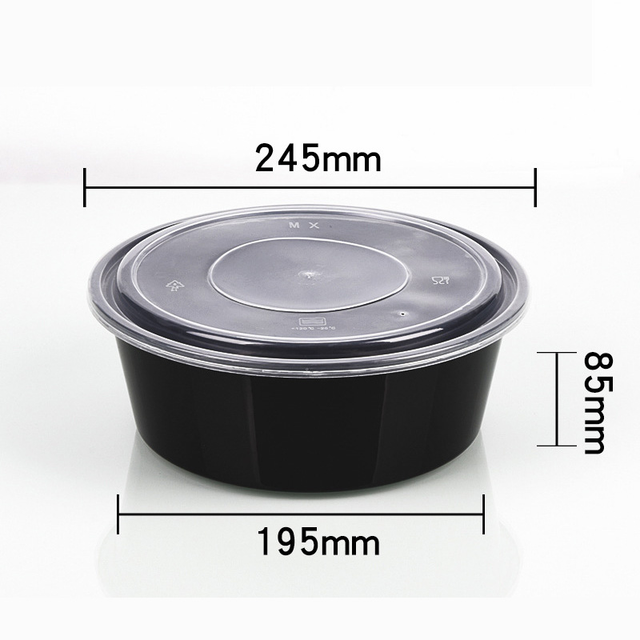
PP Food Bowls with Lids for Takeout and Food Delivery
HSQY PLASTIC manufactures and supplies PP food bowls with lids for restaurants, food delivery companies, catering businesses, meal-prep services, supermarkets, convenience stores and food packaging distributors. Our polypropylene bowls are designed for a wide range of hot and cold food applications including soup, noodles, rice, pasta, salads, grain bowls, prepared meals and family-size portions.
HSQY offers a broad range of disposable PP bowls from approximately 12 oz to 152 oz, including compact individual portions, standard takeaway meal bowls and large catering or family-size containers. Available product styles include round black bowls, clear PP bowls and selected specialty shapes.
Matching lids are available for many models. Depending on the product, buyers can evaluate lid fit, food visibility, venting, microwave requirements, leak resistance and stacking performance according to the intended food and delivery conditions.
What Is a PP Food Bowl?
A PP food bowl is a food container made primarily from polypropylene, commonly abbreviated as PP. Polypropylene combines relatively low weight with useful rigidity, moisture resistance, grease resistance and temperature performance, making it widely used for foodservice packaging.
PP bowls are commonly paired with a matching lid to create a convenient package for takeaway food, restaurant delivery, refrigerated meal preparation, grab-and-go displays and food storage.
Depending on the market, these products may also be searched as PP plastic bowls, microwaveable food bowls, takeout bowls with lids, soup bowls with lids, noodle bowls, disposable lunch bowls or polypropylene food containers.
Why Choose Polypropylene Bowls for Food Packaging?
Suitable for Hot Food Applications: Appropriate PP bowl models can be used for many hot foods such as soup, noodles, rice, pasta and cooked dishes when used within their validated temperature conditions.
Microwave Reheating Options: Suitable polypropylene bowls can support microwave reheating. The exact bowl, lid, food composition, microwave wattage and heating duration should be confirmed before commercial use.
Grease and Moisture Resistance: PP performs well with many oily, moist and sauce-based foods commonly found in takeaway and restaurant applications.
Lightweight Construction: Thermoformed or molded PP packaging can provide useful rigidity without the weight associated with glass or ceramic food containers.
Wide Capacity Range: Different bowl depths and diameters support individual meals, soups, salads, noodle dishes, family portions and catering applications.
Matching Lid Options: Suitable lids help protect food during storage and transportation while transparent lid options can improve product visibility and order identification.
Stackable and Nestable: Bowl and lid designs can support efficient storage, carton packing and restaurant handling when matched correctly.
PP Food Bowl Specifications
| Product | PP Food Bowl / PP Takeout Bowl with Lid |
| Main Material | Polypropylene (PP) |
| Current Capacity Range | Approximately 12 oz to 152 oz according to product model |
| Available Capacity Examples | 12, 15, 16, 23, 24, 27, 28, 33, 34, 35, 37, 40, 42, 50, 59, 67, 68, 85, 101 and 152 oz |
| Shapes | Round and selected specialty shapes according to product model |
| Colors | Black, clear and custom colors subject to model and order requirements |
| Lid Options | Matching lids available according to bowl model; lid material and temperature compatibility should be confirmed separately |
| Food Applications | Soup, noodles, ramen, rice, pasta, curry, salads, grain bowls, prepared meals, vegetables and catering portions |
| Main Markets | Restaurants, food delivery, takeaway, catering, meal prep, supermarkets, convenience stores and foodservice distribution |
| Custom Options | Capacity, diameter, depth, color, bowl weight, lid design, embossing, mold and carton packaging |
PP Bowl Capacity Guide
Bowl capacity is one of the most important purchasing parameters. The correct size depends on food volume, portion weight, toppings, required headspace and whether the package will be transported with a lid.
| Capacity Range | Typical Applications | Selection Considerations |
| 12–16 oz | Small soups, side dishes, desserts, snacks, rice portions and smaller salads | Compact single-serving portions and smaller takeaway meals |
| 20–28 oz | Noodles, rice dishes, pasta, salads, grain bowls and standard lunch portions | Balance between portion volume and economical package size |
| 30–42 oz | Ramen, soup meals, large salads, curry, rice combinations and full takeaway meals | Suitable for larger individual meals and food requiring additional headspace |
| 50–68 oz | Large entrées, family portions, catering food and shared dishes | Bowl rigidity and lid retention become increasingly important with heavier food loads |
| 85–152 oz | Family-size meals, catering portions, party food and large prepared-food packs | Evaluate filled weight, stacking, carrying method, lid fit and transportation conditions |
Nominal capacity does not always equal recommended working fill volume. For liquid food, hot soup or delivery applications, additional headspace may be required to reduce spill risk.
PP Soup Bowls with Lids
PP soup bowls are suitable for many hot liquid foods such as soup, stew, porridge, curry and broth when the selected bowl-and-lid combination has been validated for the intended temperature and transport conditions.
For liquid foods, buyers should pay particular attention to lid engagement, rim geometry, available headspace, food temperature and delivery orientation.
A matching lid can reduce spills during normal handling, but the term "leak-proof" should only be used after the specific bowl-and-lid combination has been tested with the intended liquid product.
PP Noodle and Ramen Bowls
Noodle dishes and ramen often require a deeper bowl than conventional rice meals because the package must accommodate noodles, broth, meat, vegetables and toppings.
For ramen and soup-noodle applications, buyers should evaluate the internal diameter, bowl depth, liquid volume, lid clearance and delivery time rather than selecting the bowl only by nominal ounce capacity.
PP Rice and Takeout Lunch Bowls
Round PP bowls can be used for rice dishes, curry rice, fried rice, bibimbap, meat-and-rice meals and other restaurant takeaway foods.
Smaller and medium-size bowls suit individual meals, while larger containers can support shared meals or catering portions. Black bowls can provide strong contrast with colorful food, while clear bowls provide greater side visibility.
PP Salad and Grain Bowls
PP bowls can also be used for salads, grain bowls, poke-style meals, fruit combinations and cold prepared foods where a robust takeout package is required.
Clear lids can help retailers and food-delivery staff identify contents without opening the package. If high food visibility is the main requirement and microwave use is not required, buyers may also compare alternative food-packaging materials according to the application.
Large PP Bowls for Catering and Family Meals
HSQY's larger PP bowl range includes capacities substantially above conventional individual takeaway portions, including selected 50 oz, 59 oz, 67 oz, 68 oz, 85 oz, 101 oz and 152 oz models.
These larger bowls can be considered for catering, family meals, shared dishes, salads, party foods and bulk prepared-food applications.
For large-capacity packaging, filled weight becomes increasingly important. Bowl wall strength, base rigidity, lid retention and stacking should be tested with the actual food before high-volume use.
PP Bowls for Restaurant Takeout and Delivery
Restaurant delivery exposes packaging to filling, closing, stacking, bagging, vehicle movement and customer handling. The correct food bowl therefore needs to be selected as a complete bowl-and-lid system.
For delivery projects, buyers should consider food temperature, portion weight, sauce or soup content, delivery distance, lid security and whether containers will be stacked inside a delivery bag.
For restaurant menus containing several food categories, using multiple bowl depths with compatible lid footprints can also simplify kitchen inventory when such a product family is available.
PP Bowls for Meal Prep
Meal-prep businesses can use PP bowls for refrigerated rice dishes, pasta, salads, grain bowls and prepared meals that may later require reheating.
When a meal is intended to move directly from refrigeration into a microwave, both the bowl and lid instructions should be confirmed. Some packaging systems require the lid to be removed, loosened or vented before reheating.
PP Bowls for Grab-and-Go Food
Supermarkets, convenience stores and deli counters can use PP bowls for prepared food, salads, rice bowls, noodles and ready-to-reheat meals.
Transparent lid options can improve food visibility and make order identification easier. Labels, tamper-evident stickers or sleeves can be added according to the retailer's packaging and branding requirements.
Choosing the Right Lid for PP Food Bowls
The lid is just as important as the bowl for takeaway packaging. A bowl with the wrong lid can experience poor closure, leakage, stacking problems or deformation during transport.
| Lid Feature | Why It Matters |
| Correct Bowl Fit | Correct rim dimensions and locking geometry are essential for secure closure. |
| Clear Lid | Improves visibility and helps restaurant staff check food orders without opening the package. |
| Venting | Can help release steam from selected hot-food applications and reduce excessive condensation. |
| Anti-Fog Requirement | May improve food visibility where steam and condensation would otherwise obscure the lid. |
| Microwave Compatibility | Bowl microwave suitability does not automatically mean every matching lid can be microwaved under the same conditions. |
| Stackability | Lid geometry can help stabilize filled bowls during storage and delivery. |
Please confirm the exact matching lid, lid material and intended temperature conditions for the selected HSQY bowl model.
Are PP Food Bowls Microwave Safe?
Polypropylene is widely used for microwave-capable food packaging, and suitable HSQY PP bowl models can be evaluated for microwave reheating.
However, microwave suitability should be confirmed for the specific bowl and lid combination. Performance can vary according to material formulation, wall thickness, bowl geometry, food composition and heating conditions.
High-fat, oily or low-moisture foods can create different local temperatures than soup or water-based foods. Buyers should therefore provide the expected microwave wattage and heating duration when microwave use is an important requirement.
Can PP Bowls Hold Hot Soup and Hot Food?
Suitable PP bowl models can be used for many hot foods, including soup, rice, noodles, curry, pasta and cooked dishes.
The maximum recommended filling temperature is product-specific. Instead of applying one temperature limit to the entire PP bowl category, buyers should confirm the actual specification of the selected model.
Hot-food tests should consider the actual food composition, filling temperature, holding time and whether the package remains closed during transport.
Are PP Bowls Suitable for Cold and Frozen Food?
PP bowls can be used for many refrigerated food applications, including salads, prepared meals and meal-prep products.
Frozen-food suitability should be confirmed for the specific bowl model because material formulation, wall thickness, filled weight and storage temperature can influence low-temperature impact performance.
If a package will be frozen and subsequently microwaved, HSQY recommends testing the complete freeze-storage-thaw-reheat cycle with the actual food.
Leak Resistance for Soup and Liquid Food
Reliable liquid-food packaging depends on both the bowl and its matching lid. Rim dimensions, lid engagement, food temperature, fill level and transport orientation all affect leakage performance.
For soup, broth, curry or other fluid foods, buyers should leave appropriate headspace and test the selected package through normal restaurant packing and delivery conditions.
If complete liquid containment is a critical specification, provide your food viscosity, fill volume, temperature and delivery conditions so the suitable model can be evaluated.
Venting and Condensation Control
Hot soup, noodles and freshly prepared meals can generate steam after a lid is closed. Excess condensation can reduce product visibility and may affect the texture of certain foods.
Where venting or anti-fog performance is required, this should be specified during product selection. Availability depends on the matching lid and bowl model.
Black vs. Clear PP Food Bowls
| Feature | Black PP Bowl | Clear PP Bowl |
| Presentation | Creates strong visual contrast with colorful food | Allows greater visibility of food through the bowl wall |
| Typical Applications | Rice meals, noodles, premium takeaway, meal prep and hot food | Salads, prepared foods, display packaging and products where visibility is important |
| Branding | Premium-looking dark background works well with contrasting labels | Emphasizes the food itself as part of the package presentation |
PP Bowls vs. PET Bowls
PP and PET can both be used in food packaging, but they are normally selected for different application priorities.
| Feature | PP Bowl | PET Bowl |
| Main Strength | Hot-food and microwave-capable options | High clarity for cold-food display applications |
| Common Uses | Soup, noodles, rice, hot prepared meals and takeout | Salads, fruit, cold prepared food and display packaging |
| Microwave Reheating | Available with suitable PP models | Standard APET cold-food packaging should not automatically be treated as microwave-safe |
How to Choose the Right PP Food Bowl
1. Confirm the Food Type
Specify whether the bowl will contain soup, ramen, noodles, rice, pasta, salad, curry, meal-prep food or another product.
2. Confirm the Required Capacity
Provide the required food volume and packed weight. HSQY currently offers a broad range from approximately 12 oz to 152 oz.
3. Check Bowl Diameter and Depth
Two bowls with similar nominal capacity can have different diameters and depths. Wide bowls may suit salads and rice dishes, while deeper bowls can be advantageous for soup and noodles.
4. Confirm Lid Requirements
Confirm whether you need a standard matching lid, clear lid, venting, improved visibility or another specific feature.
5. Confirm Hot Filling Conditions
Provide the approximate temperature of the food when it is filled into the bowl, especially for hot soup, noodles and freshly cooked meals.
6. Confirm Microwave Requirements
If customers will microwave the meal, provide the expected microwave power, heating duration and whether the lid will remain on the package.
7. Evaluate Liquid and Sauce Content
Soup and sauce-heavy meals require closer evaluation of lid engagement, headspace and delivery orientation.
8. Evaluate Delivery Conditions
Consider delivery distance, bagging, stacking, food temperature and vehicle movement.
9. Test Samples Before Bulk Ordering
Test the actual bowl and lid with your food, filling temperature, microwave process, stacking and delivery conditions before confirming a high-volume order.
Custom PP Food Bowl Manufacturing
HSQY supports OEM and custom PP bowl projects for food manufacturers, restaurant groups, packaging distributors, catering suppliers and private-label foodservice companies.
Custom options can include bowl diameter, depth, nominal capacity, wall structure, material weight, color, rim design, matching lid, embossed markings, stacking features and new mold development.
If you already use an existing bowl, sending HSQY a sample, drawing or detailed dimensions can help determine whether an existing product can replace it or whether new tooling is required.
Custom PP Bowl Development Process
| Step | Process |
| 1. Requirement Review | Confirm food application, capacity, dimensions, lid, temperature conditions and expected purchasing volume. |
| 2. Existing Product Comparison | Compare the requirement with HSQY's existing 12–152 oz bowl range before creating new tooling. |
| 3. Technical Drawing | Confirm diameter, depth, usable capacity, rim, lid engagement and stacking features. |
| 4. Mold Development | New tooling is developed when an existing bowl cannot meet the packaging requirement. |
| 5. Sample Testing | Test food fit, lid closure, filling temperature, stacking, microwave use and delivery conditions as required. |
| 6. Mass Production | Begin commercial production after the bowl, lid and packaging specifications are approved. |
Food-Contact and Regulatory Requirements
Food-contact requirements depend on the polypropylene formulation, food type, contact duration, temperature and destination market.
When requesting a quotation, provide the destination country and intended conditions of use so HSQY can confirm the documentation available for the selected bowl and lid.
Are PP Food Bowls Recyclable?
Polypropylene is generally identified by resin identification code 5. Whether used PP food packaging is actually accepted for recycling depends on local collection and sorting infrastructure, food contamination, pigments, labels and other package components.
Buyers should therefore verify local recycling requirements before making universal recyclability claims for the complete bowl-and-lid package.
Wholesale Packing and International Shipping
Empty PP bowls are normally nested to reduce warehouse and shipping volume. Bowl size, depth and nesting pitch directly influence pieces per carton and container-loading efficiency.
International buyers should compare unit price together with carton dimensions, case quantity, CBM, pallet configuration and loading quantity because shipping efficiency can have a significant effect on the landed cost of lightweight food packaging.
Why Choose HSQY as Your PP Bowl Manufacturer?
Wide Capacity Range: HSQY currently offers multiple PP bowl capacities from approximately 12 oz to 152 oz for individual meals, takeaway, family portions and catering.
Multiple Designs: Black, clear, round and selected specialty bowl styles provide options for different foodservice applications.
Matching Lid Supply: Bowl-and-lid combinations can be discussed together to reduce sourcing complexity and help ensure compatibility.
PP Food Packaging Portfolio: HSQY also supplies PP lunch boxes, hinged containers, cups, plates, portion cups and other polypropylene food packaging products.
OEM and Custom Manufacturing: Custom capacity, dimensions, color, lid design, embossing and new molds can be evaluated for suitable volume projects.
Sample Evaluation: Available samples can be used to test food fit, lid closure, microwave requirements, stacking and food-delivery performance before bulk purchasing.
Information Needed for a PP Bowl Quote
| Required Capacity | Required ounce or milliliter capacity, or existing bowl model |
| Bowl Dimensions | Top diameter, bottom diameter, height and usable internal dimensions where available |
| Food Application | Soup, noodles, rice, salad, meal prep, catering or other food |
| Food Temperature | Hot filling, refrigerated, frozen or other conditions |
| Lid Requirement | Matching lid, clear lid, vent requirement or other specifications |
| Microwave Requirement | Required or not required; provide microwave wattage and heating duration where available |
| Color | Black, clear or custom color |
| Estimated Quantity | Trial quantity, regular order quantity and estimated annual demand |
| Custom Requirements | Custom mold, logo, embossing, color, carton or private-label requirements |
| Destination | Destination country, port or delivery location |
PP Food Bowl FAQ
What are PP food bowls used for?
PP food bowls are commonly used for soup, noodles, ramen, rice, pasta, curry, salads, grain bowls, prepared meals and takeaway food. Different capacities are suitable for individual meals, family portions and catering.
Are PP bowls microwave safe?
Suitable polypropylene bowl models can be used for microwave reheating. The exact bowl, lid, food type, microwave power and heating duration should be confirmed before commercial use.
Can I microwave a PP bowl with the lid on?
This depends on the lid material and package design. Some lids need to be removed, loosened or vented during reheating. Always confirm the instructions for the specific bowl-and-lid combination.
Are PP bowls suitable for hot soup?
Suitable PP bowls can be used for hot soup and other hot foods. The actual filling temperature, food composition and holding time should be within the validated conditions of the selected bowl and lid.
Are PP soup bowls leak-proof?
Leakage performance depends on the bowl, lid, rim fit, liquid level, food temperature and transport orientation. Customers packing soup or thin liquids should test the selected bowl-and-lid combination before making a leak-proof claim.
What sizes of PP bowls does HSQY offer?
HSQY currently offers products ranging from approximately 12 oz to 152 oz, with multiple intermediate sizes for snacks, individual meals, soups, salads, family portions and catering.
What PP bowl size is best for soup?
The best size depends on the serving volume and required headspace. Smaller portions may use approximately 12–24 oz bowls, while larger soup or noodle meals may require 32 oz or more. Always consider the actual fill level rather than nominal capacity alone.
What size PP bowl is suitable for ramen or noodles?
Noodle and ramen applications often require deeper bowls with enough space for broth and toppings. Medium and larger capacities are commonly considered, but the final choice should be based on the actual meal volume and required headspace.
Do PP food bowls come with lids?
Many HSQY PP bowl models are available with matching lids. Exact lid design, material, transparency, venting and temperature suitability depend on the selected model.
Are vented lids available for PP bowls?
Venting requirements can be discussed according to the bowl model and project. Vented lids may be useful for selected hot foods where steam release and condensation control are important.
Can PP bowls be used for salads and cold food?
Yes. PP bowls can be used for salads, grain bowls, prepared foods and many other refrigerated or cold-food applications.
Can PP bowls be frozen?
Selected PP bowl models can be evaluated for frozen-food storage. Low-temperature suitability should be confirmed for the exact material formulation, food weight and storage temperature.
What is the difference between PP and PET food bowls?
PP bowls are commonly selected for hot food and microwave-capable applications, while standard APET packaging is commonly selected where high clarity and cold-food display are priorities. The correct material depends on the actual food and temperature conditions.
Are black PP bowls suitable for restaurant takeout?
Yes. Black PP bowls are commonly suitable for rice, noodles, pasta, salads, meal prep and other takeaway applications and can provide strong visual contrast with the food.
Are PP bowls stackable?
PP bowls are typically nested before filling to reduce storage volume. Suitable bowl-and-lid designs can also support stacking after filling, but performance should be tested using the actual food weight.
Can HSQY customize PP bowl sizes and colors?
Yes. HSQY can evaluate custom capacities, diameters, depths, bowl weights, colors, rim structures, matching lids and new molds for suitable B2B projects.
Can HSQY produce PP bowls based on my existing sample?
Yes. Providing an existing bowl and lid, technical drawing or detailed measurements can help determine whether a current HSQY model is suitable or whether custom tooling is required.
Can I add my logo to PP food bowls?
Embossed markings, labels and other branding options can be discussed according to the bowl design, manufacturing process and purchasing quantity.
What is the MOQ for wholesale PP bowls?
MOQ depends on the selected model, color, lid, carton configuration and customization. Standard existing models generally have different requirements from custom-color or new-mold projects.
Can I request PP bowl samples before placing a bulk order?
Available samples can be discussed for checking food fit, lid closure, heat resistance, microwave requirements, stacking and delivery performance before bulk purchasing.
How do I request a PP bowl quotation?
Send HSQY your required capacity or dimensions, food application, lid requirements, filling temperature, microwave conditions, estimated quantity, preferred color and destination country.
Request a PP Food Bowl Quote
Looking for a reliable PP bowl manufacturer, microwaveable takeout bowl supplier or wholesale food bowl with matching lids?
Send HSQY your required capacity, food application, lid requirement and estimated purchasing quantity. Our team can help you select from the existing 12–152 oz product range or evaluate a customized PP food bowl for your restaurant, catering, food delivery or distribution project.