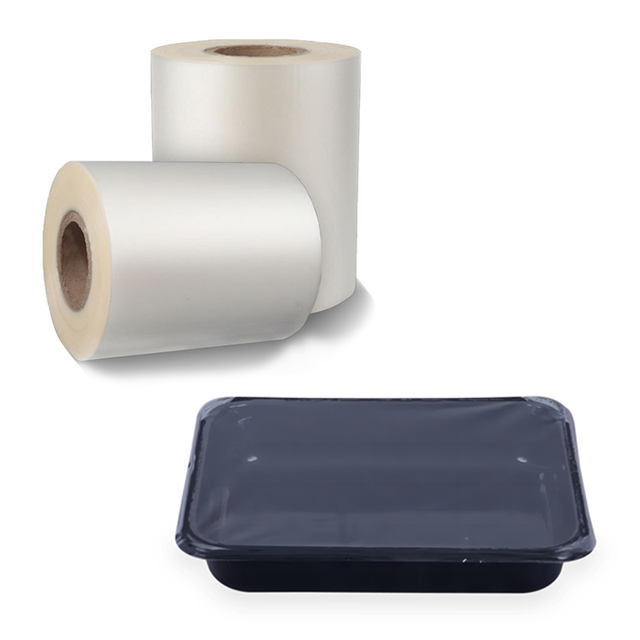
What Is BOPET Coated Sealing Film?
BOPET coated sealing film, also known as heat-sealable BOPET film, coated PET lidding film or polyester tray-sealing film, is a biaxially oriented polyethylene terephthalate film with a functional heat-seal coating applied to one surface.
The BOPET base film provides clarity, tensile strength, dimensional stability, heat resistance and a printable outer surface. The functional coating creates the sealing interface between the film and a compatible tray, cup, container or coated paperboard surface.
Depending on the coating formulation, the film can be designed for easy-peel opening, lock-seal closure, heat-release peeling, anti-fog performance, seal-through-contamination performance or selected microwave and oven applications.
HSQY supplies clear, printable and customized BOPET lidding films for compatible APET, CPET, rPET, PETG and coated packaging substrates. Compatibility with PP, PE, PS, PVC, aluminum or paperboard must be confirmed for the exact coating grade.
Coated BOPET Film vs. BOPET/PE Laminated Film
Coated BOPET film and BOPET/PE laminated film are related lidding-film technologies, but they are not identical.
| Comparison | BOPET Coated Film | BOPET/PE Laminated Film |
| Basic Structure | BOPET base film with a thin functional heat-seal coating | BOPET film laminated to a separate PE film or PE-based sealant layer |
| Sealant Amount | Normally uses a relatively low coating weight | Uses a distinct PE layer with greater thickness |
| Typical Total Thickness | Can be relatively thin, depending on BOPET gauge and coating weight | Normally thicker because it contains at least two full film layers |
| Tray Compatibility | Determined by the specific heat-seal coating chemistry | Normally designed for a compatible PE or modified-polyolefin sealing surface |
| Sustainability Potential | May support lightweight or PET-compatible designs when properly formulated | Contains different polymer families and is not normally a mono-PET structure |
| Common Applications | APET, CPET, rPET, PETG and coated paperboard lidding | PET/PE trays, selected PP trays and other PE-compatible sealing surfaces |
Buyers should confirm whether the required product is a true coated BOPET film, a coextruded heat-sealable polyester film or a BOPET/PE laminate before requesting a quotation.
How Does the Heat-Seal Coating Work?
During tray sealing, the coated side of the film is placed against the tray flange. The sealing tool applies controlled heat, pressure and dwell time.
When the coating reaches its activation temperature, it softens and forms a bond with the compatible tray surface. The bond develops further as the package cools.
The coating formulation determines important properties such as:
Seal-initiation temperature
Maximum sealing temperature
Seal strength
Hot-tack performance
Easy-peel or lock-seal behavior
Cold and hot peel force
Resistance to grease, acids and moisture
Anti-fog performance
Heat-release or self-venting behavior
Compatibility with the tray substrate
The coating does not make the film universally compatible with every packaging substrate. Each coating grade must be selected according to the actual tray flange.
BOPET Coated Sealing Film Specifications
The following table summarizes the current HSQY supply range. Final specifications depend on whether the product is a true coated BOPET film, a coextruded polyester film or a BOPET/PE laminate.
| Product Name | Heat-Sealable BOPET Coated Lidding Film |
| Base Film | Biaxially oriented polyethylene terephthalate |
| Sealant Structure | Heat-seal coating, copolyester sealant, EVA-based coating or other application-specific coating |
| Alternative Structure | BOPET/PE laminated film for selected tray-sealing applications |
| Reference Thickness Range | Approximately 19–100 μm across selected current HSQY products |
| Selected Standard Thicknesses | 50 μm, 60 μm and other customized gauges |
| Selected Roll Widths | 150 mm, 200 mm, 230 mm, 250 mm and 280 mm |
| Custom Width | Custom slitting according to tray mold and sealing machine |
| Reference Roll Length | Approximately 500 m for selected standard products |
| Core Diameter | Customized according to the tray sealing machine |
| Appearance | Clear, high-gloss, matte, white, metallized or custom printed, depending on product structure |
| Seal Options | Easy peel, controlled peel, heat-release peel, lock seal or permanent seal |
| Functional Options | Anti-fog, perforated, printable, high-barrier, contamination sealing, freezer-grade, microwave-grade and selected ovenable grades |
| Compatible Trays | APET, CPET, rPET, PETG and other coated substrates, subject to the exact coating formulation |
| Packaging Equipment | Manual, semi-automatic and automatic tray sealing machines after compatibility testing |
| Typical Applications | Ready meals, produce, salads, bakery products, desserts, chilled food, frozen meals and airline catering |
| Reference MOQ | Approximately 500 kg per specification for selected products |
| Reference Lead Time | Approximately 10–20 working days after final specification and order confirmation |
Thickness, temperature resistance, food-contact compliance and ovenability must be confirmed for the exact commercial film. The broad category range should not be treated as a universal specification for every product.
Types of BOPET Coated Lidding Film
Easy-Peel BOPET Coated Film
Easy-peel coated film forms a secure seal during filling, distribution and storage while allowing the consumer to remove the film progressively from a peel tab.
A well-matched easy-peel film should open in one continuous piece without excessive tray deformation, film tearing or plastic fragments.
Lock-Seal BOPET Coated Film
Lock-seal film creates a stronger closure and is selected when leakage resistance, tamper evidence and transport security are more important than manual opening convenience.
Lock-seal packages may require cutting or puncturing before opening. Excessive seal strength should still be avoided because it can damage the tray flange or cause uncontrolled film tearing.
Heat-Release Coated Film
Heat-release film can be designed to maintain a stronger seal during chilled or frozen storage and become easier to peel after a validated heating cycle.
It is commonly evaluated for CPET ready-meal packaging where the lid must remain secure during transport but open conveniently after reheating.
Anti-Fog Coated BOPET Film
Anti-fog coated film reduces visible water droplets by spreading condensed moisture across the food-facing surface.
It is suitable for chilled produce, salads, ready meals, bakery products, meat and seafood where condensation would otherwise obstruct product visibility.
For dedicated anti-fog PET/PE structures, review the anti-fog PET/PE sealing-film category.
Perforated BOPET Lidding Film
Perforated or microperforated BOPET film can be used for fresh fruit, vegetables and other respiring products that require controlled gas exchange.
Hole size, hole density and transmission rate should be matched to the product respiration rate, tray volume and storage temperature.
Dual-Ovenable BOPET Lidding Film
Selected coated or coextruded polyester films can be developed for both microwave and conventional-oven applications.
Dual-ovenable performance must be confirmed for the complete tray, film, coating, ink, food product, heating temperature and cooking time.
Easy Peel vs. Lock Seal
| Comparison | Easy-Peel Film | Lock-Seal Film |
| Opening Method | Controlled manual peeling | Cutting, puncturing or stronger manual force may be required |
| Consumer Convenience | Higher | Lower, but provides greater closure security |
| Typical Applications | Produce, salads, desserts, chilled meals and consumer-ready packages | Liquid-rich meals, transport-sensitive food and tamper-evident packs |
| Main Risk | Insufficient peel force can reduce package security | Excessive seal force can tear the film or damage the tray |
Compatible Tray and Container Materials
Tray compatibility is determined by the heat-seal coating grade. One BOPET coated film should not be assumed to seal all tray materials.
| Tray Material | Compatibility Guidance |
| APET Tray | Common application for direct-to-PET or copolyester-coated BOPET film |
| CPET Tray | Requires a CPET-compatible coating and separate validation for microwave or oven use |
| rPET Tray | Compatibility depends on recycled content, surface condition and any additional coating |
| PETG Tray | Selected coated films can seal to PETG after temperature and peel-force testing |
| PP Tray | Requires a PP-compatible coating; standard PET-seal coating may require excessive temperature or may not seal |
| PE Tray or PE-Coated Tray | Requires an EVA-based, modified-polyolefin or other PE-compatible coating |
| PS or HIPS Tray | Requires a coating grade specifically formulated for polystyrene |
| PVC Tray | Selected coating grades may provide peelable or permanent seals |
| Aluminum Tray | Requires an aluminum-compatible coating or lacquer system |
| Coated Paperboard Tray | The paperboard coating or liner must be compatible with the BOPET heat-seal layer |
Applications of BOPET Coated Sealing Film
Chilled Ready Meals
BOPET coated lidding film can be used for pasta, rice meals, meat dishes, vegetables, sauces and prepared chilled meals packed in compatible PET-based trays.
Frozen and Ovenable Meals
Selected freezer-grade or dual-ovenable polyester films can be used with CPET trays for frozen meals and heat-and-serve applications.
Standard coated film should not be used for oven applications unless the exact product has been validated for the maximum temperature and cooking duration.
Fresh Produce and Salads
Easy-peel, anti-fog or perforated films can be used for berries, tomatoes, vegetables, mushrooms, cut fruit and prepared salads.
Respiring produce may require controlled permeability or microperforation rather than a fully hermetic high-barrier package.
Bakery and Dessert Packaging
Clear or printed coated BOPET film can be used for cakes, pastries, puddings, desserts, confectionery and bakery trays.
Airline and Institutional Catering
CPET meal trays with compatible coated polyester lids can be used for airline meals, hospitals, schools, central kitchens and institutional foodservice.
Meat, Poultry and Seafood
Coated BOPET films can be evaluated for meat, poultry and seafood when the package requires clarity, strong sealing or anti-fog performance.
These applications may also require puncture resistance, contamination sealing and a separate high-barrier layer.
Is BOPET Coated Film a High-Barrier Film?
A heat-seal coating does not automatically create a high-oxygen-barrier film.
BOPET provides useful mechanical, aroma and gas-barrier properties, but demanding modified atmosphere packaging may require additional barrier technology.
High-barrier structures may use:
EVOH barrier layers
AlOx or SiOx transparent coatings
PVdC or application-specific barrier coatings
Metallized PET
Multilayer laminates
Special oxygen-barrier lacquers
Projects requiring MAP or extended gas retention should specify the required oxygen transmission rate, water-vapor transmission rate, storage humidity and target shelf life.
Microwave, Freezer and Oven Performance
Can BOPET Coated Film Be Microwaved?
Selected microwave-grade coated polyester films can be used for reheating, but microwave suitability is not a universal property of all BOPET coated films.
Testing must include the tray, film, coating, food composition, microwave power, heating time and steam-release instructions.
Can the Film Be Used for Frozen Food?
Selected films can be used at frozen temperatures after low-temperature flexibility, seal retention, puncture resistance and peel behavior have been validated.
Can the Film Be Used in a Conventional Oven?
Only a dedicated ovenable or dual-ovenable coated polyester film should be used in a conventional oven.
The coating, base film, printing ink, adhesive, tray and food must remain stable throughout the complete heating cycle.
Can the Film Self-Vent During Heating?
Selected heat-release or burst-peel coatings can be designed to release steam at a controlled temperature or package pressure.
Other packages may require perforation, laser scoring, piercing or peeling back one corner before heating.
Tray Sealing Machine Compatibility
BOPET coated lidding film can be supplied for manual, semi-automatic and fully automatic tray sealing lines.
Buyers should provide:
Machine manufacturer and model
Tray mold and cavity layout
Film width
Core inside diameter
Maximum roll outside diameter
Maximum roll weight
Coated side wound inside or outside
Unwind direction
Sealing temperature range
Dwell time
Sealing pressure
Line speed
Film-cutting method
Registration-mark position
MAP or gas-flush function
HSQY also supplies food tray sealing machines for standard heat sealing and modified atmosphere packaging.
How to Establish the Correct Sealing Window
A sealing window is the range of temperature, pressure and dwell time that produces an acceptable package without damaging the tray or film.
Commercial trials should evaluate:
Seal-initiation temperature
Maximum temperature before film distortion
Hot-tack strength
Seal strength after cooling
Peel force at ambient temperature
Peel force after chilling or freezing
Peel force after heating where applicable
Seal-through-contamination performance
Film tracking at production speed
Wrinkle and channel-leak formation
Tray-flange deformation
Leak and burst resistance
Common Sealing Problems
| Problem | Possible Causes | Items to Check |
| Film Does Not Seal | Wrong coating grade, reversed film, low temperature or insufficient pressure | Tray material, coated side, temperature, pressure and dwell time |
| Seal Is Too Weak | Insufficient sealing energy, contaminated flange or poor coating compatibility | Seal window, tray surface, coating grade and flange cleanliness |
| Peel Force Is Too High | Excessive temperature, pressure or dwell time, or a lock-seal grade was selected | Confirm the film grade and reduce sealing energy within the validated range |
| Film Tears During Opening | Seal strength exceeds film strength, thin film or poor peel-tab design | BOPET gauge, coating type, peel force and opening-tab geometry |
| Wrinkles Appear in the Seal | Uneven web tension, poor tracking, tray deformation or tool misalignment | Roll alignment, film tension, tray position and sealing-plate flatness |
| Package Leaks | Channel leaks, contamination, film punctures, damaged trays or incomplete seals | Flange cleanliness, film integrity, tray condition and full seal continuity |
| Coating Transfers to the Tray | Excessive heat, incompatible coating or insufficient coating cure | Coating formulation, drying conditions and sealing temperature |
| Poor Roll Unwind | Blocking, excessive coating tack, incorrect storage or winding tension | Coefficient of friction, storage temperature, roll pressure and coating cure |
Custom-Printed BOPET Lidding Film
BOPET provides a suitable surface for high-quality printing and can be customized with logos, product names, cooking instructions, nutritional information, barcodes and QR codes.
Printed-film projects normally require:
Editable artwork files
Finished film width
Print repeat length
Number of colors
Pantone or approved color references
Printing side
Coated side and winding direction
Registration-mark position
Tray orientation in the sealing mold
Required matte or gloss finish
Microwave or oven requirements
Food-contact ink requirements
Food-Contact Compliance
Food-contact suitability depends on the BOPET resin, heat-seal coating, anti-fog agent, printing ink, primer, food type, contact duration and use temperature.
Buyers should specify:
Destination country or market
Food type
Direct food-contact conditions
Contact duration
Chilled, frozen or heated use
Microwave or conventional-oven conditions
Printed or unprinted film
Required declarations or migration tests
Restricted-substance requirements
Applicable compliance documents must be confirmed for the exact film grade and intended use. ISO quality-system certification should not be treated as a substitute for product-specific food-contact documentation.
Is BOPET Coated Lidding Film Recyclable?
A coated BOPET film may use less sealant material than a BOPET/PE laminate and may support a PET-compatible packaging design when the coating, ink and tray are appropriately selected.
However, recyclability depends on:
Type and weight of the heat-seal coating
BOPET film thickness
Printing inks and primers
Tray material
Ability to separate the film from the tray
Food contamination
Local collection and sorting systems
Destination-market recycling guidelines
BOPET/PE laminated films should not automatically be described as mono-PET or recyclable in a PET recycling stream.
Customization Options
Custom BOPET thickness
Custom heat-seal coating chemistry
Custom coating weight
Easy-peel or lock-seal performance
Customized peel force
Heat-release peel
Anti-fog coating
Seal-through-contamination performance
High-barrier coating or laminate
Microwave-grade or dual-ovenable structure
Microperforation
Custom printing
Custom film width and roll length
Custom core and roll diameter
Custom winding direction
Registration marks for automatic tray sealers
Custom cartons, labels and export pallets
Quality Control
Relevant quality-control items may include:
BOPET base-film verification
Total film thickness
Coating weight and uniformity
Coating cure and residual solvent
Roll width and length
Core size and roll diameter
Winding tension and roll alignment
Coefficient of friction
Transparency, haze and gloss
Seal-initiation temperature
Hot-tack strength
Seal strength and peel force
Blocking and unwind performance
Anti-fog testing when required
OTR and WVTR when specified
Microwave or oven testing when required
Print color and registration accuracy
Food-contact documentation review
Information Required for a Quotation
To receive an accurate BOPET coated-film recommendation and quotation, please provide:
Tray material and complete layer structure
Material or coating on the tray flange
Physical tray samples
Tray dimensions and flange width
Food product
Filling temperature
Chilled, frozen, microwave or oven use
Easy-peel, heat-release or lock-seal requirement
Target peel force
Anti-fog requirement
High-barrier or MAP requirement
Required OTR or WVTR
Film thickness
Film width and roll length
Core inside diameter
Maximum roll outside diameter
Coated side winding direction
Tray sealing machine manufacturer and model
Sealing temperature, pressure and dwell time
Production speed
Printed or unprinted film
Artwork and printing repeat length
Food-contact documentation requirements
Order quantity and annual consumption
Destination country, port or delivery address
Frequently Asked Questions About BOPET Coated Sealing Film
What is BOPET coated sealing film made from?
It consists of a biaxially oriented PET base film with a functional heat-seal coating on one surface. The coating chemistry varies according to the target tray material and opening requirement.
Is coated BOPET the same as BOPET/PE film?
No. Coated BOPET uses a relatively thin functional coating, while BOPET/PE film normally contains a separate PE layer laminated to the BOPET base.
Can one BOPET coating seal every tray material?
No. Coatings for PET, PP, PE, PS, PVC, aluminum and coated paperboard use different formulations and sealing conditions.
Can BOPET coated film seal directly to APET trays?
Yes, when the film uses a direct-to-PET heat-seal coating formulated for APET. The exact tray and coating must still be tested.
Can it seal CPET trays?
Selected coating grades can seal CPET trays. Microwave and oven performance require separate validation.
Can it seal PP trays?
Only a PP-compatible or universal-seal coating should be used. A standard polyester coating may not seal PP or may require an impractically high temperature.
What thicknesses are available?
Selected current HSQY products cover approximately 19–100 μm. The exact available range depends on whether the film is coated, coextruded or laminated.
What roll widths are available?
Selected standard widths include 150 mm, 200 mm, 230 mm, 250 mm and 280 mm. Custom slitting is available.
What is the difference between easy peel and lock seal?
Easy-peel film is designed for controlled manual opening. Lock-seal film creates a stronger closure and may require cutting or puncturing.
What is heat-release peel film?
Heat-release film remains secure while cold and becomes easier to peel after a validated microwave or oven-heating cycle.
Is anti-fog coating available?
Yes. Anti-fog can be incorporated into selected heat-seal coatings or supplied as a separate food-facing treatment.
Is BOPET coated film automatically high barrier?
No. Heat-seal coating and oxygen-barrier coating are different functions. High-barrier applications may require EVOH, AlOx, SiOx, metallization or another barrier structure.
Can the film be used for MAP packaging?
Yes, when the film has a suitable gas barrier and is combined with a compatible high-barrier tray and validated seal.
Can coated BOPET film be microwaved?
Selected microwave-grade films can be used after validation. Standard coated BOPET should not automatically be described as microwave-safe.
Can it be used in a conventional oven?
Only a dedicated ovenable or dual-ovenable film should be used. The complete package must be tested at the intended oven temperature and duration.
Can it be used for frozen food?
Selected freezer-grade films can be used after low-temperature flexibility, seal integrity and opening performance have been tested.
Why does the film not seal to the tray?
Possible causes include an incompatible coating, reversed film, low temperature, insufficient pressure, short dwell time or a contaminated tray flange.
Why does the film tear during peeling?
Seal strength may exceed film strength, the BOPET gauge may be too thin, the coating may be unsuitable or the tray may not have an adequate peel tab.
Can the film seal through grease or food contamination?
Selected contamination-sealing coatings can tolerate limited grease, acid or moisture, but the tray flange should still be kept as clean as possible.
Can the film be custom printed?
Yes. Logos, graphics, cooking instructions, barcodes, QR codes and registration marks can be printed according to the approved artwork.
Is BOPET coated film recyclable?
Some low-coating-weight BOPET structures may support PET-compatible packaging designs. Actual recyclability depends on the coating, ink, tray and local recycling system.
What is the MOQ?
The reference MOQ is approximately 500 kg per specification for selected current products. Custom coating and printed orders may require a different MOQ.
What is the production lead time?
The reference production lead time is approximately 10–20 working days after all technical and commercial details are confirmed.
Can I request a trial roll?
Sample film or trial rolls can be discussed for coating compatibility, sealing, peeling, heating and packaging-line testing.
Request a BOPET Coated Sealing Film Quote
Looking for a BOPET coated sealing-film manufacturer, direct-to-PET lidding film, easy-peel coated film or dual-ovenable CPET tray film?
Contact HSQY to request technical recommendations, trial rolls, custom coating, printed film, tray compatibility support, factory pricing and international shipping information.
Request a Quote