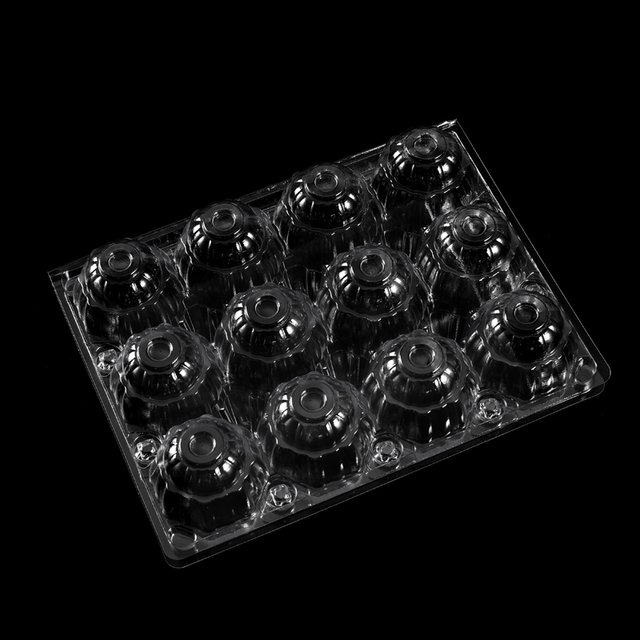
Clear PET Egg Carton Manufacturer for Retail and Farms
HSQY supplies clear PET and rPET egg cartons for poultry farms, egg grading and packing businesses, supermarkets, grocery distributors, farmers markets and private-label egg brands. The current category includes cartons for 4, 6, 8, 9, 10, 12, 15, 16, 18, 20 and 30 eggs, together with dedicated duck-egg and 24-count quail-egg packaging.
Transparent PET packaging allows buyers and consumers to inspect shell color, cleanliness and visible breakage without opening the carton. Individual egg cells, center posts, perimeter ribs and locking tabs help limit egg movement and support stacking during storage, retail display and distribution.
Quick answer: A clear PET egg carton is a thermoformed clamshell package that separates individual eggs and closes with integrated tabs or buttons. The correct carton must be selected by egg dimensions and weight, not only by the number of cells or the bird species.
HSQY Clear Plastic Egg Carton Product Range
The HSQY range covers small retail packs, standard dozen cartons, larger farm packs and species-specific cartons. Exact dimensions, egg-cell geometry, pack quantity and minimum order depend on the selected model.
| Egg Carton Type | Main Characteristics | Typical Applications |
| 4-Count PET Egg Carton | Compact clamshell pack with four individual egg cells. | Premium eggs, samples, small households and gift packs. |
| 6-Count PET Egg Carton | Half-dozen format with clear product visibility and flat label area. | Retail, farmers markets, specialty eggs and small packs. |
| 8- and 9-Count PET Cartons | Alternative cell counts for regional retail and farm packaging programs. | Farm shops, supermarkets, subscription boxes and local brands. |
| 10- and 12-Count PET Cartons | Common retail formats for standard egg sales. | Grocery chains, distributors, poultry farms and export markets. |
| 15-, 16-, 18- and 20-Count Cartons | Larger retail and foodservice packs with more eggs per unit. | Wholesale clubs, family packs, foodservice and commercial farms. |
| 30-Count PET Egg Carton | Large-capacity format with flat-top labeling and internal egg support. | Bulk distribution, foodservice, farms and wholesale markets. |
| Duck Egg Cartons | Available in selected 4, 6, 8, 9 and 10-count formats with larger-cell options. | Duck eggs and other larger eggs after fit testing. |
| 24-Count Quail Egg Carton | Shallow small-cell design developed for quail eggs. | Quail farms, supermarkets, foodservice and specialty retail. |
Related models include the 4-count clear PET egg carton, 6-count egg carton, 8-count egg carton, 12-count egg carton, 18-count egg carton, 30-count egg carton, duck egg cartons and the 24-count quail egg carton.
Typical PET Egg Carton Specifications
The following data summarize published HSQY options. Because the website contains multiple product generations and some pages use different commercial units, buyers should confirm the final drawing and quotation for the exact SKU.
| Specification | Typical HSQY Options |
| Material | Clear PET or recycled PET for selected products; confirm recycled-content percentage and food-contact documentation by SKU |
| Cell Counts | 4, 6, 8, 9, 10, 12, 15, 16, 18, 20, 24 and 30; custom designs may be evaluated |
| Published Dimensions | Examples include 4-cell 105 × 100 × 65 mm, 6-cell 150 × 105 × 65 mm, 8-cell 191 × 105 × 65 mm, 10-cell 235 × 105 × 65 mm, 16-cell 195 × 190 × 65 mm and 18-cell 285 × 150 × 65 mm |
| Quail Carton | Published 24-cell model: approximately 200 × 130 × 35 mm |
| Color | Clear as standard; custom color or tint subject to technical and volume review |
| Closure | Integrated tabs, buttons or buckle-style closure depending on the mold |
| Top Surface | Flat or semi-flat area suitable for labels, inserts or sleeves on selected models |
| Published Temperature Range | One HSQY page lists approximately -26°C to 66°C; confirm the exact grade and finished package |
| Case Pack Examples | Published examples include 800 pieces for an 8-count carton and 400 pieces for an 18-count carton |
| Published MOQ | Website pages show 1,000 units, 10,000 units, 30,000 units and 500 kg depending on product page; confirm the model and quotation unit |
| Customization | Cell dimensions, cell count, color, label area, embossed marks, inserts, carton labels and export packing subject to feasibility |
How to Select the Correct Egg Carton
Egg cartons should be chosen using actual egg measurements and the complete distribution process. Descriptions such as small, large, jumbo, chicken or duck are useful starting points but are not precise enough for mold approval.
Measure egg width: Record the maximum diameter of a representative sample from the target grade.
Measure egg length: Confirm overall height from the broad end to the pointed end.
Record egg weight: Provide the minimum, average and maximum weight in the intended retail grade.
Check shell shape: Long, round and asymmetrical eggs can fit differently even at the same weight.
Define cell count: Select the retail quantity and carton footprint required by the destination market.
Confirm closure clearance: The lid must close without pressing the shell or allowing excessive movement.
Evaluate stacking: Test the loaded carton under the intended stack height and distribution time.
Run transport trials: Use the real outer carton, pallet pattern, road conditions and cold-chain cycle.
Approve production samples: Freeze the drawing, PET grade, material weight, closure and packing specification.
Egg Size and Cell Geometry
The protective performance of an egg carton depends on the relationship between the egg and the cell. If the cell is too small, the shell may contact the lid or experience pressure at the widest point. If the cell is too large, the egg can rotate and strike the walls during handling.
| Design Feature | Function | What Buyers Should Check |
| Individual Egg Cups | Separate adjacent eggs and restrict lateral movement. | Cup diameter, depth, taper and fit across the complete egg-size range. |
| Center Posts or Cones | Provide separation and can transfer stacking loads away from the eggs. | Post height, contact with the lid and deformation under compression. |
| Perimeter Ribs | Increase edge rigidity and protect the carton during handling. | Corner strength and resistance to crushing inside outer cartons. |
| Hinged Lid | Keeps the cover attached and supports rapid packing. | Hinge fatigue, closing angle and stress whitening after repeated handling. |
| Locking Tabs or Buttons | Hold the lid closed during storage and transport. | Closure force, opening force and resistance to accidental release. |
| Vent Openings | Support airflow and reduce trapped condensation in some conditions. | Hole position, carton strength and compatibility with labels or sleeves. |
| Flat Label Panel | Provides space for branding, grades, dates, barcodes and handling text. | Printable or label area, scanner visibility and retail presentation. |
How Clear PET Egg Cartons Protect Eggs
Cell separation: Each egg is isolated to reduce shell-to-shell contact.
Movement control: Properly sized cups help reduce rotation and impact during transport.
Load transfer: Posts and ribs can transfer part of the stacking load through the carton structure.
Secure closure: Integrated locks help keep the carton closed during normal handling.
Visual inspection: Clear PET allows broken or dirty eggs to be identified without opening the package.
Moisture resistance: PET does not absorb refrigerator or cold-room moisture like uncoated molded fibre.
Retail protection: The closed clamshell provides a barrier against casual handling and direct contact.
Performance note: No egg carton can prevent all breakage. Results depend on egg strength, egg fit, carton material weight, stack load, outer packaging, pallet pattern and handling severity.
Stacking, Compression and Transport Testing
A carton that looks rigid when empty may behave differently after loading, refrigeration and prolonged stacking. Commercial approval should therefore include filled-pack testing rather than visual inspection alone.
Top-load compression using the intended loaded stack height
Compression after refrigerated or humid storage
Drop testing of the loaded retail carton where appropriate
Vibration and road-transport simulation inside the shipping case
Pallet compression and lower-layer carton deformation
Closure retention after impact and repeated handling
Egg movement and breakage inspection after the logistics cycle
Evaluation of corner crushing and lid collapse
Retail shelf stacking and consumer opening tests
Ventilation, Condensation and Cold-Chain Use
Openings and gaps in an egg carton can support airflow, but ventilation alone does not guarantee longer shelf life. Egg quality depends on washing practices, refrigeration, humidity, sanitation, time, temperature and destination-market handling rules.
Clear PET does not absorb condensed water, which helps maintain package shape in refrigerated environments. However, condensation can remain on the plastic or egg surface. Cold-chain trials should evaluate fogging, label adhesion, closure performance and carton rigidity after temperature cycling.
Clear PET Egg Cartons vs Molded Pulp and Foam
| Packaging Material | Main Advantages | Limitations | Typical Best Fit |
| PET or rPET | Clear visibility, moisture resistance, precise thermoformed details and strong shelf presentation. | Recycling acceptance varies; clear plastic can show condensation and requires accurate cell fit. | Retail display, branded eggs, farmers markets and humid cold-chain environments. |
| Molded Pulp | Good cushioning, opaque surface for printing and fibre-based material positioning. | Can absorb moisture, lose rigidity when wet and does not allow full visual inspection. | Conventional grocery packs and brands prioritizing fibre packaging. |
| Foamed PS | Lightweight and cushioning with low material usage. | Limited recycling access in many markets and weaker premium visual presentation. | Markets where foam egg cartons remain accepted and cost is the main driver. |
| Reusable HDPE Tray | Durable, washable and suitable for repeated farm or hatchery handling when designed for it. | Heavier, higher initial cost and normally not a closed retail carton. | Internal farm logistics, egg handling systems and returnable transport loops. |
Are HSQY Egg Cartons Made from Recycled PET?
Selected HSQY product pages describe the cartons as being made from recycled PET, and some pages state 100% recycled PET. Recycled-content claims should be confirmed for the exact product, production batch and supply route because formulations and regulatory requirements may differ by destination market.
For direct egg contact, buyers should request food-contact documentation applicable to the finished rPET carton and its intended temperature and storage conditions. A general recycled-content certificate does not by itself establish suitability for every food-contact application.
Food-Contact Safety and Hygiene
Eggshells are fragile and porous, and cartons can become contaminated during filling, transport or consumer handling. The package should therefore be manufactured, stored and handled under appropriate hygiene controls.
Confirm food-contact suitability for the exact PET or rPET formulation.
Keep empty cartons protected from dust, pests, moisture and strong odors.
Use clean packing equipment and handling surfaces.
Remove cartons that are cracked, visibly contaminated or deformed.
Follow destination-market labeling and safe-handling requirements for shell eggs.
Do not treat a retail PET carton as a sterile package.
Do not assume repeated reuse is permitted for commercial egg sales without checking local rules and sanitation requirements.
Can Plastic Egg Cartons Be Reused?
A PET carton may remain physically intact after one use, but physical durability is not the same as validated hygienic reuse. Egg residue, cracks, scratches and complex cell geometry can make cleaning difficult.
Commercial farms and retailers should follow local food-safety and packaging rules before refilling a used retail carton. Where reuse is allowed, a documented cleaning, inspection and traceability procedure may be required. Damaged or contaminated cartons should not be reused.
Recyclability and Packaging Design
PET is identified by resin code 1 and is recyclable where local programs accept clear PET thermoforms. Actual recovery depends on collection rules, label construction, adhesives, color, food contamination and the capabilities of local sorting and recycling facilities.
For improved recycling compatibility, buyers should consider clear PET, easy-to-remove paper labels, minimal ink coverage and adhesives designed for the destination recycling stream. Avoid claiming that every egg carton will be recycled simply because the base resin is PET.
Labels, Inserts and Private-Label Branding
Clear egg cartons commonly use pressure-sensitive labels, internal paper inserts, sleeves or printed outer cases. The flat top available on selected HSQY cartons provides space for brand identity and mandatory retail information.
| Branding Option | Information Required | Key Consideration |
| Top Label | Label dimensions, artwork, material, adhesive and application temperature. | Adhesive must remain attached through cold storage without preventing recycling where possible. |
| Internal Insert | Insert size, paper grade, print colors and placement. | The insert must not interfere with the eggs, closure or visual inspection. |
| Paper Sleeve | Carton perimeter, locking method, barcode and artwork. | Sleeves add branding area but affect labor, packing speed and material separation. |
| Embossed Logo | Vector logo, position, depth and order volume. | Tool modification or a new mold may be required. |
| Custom Color | Color reference, transparency and regulatory market. | Tinted PET can reduce product visibility and affect recycling sorting. |
| Custom Cell Layout | Egg measurements, cell count, carton footprint and annual demand. | New tooling, sampling and transport validation are required. |
Custom Egg Cartons for Chicken, Duck, Goose and Quail Eggs
Species names alone do not define carton fit. Chicken, duck, goose and quail eggs vary by breed, grade and supplier. HSQY can evaluate existing cartons or new molds after receiving actual egg dimensions and samples.
Custom development can include cell diameter, cell depth, post height, lid clearance, carton footprint, locking structure, label panel and material weight. A pilot tool or production sample should be tested with the customer's eggs before final mold approval.
Are Retail Egg Cartons Suitable for Incubation?
The clear PET cartons in this category are primarily designed for storage, retail display and transport. They should not automatically be used as hatchery incubation trays.
Incubation equipment requires specific airflow, egg angle, turning geometry, temperature resistance, sanitation and machine compatibility. Buyers needing incubator trays should specify the incubator brand, tray interface, egg size, turning system and cleaning process.
Quality Control for PET Egg Cartons
PET or rPET material identification and approved formulation
Carton length, width, height and cell dimensions
Individual carton weight and material distribution
Clarity, haze, color and visible contamination
Hinge strength and repeated opening performance
Locking-tab engagement and closure force
Top-load compression and stack stability
Egg-fit inspection with minimum and maximum egg sizes
Drop, vibration and transport performance
Cold-temperature and condensation testing when required
Label-panel dimensions and label adhesion
Case-pack count, carton dimensions and batch traceability
Common Egg Carton Problems and Corrective Actions
| Problem | Possible Causes | Recommended Checks |
| Eggs Move Inside the Cells | Cell is too wide or shallow, egg grade varies or lid clearance is excessive. | Measure the full egg-size distribution and revise cell geometry or select another model. |
| Lid Presses on the Eggs | Eggs are too tall, posts are too short or the carton is distorted. | Check maximum egg height, lid clearance and top-load deformation. |
| Closure Opens During Transport | Weak tabs, incomplete closing, carton distortion or excessive external load. | Measure closure force and run vibration and drop tests. |
| Lower Cartons Collapse in a Stack | Stack is too high, carton weight is too low or posts do not transfer load correctly. | Run refrigerated top-load testing with the intended case and pallet pattern. |
| Cartons Stick Together | Excessive nesting, static, compression or dimensional variation. | Review denesting features, packing pressure and forming consistency. |
| Hinge Cracks | Brittle material, excessive folding angle, cold handling or poor thickness distribution. | Test hinge cycles at packing and cold-room temperatures. |
| Labels Lift in Refrigeration | Incorrect adhesive, condensation, dirty surface or label applied below its rated temperature. | Select a cold-temperature adhesive and validate the complete storage cycle. |
| Cartons Arrive Crushed | Outer case is weak, pack count is excessive or pallet load is poorly distributed. | Review case strength, carton orientation, pallet stacking and container loading. |
Bulk Packaging and Export Logistics
Empty PET egg cartons are lightweight but occupy significant cubic volume. Freight efficiency therefore depends heavily on nesting depth, pieces per sleeve, case dimensions and container loading.
Before confirming a wholesale order, request:
Pieces per sleeve and sleeves per export carton
Carton dimensions, net weight and gross weight
Whether cartons are supplied open, folded or fully nested
Maximum compression permitted during packing
Pallet dimensions and stacking height
Estimated quantity per 20-foot, 40-foot or 40HQ container
Mixed-model and mixed-cell-count loading rules
Label, barcode and shipping-mark requirements
Protection against heat, dust and crushing during transit
How to Evaluate Egg Carton Samples
Measure the carton: Verify the external footprint, closed height and egg-cell dimensions.
Test egg fit: Use the smallest and largest eggs expected in production.
Close the carton: Check lid clearance, locking force and accidental opening.
Stack loaded samples: Use the actual planned stack height and holding time.
Run cold-chain conditioning: Evaluate closure, rigidity, condensation and labels after refrigeration.
Simulate transport: Test loaded retail cartons in the intended shipping case.
Inspect egg breakage: Record cracks, shell rubbing and movement after the test.
Check denesting: Confirm efficient separation during manual or automated packing.
Review branding: Verify label area, barcode scanning and product visibility.
Match documentation: Confirm that the tested sample corresponds to the quoted material and mold.
Why Choose HSQY as Your PET Egg Carton Supplier?
Clear PET and rPET egg carton options for retail and farm packaging
Product range covering 4 to 30 eggs
Dedicated duck-egg and quail-egg carton models
Transparent designs for egg inspection and retail presentation
Integrated hinges, locks, posts and stack-support structures
Flat label areas on selected models
Custom cell count, dimensions, color, branding and mold development
Sample support for egg-fit and transport testing
Bulk case packing, pallet planning and international export supply
For complementary clear packaging, review the PET food container category, fruit and vegetable trays, clamshell containers and special fruit containers.
Request Egg Carton Samples and Wholesale Pricing
To receive an accurate recommendation and quotation, provide:
Egg species, grade and intended retail market
Minimum, average and maximum egg weight
Maximum egg width and overall egg length
Required cell count and carton footprint
Preferred clear PET or recycled-content requirement
Required label, insert, sleeve or embossed branding
Order quantity and annual demand
Manual or automated packing method
Cold-storage and transport conditions
Destination country and required food-contact documents
Pieces per case, pallet and shipping requirements
Contact HSQY through the inquiry page to request samples, drawings, packing data and bulk pricing.
FAQ About Clear PET Egg Cartons
What is a clear PET egg carton?
It is a thermoformed transparent PET clamshell with individual cells that separate eggs and an integrated lid that closes with tabs or buttons.
What egg-carton sizes does HSQY supply?
The current category includes 4, 6, 8, 9, 10, 12, 15, 16, 18, 20 and 30-count cartons, plus a 24-count quail carton and selected duck-egg formats.
What material are HSQY egg cartons made from?
Selected products are described as clear PET or recycled PET. Confirm the exact material, recycled-content percentage and food-contact documentation for the ordered SKU.
How do I choose the right carton for my eggs?
Measure egg width, length and weight across the full grade range, then test the proposed carton for clearance, movement, closure and stacking.
Can one carton fit chicken, duck, goose and quail eggs?
Not reliably. Egg dimensions vary substantially. Species labels are not a substitute for measurements and sample testing.
Are clear PET cartons better for retail display?
Clear PET allows customers and staff to inspect shell color, cleanliness and visible breakage without opening the carton.
Do PET egg cartons prevent all egg breakage?
No. They reduce contact and movement when correctly designed, but breakage also depends on shell strength, handling, stacking and transport conditions.
Are PET egg cartons stackable?
Selected designs include posts and ribs that support stacking. The safe stack height must be tested with loaded cartons under the intended storage conditions.
Do plastic egg cartons provide ventilation?
Many designs include gaps or openings that support airflow. Ventilation alone does not determine egg shelf life.
Can clear PET egg cartons be used in refrigerators?
Yes, suitable PET cartons are commonly used for refrigerated egg storage. Confirm the exact temperature range and evaluate condensation and label adhesion.
Can PET egg cartons be frozen?
Do not assume freezer suitability. Confirm the product temperature rating and test for brittleness, hinge cracking and closure performance.
Are PET egg cartons food-safe?
Food-contact suitability depends on the exact virgin or recycled PET formulation and intended conditions. Request documentation for the finished carton.
Are HSQY cartons made from 100% recycled PET?
Some HSQY pages state 100% recycled PET. Confirm this claim for the exact model and production batch before using it in packaging or marketing claims.
Are PET egg cartons recyclable?
Clear PET thermoforms may be recyclable where local programs accept them. Labels, adhesives, contamination and local sorting capabilities affect actual recovery.
Are plastic egg cartons biodegradable?
No. Conventional PET and rPET are not biodegradable or compostable.
Can clear egg cartons be reused?
They may remain physically intact, but commercial reuse depends on hygiene, damage, cleaning feasibility and local food-safety rules.
Can HSQY add custom labels or inserts?
Yes. Selected cartons have flat label areas and can support pressure-sensitive labels, paper inserts, sleeves and branded outer cases.
Can HSQY emboss a logo on the carton?
Embossing may be evaluated, but it can require mold modification or a new tool and a higher minimum production volume.
Can HSQY develop a custom egg carton mold?
Yes. Provide egg measurements, cell count, carton footprint, closure requirements and annual volume for engineering review.
Are retail PET cartons suitable for incubation?
Not automatically. Hatchery trays require specific airflow, turning geometry, temperature resistance and incubator compatibility.
What is the MOQ for HSQY egg cartons?
Published HSQY pages use different MOQ units, including 1,000 units, 10,000 units, 30,000 units and 500 kg. Confirm the exact SKU and quotation unit.
Can I request samples before ordering?
Yes. Samples should be tested with the actual eggs, cold-storage cycle, labels, shipping case and planned stack height.
What information is required for a quotation?
Provide egg dimensions and weight, cell count, material requirement, quantity, branding, packing method, destination market and shipping terms.