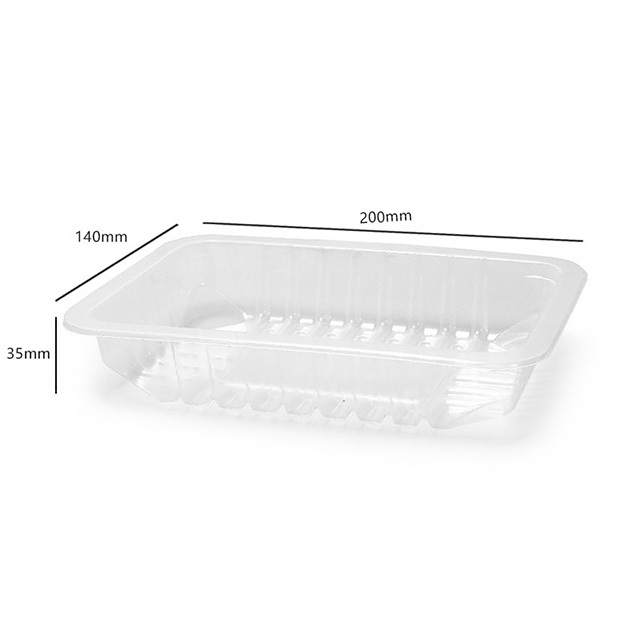
What Is a High Barrier PP Tray?
A high barrier PP tray is a thermoformed polypropylene food tray manufactured with a multilayer structure designed to reduce the transmission of oxygen and other gases through the package.
Depending on the required application, the structure may combine polypropylene with an EVOH barrier layer, polyethylene or another sealing layer, and adhesive tie layers. Common structures include PP/EVOH/PE, PP/EVOH/PP and other project-specific PP-based constructions.
HSQY supplies clear high barrier PP trays for fresh meat, poultry, fish, seafood, prepared food, chilled meals and modified atmosphere packaging. Existing products include multiple depths, single-compartment and two-compartment designs, with custom sizes, colors, barrier structures and molds available for qualified projects.
A high barrier tray is one component of a complete packaging system. Final package performance also depends on the lidding film, seal quality, food product, gas mixture, packing equipment and cold-chain conditions.
High Barrier PP Tray Specifications
The following table summarizes the principal options available across the HSQY high barrier PP tray category. Exact specifications should be confirmed for the selected tray model.
| Product Name | Clear High Barrier PP Food Tray |
| Base Material | Food packaging grade polypropylene, PP |
| Possible Barrier Structure | PP/EVOH/PE, PP/EVOH/PP or customized PP-based multilayer structure |
| Manufacturing Process | Multilayer sheet production and thermoforming |
| Existing Tray Footprints | Approximately 180 × 120 mm and 200 × 140 mm |
| Existing Depth Options | Approximately 20, 25, 35, 45, 50, 55, 60, 65 and 70 mm |
| Compartments | Single compartment and two compartments; custom layouts can be evaluated |
| Standard Color | Clear |
| Custom Colors | Black, white and custom colors subject to specification and MOQ |
| Selected Model Temperature Reference | Approximately -16°C to 100°C; actual performance must be verified for the specific tray and application |
| Packaging Methods | Heat sealing, modified atmosphere packaging and selected chilled food packaging systems |
| Lidding Film Options | High barrier, anti-fog, easy-peel, lock-seal, puncture-resistant and printed lidding films |
| Typical Applications | Fresh meat, poultry, fish, seafood, processed meat, prepared foods and chilled ready meals |
| Reference MOQ | Approximately 30,000 pieces for selected standard models |
| Customization | Tray size, depth, color, compartments, logo, barrier structure, sealing flange, lidding film and export packaging |
| Sample Support | Stock samples may be available for product fit, sealing, gas retention and machine compatibility testing |
The listed temperature range is a reference for selected PP trays and is not a universal guarantee. Material structure, tray thickness, food composition, filling temperature, heating time, freezing conditions and lidding film can all affect final performance.
How Does a PP/EVOH High Barrier Tray Work?
A high barrier PP tray uses several functional polymer layers. The layers are bonded together during sheet production and remain integrated when the sheet is thermoformed into a tray.
| Layer | Main Function | Packaging Benefit |
| PP Structural Layer | Provides the principal tray structure and thermoforming base | Supports rigidity, impact resistance, moisture resistance and selected temperature performance |
| EVOH Barrier Layer | Reduces oxygen and gas transmission | Helps protect oxygen-sensitive food and retain a modified atmosphere |
| PE or Sealant Layer | Provides a project-specific sealing surface and moisture protection | Supports heat sealing to compatible lidding films |
| Tie Layers | Bond PP, EVOH, PE or other otherwise incompatible polymers | Helps prevent delamination during forming, filling, sealing and distribution |
The exact number, sequence and thickness of the layers should be selected according to the required oxygen transmission rate, moisture exposure, forming depth, tray stiffness, sealing system and target shelf life.
Buyers requiring a defined multilayer construction can also review HSQY's PP/EVOH/PE tray solutions.
High Barrier PP Trays vs. Standard PP Trays
| Comparison | High Barrier PP Tray | Standard PP Tray |
| Material Structure | Multilayer structure containing a gas-barrier layer such as EVOH | Primarily mono-PP or a basic PP structure |
| Oxygen Barrier | Designed to provide lower oxygen transmission | Limited oxygen barrier compared with EVOH-based structures |
| MAP Suitability | Can be selected for MAP when matched with a suitable high-barrier film | Normally used for general food containment or shorter-distribution applications |
| Main Applications | Meat, seafood, poultry, chilled food and products sensitive to oxygen | Takeout food, deli food, general storage and non-barrier packaging |
| Material Cost | Normally higher because of multilayer production and barrier resin | Normally more economical for applications that do not need gas control |
| Recycling Consideration | Acceptance depends on layer composition and local recycling systems | Mono-material structures may be simpler for some PP recycling streams |
High Barrier PP Tray vs. MAP Tray
A high barrier PP tray describes the material and barrier performance of the tray. A MAP tray describes how the tray is used within a modified atmosphere packaging process.
A high barrier PP tray can be used as a MAP tray when it has the required gas barrier, sealing flange and machine compatibility. However, simply adding an EVOH layer does not guarantee that every tray is suitable for every MAP application.
MAP performance depends on:
Tray oxygen transmission rate
Lidding-film gas barrier
Seal strength and package leak rate
Selected gas composition
Gas-to-product volume
Food type and initial microbial condition
Storage and distribution temperature
Target shelf life
Customers developing a full modified atmosphere packaging project can review HSQY's MAP tray range.
Applications of High Barrier PP Food Trays
Fresh Meat Packaging
High barrier PP trays can be used for beef, pork, lamb, minced meat, sliced meat, meatballs and marinated products packed under modified atmosphere.
The tray depth, headspace, gas mixture, absorbent pad and film puncture resistance should be matched to the meat cut and packed weight.
Poultry Packaging
Chicken breasts, legs, wings, drumsticks, turkey portions and prepared poultry can be packaged in barrier trays designed for chilled retail distribution.
Bone-in poultry may require deeper trays and lidding films with greater puncture resistance.
Fish and Seafood Packaging
Applications include fish fillets, shrimp, shellfish, seafood portions and prepared seafood products.
Seafood packaging requires careful validation of gas composition, temperature, liquid release, microbiological risk and package integrity.
Processed Meat and Sausages
High barrier trays can be evaluated for sausages, bacon, sliced processed meat, meatballs, marinated products and other chilled proteins requiring controlled gas transmission.
Chilled Ready Meals
Single-compartment and divided PP barrier trays can hold rice, pasta, meat, vegetables, sauces and multicomponent meals.
The required tray structure depends on whether the meal is packed cold, reheated in the tray, pasteurized, frozen or distributed only under refrigeration.
Cheese and Dairy-Based Food
Selected cheeses, dairy-based meals, dips and chilled dairy products can use barrier packaging when oxidation, aroma transfer or gas retention must be controlled.
Prepared and Ready-to-Cook Food
High barrier PP trays are also suitable for selected ready-to-cook ingredients, meal components, marinated foods and foodservice products requiring heat sealing and refrigerated distribution.
High Barrier Lidding Films for PP Trays
The lidding film must be matched to the tray structure. A high barrier tray sealed with an unsuitable or low-barrier film will not provide a complete high-barrier package.
Important lidding-film properties include:
Compatible sealant layer for PP, PE or the specified tray surface
Appropriate oxygen transmission rate
Carbon dioxide barrier where required
Water-vapor barrier
Seal strength
Easy-peel or lock-seal opening performance
Hot-tack performance
Ability to seal through limited moisture or grease contamination
Anti-fog performance
Puncture resistance
Printing and branding requirements
Compatibility with the tray sealing machine
HSQY can discuss compatible EVOH/PP high barrier lidding films for selected PP trays.
Samples should be tested on the customer's actual sealing machine before a bulk tray-and-film order is approved.
Tray Sealing Machine Compatibility
High barrier PP trays can be used with manual, semi-automatic and fully automatic tray sealing equipment when the tray dimensions and flange geometry match the sealing tool.
Buyers should confirm:
External tray length and width
Tray depth
Flange width
Corner radius
Tool cavity dimensions
Number of cavities per cycle
Maximum product height
Film width
Seal-plate profile
Sealing temperature, pressure and dwell time
Vacuum and gas-flush function
Automatic denesting requirements
Customers planning a complete packaging line can also review HSQY's food tray sealing machines.
Are High Barrier PP Trays Microwave Safe?
Polypropylene is commonly used in microwaveable food packaging, but a high barrier PP tray should not automatically be described as microwave-safe solely because it contains PP.
Microwave suitability depends on:
Exact PP resin and multilayer structure
Tray wall thickness and geometry
Food composition, especially oil, sugar and fat content
Food weight
Microwave power and heating time
Whether the lidding film is removed or vented
Maximum local food temperature
The selected tray should be tested with the actual meal and reheating instructions before microwave claims are added to retail packaging.
Are High Barrier PP Trays Freezer Safe?
Selected PP tray formulations can be evaluated for frozen food packaging. However, freezer performance depends on more than the nominal storage temperature.
Testing should consider:
A packaging tray alone does not prevent freezer burn. Moisture loss and freezer burn also depend on film barrier, seal integrity, headspace and storage conditions.
Can High Barrier PP Trays Be Pasteurized or Retorted?
Not every high barrier PP tray is suitable for pasteurization, hot filling or retort processing.
These applications require a tray structure specifically developed and tested for the intended time, temperature, pressure and food formulation.
Retort processing normally involves temperatures above the 100°C reference listed for selected HSQY category products. Therefore, standard trays in this category should not be promoted as retortable unless a separate validated retort-grade specification is provided.
Do High Barrier PP Trays Extend Food Shelf Life?
High barrier trays can support longer distribution periods by reducing oxygen ingress and retaining the selected internal atmosphere. However, the tray does not independently determine food shelf life.
Shelf life depends on:
Commercial shelf-life claims should be supported by microbiological, sensory, gas-retention, seal-integrity and storage testing using the actual food and package.
How to Choose a High Barrier PP Tray
Define the Food Product
Fresh meat, seafood, poultry, cheese and ready meals have different oxygen sensitivity, moisture release, temperature and microbiological requirements.
Confirm the Portion Weight
The tray must support the food weight without excessive bending and provide enough internal volume for the food, absorbent pad and required gas headspace.
Select the Correct Depth
A shallow tray may cause the food to contact the film or contaminate the sealing flange. An unnecessarily deep tray increases package volume and transport cost.
Define the Barrier Requirement
Provide the target shelf life, gas mixture, storage temperature and required oxygen transmission rate when available. This allows the barrier-layer structure to be evaluated more accurately.
Match the Lidding Film
The lidding film should match the tray sealant surface and provide the required barrier, anti-fog, peel and puncture performance.
Check the Sealing Machine
Tray dimensions and flange geometry must be compatible with existing sealing tools. A drawing, current tray sample or machine-tool specification should be provided before ordering.
Confirm the Required Use Temperature
State whether the product will be chilled, frozen, microwaved, hot filled or pasteurized. Do not select the tray only from the fact that the structural resin is polypropylene.
Custom High Barrier PP Tray Options
HSQY supports custom barrier tray projects for food manufacturers, meat processors, seafood companies, supermarket groups, ready-meal producers and packaging distributors.
Custom external length and width
Custom internal dimensions
Custom tray depth and capacity
Single, double or multiple compartments
Custom PP/EVOH/PE or PP/EVOH/PP structure
Custom tray thickness and weight
Clear, black, white or custom colors
Custom flange width and corner geometry
Automatic denesting features
Embossed logo or recycling mark
Absorbent-pad matching
High-barrier lidding-film matching
Easy-peel or lock-seal opening system
Printed lidding film or branded label support
New thermoforming mold development
Custom carton and pallet packaging
Custom Mold Development Process
Application review: The customer provides the food type, portion weight, packaging method, storage conditions and annual demand.
Dimension review: External size, internal volume, depth, headspace and sealing-machine tooling are confirmed.
Material selection: The PP grade, EVOH barrier and sealant structure are evaluated.
Tray design: Wall angles, ribs, flange, stacking and denesting features are developed.
Drawing approval: The customer confirms the technical drawing and tolerances.
Tooling: Thermoforming and cutting molds are produced.
Sample trial: Samples are tested with the actual food, lidding film, gas mixture and packaging machine.
Commercial validation: Seal integrity, barrier performance, transport and shelf life are evaluated.
Mass production: Bulk production begins after the tray and packaging system are approved.
Quality Control for High Barrier PP Trays
Small variations in tray dimensions, flange flatness or multilayer distribution can affect sealing and gas retention. Quality control should therefore cover both mechanical and packaging-system performance.
Inspection items may include:
Raw material and multilayer-structure verification
Tray external dimensions
Internal dimensions and capacity
Tray weight
Thickness distribution
Flange width and flatness
Edge and cutting quality
Clarity and color consistency
Black spots, gels and surface contamination
Stacking and denesting performance
Compression and handling resistance
Low-temperature performance when required
Heat-seal compatibility
Seal strength and peel performance
Leak or package-integrity testing
Oxygen transmission testing when specified
Packing quantity and pallet stability
Food-Contact Compliance
Food-contact requirements depend on the resin formulation, multilayer structure, food type, contact time, use temperature and destination market.
Buyers should specify:
Destination country or region
Direct food-contact conditions
Food type
Contact duration
Refrigerated, frozen or heated conditions
Required declaration or migration testing
Restricted-substance requirements
Required batch or traceability documentation
Compliance documentation should be confirmed for the exact tray structure and order. It should not be assumed that one report applies to every tray model, color or multilayer formulation.
Are High Barrier PP Trays Recyclable?
Polypropylene can be recycled where suitable collection, sorting and processing facilities exist. However, a high barrier PP tray is not necessarily equivalent to a simple mono-PP tray.
Actual recyclability depends on:
Percentage of PP in the total structure
EVOH, PE and tie-layer content
Tray color
Attached lidding film
Labels, inks and adhesives
Food contamination
Local sorting technology
Regional recycling acceptance rules
Buyers should review the complete package and destination-market guidance before making claims such as “fully recyclable” or “widely recyclable.”
Packaging and International Shipping
High barrier PP trays are nested to reduce storage and transportation volume. They are normally packed in protective plastic bags and export cartons.
Available packaging options may include:
Defined tray quantity per bag
Defined bag quantity per carton
Custom carton labels
Batch and product codes
Export pallet packaging
Stretch wrapping and corner protection
Customer-specific pallet height
Private-label outer packaging
Container quantity depends on the tray footprint, depth and nesting pitch. Deeper trays normally require more shipping volume even when their top dimensions are identical.
Why Choose HSQY as Your High Barrier PP Tray Manufacturer?
Direct manufacturer supply: Factory support for food processors, meat packers, retailers and packaging distributors.
Multiple standard depths: Existing clear trays cover shallow, medium and deep food packaging requirements.
Single and divided trays: One-compartment and two-compartment models are available.
Multilayer material support: PP/EVOH/PE and other PP-based barrier structures can be discussed.
Custom thermoforming: Dimensions, depth, compartments, colors, flange design and molds can be customized.
Tray-and-film supply: High barrier lidding films can be evaluated together with the tray.
Equipment support: Tray dimensions can be reviewed against the customer's tray sealing machine.
Sample testing: Samples may be supplied for sealing, MAP, food-fit and machine testing.
Multiple food tray technologies: HSQY also supplies fresh meat trays, MAP trays, VSP trays, PET trays and CPET trays.
Export support: Carton, pallet and international transportation requirements can be coordinated.
For conventional overwrap packaging, buyers can review fresh meat trays. Projects requiring vacuum skin packaging can review VSP trays.
Information Required for a High Barrier PP Tray Quote
To receive an accurate factory quotation, please provide as much of the following information as possible:
Existing tray model, sample, drawing or photograph
External tray length and width
Required depth
Internal usable dimensions
Food type
Packed food weight
Single or divided compartment design
Required tray color
Estimated order quantity and annual demand
Required PP/EVOH/PE or other barrier structure
Required oxygen transmission rate, if specified
Packaging method, such as MAP or standard heat sealing
Target shelf life
MAP gas mixture
Storage and transportation temperature
Microwave, freezing or pasteurization requirement
Lidding-film structure and width
Easy-peel, lock-seal or anti-fog requirement
Absorbent-pad dimensions and capacity
Tray sealing machine brand and model
Tooling or cavity drawing
Embossed logo or private-label requirement
Food-contact documentation requirements
Carton and pallet packaging requirements
Destination port or delivery address
Frequently Asked Questions About High Barrier PP Trays
What is a high barrier PP tray made from?
It is a PP-based thermoformed tray containing a functional gas-barrier layer such as EVOH. The structure may also contain PE, PP sealant layers and adhesive tie layers.
Why is EVOH used in PP food trays?
EVOH provides strong resistance to oxygen and gas transmission. It is placed inside a multilayer structure so the surrounding polymer layers can provide moisture protection, mechanical strength and sealing performance.
Is a high barrier PP tray the same as a MAP tray?
Not exactly. High barrier PP describes the tray material. MAP describes a packaging process in which the internal air is replaced with a controlled gas mixture. A suitable high barrier PP tray can be used in a MAP system.
Can a standard PP tray be used for MAP packaging?
Standard mono-PP may not provide sufficient gas barrier for the required distribution period. The tray and film should be selected according to the target oxygen transmission, gas mixture and shelf life.
What food can be packed in high barrier PP trays?
Typical applications include fresh meat, poultry, fish, seafood, sausages, processed meat, chilled meals, ready-to-cook food and selected cheese or dairy-based products.
What standard sizes does HSQY offer?
Existing products mainly use 180 × 120 mm and 200 × 140 mm footprints, with depths including approximately 20, 25, 35, 45, 50, 55, 60, 65 and 70 mm.
Are divided high barrier trays available?
Yes. HSQY currently displays single-compartment and two-compartment clear barrier trays. Additional compartment layouts can be evaluated through custom mold development.
Are high barrier PP trays microwave safe?
Selected trays may be suitable for reheating, but microwave performance must be verified for the exact tray, food, heating time and film-removal instructions. PP content alone does not guarantee microwave suitability.
Can high barrier PP trays be frozen?
Selected products can be tested for frozen storage. Low-temperature impact, stacking load, film flexibility and freeze-thaw conditions must be evaluated.
Are these trays suitable for retort processing?
The standard products should not automatically be treated as retortable. Retort applications require a specifically developed tray and film structure validated for the required pressure, temperature and processing time.
Which lidding film should be used?
Use a high barrier lidding film with a sealant layer compatible with the exact tray surface. Film selection should also consider oxygen barrier, anti-fog, peel strength, puncture resistance and machine settings.
Why does a sealed high barrier package lose gas?
Possible causes include an unsuitable film, contaminated tray flange, wrinkles, incomplete sealing, channel leaks, damaged trays, incorrect sealing parameters or insufficient barrier performance.
Can absorbent pads be placed inside the tray?
Yes. Absorbent pads can be matched to meat, poultry and seafood products. The pad should fit inside the tray without interfering with the sealing flange.
Can the tray be custom printed?
Branding is normally added through embossed logos, printed lidding films, labels, sleeves or outer cartons. Direct printing on the formed tray can be evaluated but is not the only or most suitable branding method for every project.
Can the tray size and color be customized?
Yes. Dimensions, depth, compartments, material structure, tray weight, flange design, color and embossed details can be customized subject to tooling and MOQ.
Are high barrier PP trays recyclable?
They may be accepted in some PP recycling systems, but actual recyclability depends on the multilayer structure, tray color, attached film, food contamination and local infrastructure.
What is the MOQ for HSQY high barrier PP trays?
The reference MOQ for selected standard products is approximately 30,000 pieces. Custom colors, barrier structures and new molds may require a different minimum quantity.
Can I request samples before placing an order?
Stock samples may be available for food-fit, stacking, lidding-film, sealing-machine and MAP testing. Sample availability and freight terms should be confirmed with the sales team.
What tests should be completed before commercial production?
Recommended tests include tray-machine fit, seal strength, peel performance, leak testing, gas analysis, oxygen transmission where required, low-temperature or reheating tests, transport testing and commercial shelf-life validation.
Request a High Barrier PP Tray Quote
Looking for a high barrier PP tray manufacturer, PP/EVOH food tray supplier or custom MAP packaging solution?
Contact HSQY to request standard tray sizes, samples, barrier structure recommendations, compatible lidding films, custom mold support, wholesale pricing and international shipping information.
Request a Quote