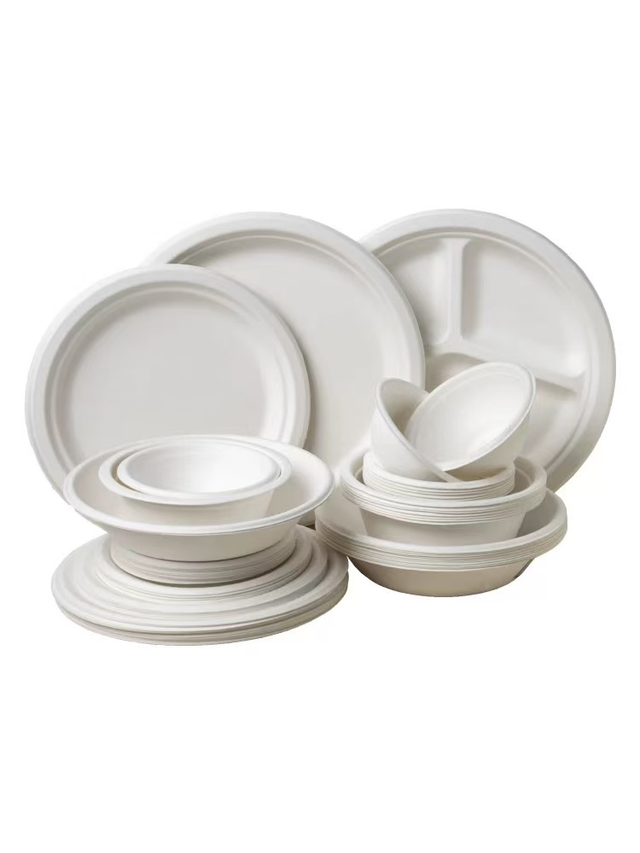
PP Plates Manufacturer for Catering and Foodservice
HSQY supplies disposable polypropylene plates for restaurants, catering companies, cafeterias, supermarkets, fast-food operators, events, barbecues and institutional foodservice. The current product range includes 6-inch, 7-inch, 8-inch, 9-inch and 10-inch round PP plates, together with single-compartment and 3-compartment designs in white and black.
Polypropylene combines low weight, moisture resistance, oil resistance and better heat performance than many conventional disposable plastic plate materials. Selected HSQY models are specified for foodservice temperatures from approximately -16°C to 100°C and for microwave reheating within the approved conditions of the exact product.
Quick answer: A PP plate is a lightweight polypropylene serving plate for hot or cold meals. HSQY offers round disposable plates in 6–10 inch sizes, including single-compartment and 3-compartment options. Buyers should choose the plate according to portion size, food weight, oil or sauce content, reheating requirements and actual strength testing.
HSQY Disposable PP Plate Product Range
The HSQY category covers small snack plates, standard dinner plates and divided meal plates. The following table helps buyers compare the main options.
| PP Plate Type | Main Characteristics | Typical Applications |
| 6-Inch Round PP Plate | Compact single-compartment plate for small servings. | Desserts, fruit, bread, appetizers and tasting portions. |
| 7-Inch Round PP Plate | Small serving plate with more area than a dessert plate. | Breakfast portions, snacks, cake and side dishes. |
| 8-Inch Round PP Plate | Medium general-purpose plate for standard portions. | Buffets, salads, sandwiches and light lunches. |
| 9-Inch Round PP Plate | Popular full-meal size available in white and black. | Restaurant meals, barbecues, cafeterias and parties. |
| 10-Inch Round PP Plate | Large serving surface for heavier portions. | Catering, buffet meals, grilled food and institutional dining. |
| 9-Inch 3-Compartment PP Plate | Three sections for a main course and two sides; white and black options. | School meals, catering, combo meals and portion control. |
| 10-Inch 3-Compartment PP Plate | Larger divided format for complete meal sets. | Cafeterias, institutional meals, events and catering. |
Browse the products above or review the 6-inch white PP plate, 8-inch white PP plate, 9-inch black PP plate, 9-inch white 3-compartment plate and 10-inch white 3-compartment plate.
Typical PP Plate Specifications
HSQY offers several plate models rather than one universal specification. Final dimensions, weight, packing quantity, temperature rating and minimum order must be confirmed for the selected SKU.
| Specification | Typical HSQY Options |
| Material | Food-contact polypropylene according to the confirmed plate formulation |
| Available Diameters | 6, 7, 8, 9 and 10 inches |
| Shape | Round |
| Compartments | Single compartment and 3 compartments |
| Colors | White and black; custom colors subject to review |
| Published Temperature Range | Approximately -16°C to 100°C for selected models |
| Typical Density | Approximately 0.9 g/cm³ for a published 10-inch 3-compartment model |
| Published MOQ | Some pages list 30,000 pieces; another model lists 1000 kg. Confirm the quotation unit by SKU |
| Typical Lead Time | Approximately 7–15 days after deposit for a published model; customization can change timing |
| Customization | Color, dimensions, compartments, logo treatment, packing and custom molds |
How to Choose the Correct PP Plate Size
Plate diameter should be selected according to the actual portion, food weight, edge clearance and carrying method. A larger plate is not automatically stronger because rigidity also depends on plate weight, rim geometry, reinforcing ribs and forming quality.
| Plate Size | Suggested Portion | Selection Notes |
| 6 Inch | Dessert, bread, fruit, appetizers and samples | Best for lighter portions. |
| 7 Inch | Breakfast, snacks, cake and side dishes | Compact format with more usable area than a dessert plate. |
| 8 Inch | Sandwiches, salads, light lunches and buffet service | General-purpose option for medium portions. |
| 9 Inch | Standard main meals, rice, grilled food and pasta | Available in single- and 3-compartment formats. |
| 10 Inch | Large meals, buffet portions and combination meals | Provides more edge clearance and compartment capacity. |
Single-Compartment vs 3-Compartment PP Plates
| Selection Factor | Single Compartment | 3 Compartments |
| Usable Area | One open surface for mixed meals and larger items. | Divided into a main section and smaller side sections. |
| Food Separation | Ingredients can contact and mix. | Helps organize proteins, starches, vegetables and sides. |
| Typical Menus | Barbecue, pasta, sandwiches, salad and rice dishes. | School meals, catering sets and portion-controlled menus. |
| Liquid Separation | Not applicable between sections. | Dividers help, but should not be assumed to be liquid-tight. |
Important: Thin sauces can cross the compartment dividers if the plate is tilted or overfilled. Test the actual menu before making a liquid-separation claim.
Key Benefits of Polypropylene Plates
Heat performance: Selected grades support hot food and controlled microwave reheating.
Moisture resistance: PP does not absorb sauces or food moisture like uncoated paper.
Oil resistance: Suitable for many fried, grilled and oily foods.
Impact resistance: PP is generally less brittle than conventional polystyrene.
Low weight: Supports efficient handling, warehousing and freight.
Stackability: Nested plates reduce counter and carton volume.
Portion flexibility: Sizes from 6 to 10 inches support snacks through full meals.
Compartment options: Three-section plates support organized meal service.
Color options: White offers a clean appearance; black provides food contrast.
Recycling potential: PP may be accepted where resin code 5 foodservice packaging is collected.
Are HSQY PP Plates Microwave-Safe?
Selected HSQY PP plate models are described as microwave-safe and have a published upper temperature of approximately 100°C. This rating applies only to the exact approved model and intended foodservice conditions.
Microwave performance depends on plate weight, food composition, heating time, microwave power and local hot spots. Foods with high oil or sugar content can become hotter than water and may soften a lightweight plate.
How Should PP Plates Be Tested for Microwave Use?
Test the exact plate model rather than relying only on the resin name.
Use the actual food, portion weight and planned heating cycle.
Check rim strength and base distortion immediately after heating.
Evaluate high-oil, high-sugar and cheese-based foods separately.
Do not expose disposable PP plates to grills, flames or conventional oven elements.
Stop using plates that become warped, cracked or structurally weak.
Can PP Plates Hold Hot, Oily and Saucy Foods?
PP plates are commonly selected for grilled food, fried food, rice, pasta and other hot meals because polypropylene resists moisture and many food oils. Performance still depends on plate weight, food temperature, holding time and the way the plate is carried.
A plate that performs well with bread or salad may bend under a heavy serving of curry or grilled meat. Test rim stiffness, one-handed carrying and base sagging with the intended food.
Are PP Plates Suitable for Soup?
Flat disposable plates are not intended to replace bowls or lidded containers for transportable liquids. For soup or broth, use a suitable PP bowl or PP lunch box.
Cold and Freezer Applications
Selected HSQY plate pages publish a lower service temperature of approximately -16°C. This makes the range relevant for chilled food and certain freezer applications after validation.
Test cold plates for cracking, rim damage and impact resistance. Avoid dropping or sharply flexing a frozen plate, particularly when it carries a heavy portion.
Applications of Wholesale PP Plates
Restaurants and quick-service food outlets
Catering companies and banquet service
Corporate cafeterias and canteens
Schools, hospitals and institutional meal programs
Airline, railway and travel catering
Supermarket prepared-food counters
Food trucks, markets and outdoor vendors
Barbecues, festivals, parties and private events
Picnics, camping and outdoor dining
Packaging wholesalers and foodservice distributors
PP Plates vs Other Disposable Plate Materials
| Material | Heat Performance | Handling | Typical Best Fit |
| PP | Selected grades support hot food and microwave reheating. | Tough, lightweight and relatively impact-resistant. | Hot meals, catering, cafeterias and events. |
| PS/HIPS | Generally lower heat tolerance than microwave-rated PP. | Rigid but often more brittle. | Cold food and appearance-focused service. |
| Paperboard | Depends on coating, moisture and heating instructions. | Can soften with oil or wet food. | Dry food, snacks and paper-based presentation. |
| Bagasse | Selected grades support hot food and microwave use. | Rigid fibre structure with natural texture. | Foodservice programs prioritizing fibre materials. |
| Melamine | Reusable melamine is generally not intended for microwaves. | Heavy, rigid and designed for repeated use. | Reusable restaurant and cafeteria tableware. |
Disposable vs Reusable PP Plates
The products in this category are marketed as disposable plates. Polypropylene can also be used for durable reusable dinnerware, but a lightweight single-use plate should not automatically be described as dishwasher-safe or suitable for repeated use.
Reusable performance requires testing for repeated washing, detergent exposure, scratching, staining, microwave cycles and mechanical handling.
Food-Contact Safety and Compliance
Food-contact suitability must be verified for the complete plate formulation, including resin, pigment, fillers and additives. Requirements vary by destination market, food type, contact time and temperature.
Before ordering, specify the country of sale and required regulatory framework. Request applicable documentation for the exact plate model and color rather than relying on a general statement about polypropylene.
Are PP Plates BPA-Free?
HSQY product pages describe selected plates as BPA-free. Buyers should request confirmation for the exact resin, color and finished product when BPA status is a contractual or regulatory requirement.
Recycling and Sustainability Considerations
Polypropylene is identified by resin code 5 and may be recyclable, but disposable plates are not accepted by every recycling program. Food residue, dark pigments, item shape and local sorting technology affect actual recovery.
Conventional PP is not biodegradable or compostable. Sustainability assessments should consider plate weight, packing density, transport efficiency, food waste prevention and the end-of-life system in the destination market.
Custom PP Plates for Foodservice Brands
HSQY can evaluate OEM and private-label projects for restaurant groups, catering companies, wholesalers and foodservice brands.
| Customization | Information Required | Key Consideration |
| Custom Color | Color reference, opacity, quantity and destination market. | Pigments must meet intended food-contact requirements. |
| Embossed Logo | Vector logo, position and dimensions. | Embossing can affect forming and stacking. |
| Printed Branding | Artwork, colors, print area and durability. | Labels, sleeves or printed cartons may be more practical than direct plate printing. |
| Custom Size or Shape | Drawing, food load, dimensions and annual volume. | New tooling and a minimum production run are normally required. |
| Custom Compartments | Meal layout, section volumes and divider height. | Geometry affects stiffness, capacity and food separation. |
| Private-Label Packing | Sleeve count, barcode, carton artwork and marks. | Packing changes affect freight and loading quantity. |
Quality Control for Disposable PP Plates
Material identity, color and visual appearance
Diameter, height, rim dimensions and compartment geometry
Individual plate weight and weight tolerance
Wall and base thickness distribution
Rim stiffness and one-handed carrying performance
Resistance to bending under the specified food load
Oil, moisture and sauce exposure
Microwave and temperature testing when required
Cold-impact performance when specified
Stacking, denesting and plate separation
Sleeve count, carton quantity and batch traceability
Common PP Plate Problems and Corrective Actions
| Problem | Possible Causes | Recommended Checks |
| Plate Bends Under Food Weight | Plate too light, portion too heavy or hot food reduces stiffness. | Test the actual load and select a heavier or stronger design. |
| Plate Warps in the Microwave | Excessive time, high power, hot oil or an unapproved model. | Verify the SKU rating and test the real meal cycle. |
| Plates Stick Together | Poor denesting geometry, carton compression or dimensional variation. | Review nesting features, packing pressure and tolerances. |
| Plate Cracks When Cold | Impact at low temperature, unsuitable grade or thin corners. | Run cold-impact testing and improve handling or material grade. |
| Sauce Crosses Compartments | Thin liquid, low dividers, overfilling or tilting. | Lower the fill or use a lidded container for liquid-rich meals. |
| Color Variation | Pigment dispersion or material-batch differences. | Define color tolerance and approve production samples. |
Bulk Packaging and Export Supply
PP plates are normally nested, wrapped in PE film or packed in sleeves, and placed in corrugated export cartons. Packing quantity depends on diameter, depth, plate weight and compartment design.
Before confirming a wholesale order, request pieces per sleeve, sleeves per carton, carton dimensions, gross weight, pallet configuration and estimated container-loading quantity.
How to Evaluate PP Plate Samples
Measure the plate: Confirm diameter, depth, rim width and compartment dimensions.
Weigh samples: Compare individual weight and variation.
Test the actual meal: Use the intended food, portion weight, oil and temperature.
Carry the plate: Evaluate rim strength, base sagging and one-handed handling.
Test reheating: Run the planned microwave cycle when required.
Evaluate compartments: Check portion volume and sauce movement.
Check denesting: Confirm efficient plate separation during service.
Review packing: Assess sleeve size, carton strength and warehouse space.
Confirm documentation: Match the sample to the quoted SKU and compliance file.
Why Choose HSQY as Your PP Plate Supplier?
Round disposable PP plates from 6 to 10 inches
Single-compartment and 3-compartment designs
White and black foodservice options
Selected microwave and low-temperature grades
Oil-resistant, moisture-resistant and stackable designs
Sample support for food-load and heating tests
Custom color, branding, packing and mold development
Bulk cartons, pallet packing and international export support
For a broader product program, review PP food containers, PP lunch boxes, PP bowls, PP cups and hinged-lid containers.
Request PP Plate Samples and Wholesale Pricing
To receive an accurate recommendation and quotation, provide:
Required plate diameter
Single-compartment or 3-compartment design
White, black or custom color
Food type, portion weight and serving temperature
Microwave or freezer requirements
Order quantity and annual forecast
Preferred quotation unit: pieces, cartons, kilograms or container load
Logo, sleeve, label and carton customization
Destination country and required food-contact documents
Shipping terms and requested delivery schedule
Contact HSQY through the inquiry page to request samples, packing data, documentation and bulk pricing.
FAQ About Disposable PP Plates
What is a PP plate?
A PP plate is a foodservice plate made from polypropylene. It is lightweight, moisture-resistant and suitable for many hot and cold foods.
What sizes does HSQY supply?
The current category includes 6-inch, 7-inch, 8-inch, 9-inch and 10-inch round plates, including selected 3-compartment models.
Which size is best for a full meal?
Nine-inch and 10-inch plates are generally better suited to complete meals. The correct choice depends on food weight and required edge clearance.
Are HSQY PP plates microwave-safe?
Selected models are described as microwave-safe and specified up to approximately 100°C. Confirm the exact SKU and test the intended meal cycle.
Can PP plates be used in a conventional oven?
Do not assume conventional-oven suitability. Standard disposable PP plates should not contact heating elements, flames or grill heat.
Can PP plates hold hot food?
Approved models can hold hot prepared food within their stated range. Test the plate because heat can reduce stiffness.
Are PP plates suitable for oily food?
PP resists many food oils, but very hot oil and heavy portions should be tested for bending and distortion.
Can PP plates be used for soup?
A flat plate is not the preferred format for soup or transportable liquids. Use a PP bowl or lidded container.
Do 3-compartment plates prevent mixing?
They help separate solid and semi-solid food, but the dividers are not necessarily liquid-tight.
Can PP plates be frozen?
Selected HSQY models publish a lower temperature of approximately -16°C. Confirm the SKU and test cold-impact performance.
Are PP plates stronger than PS plates?
PP is generally tougher and less brittle, while PS can feel more rigid. Finished strength depends on plate weight and design.
Are disposable PP plates reusable?
These products are designed as disposable plates. Repeated-use claims require a product specifically designed and tested for reuse.
Are PP plates dishwasher-safe?
Do not assume a lightweight disposable plate is dishwasher-safe. Use a product rated for repeated dishwasher cycles when required.
Are PP plates recyclable?
PP may be recyclable where local programs accept resin code 5 foodservice products. Acceptance varies by market.
Are PP plates biodegradable?
No. Conventional polypropylene is not biodegradable or compostable.
What colors are available?
The current HSQY range includes white and black. Custom colors may be evaluated for qualifying orders.
Can HSQY add a logo?
Embossing, labels, printed sleeves or branded cartons may be available, subject to technical review.
Can HSQY develop a custom mold?
Yes. Provide a drawing, plate dimensions, food-load requirement and annual forecast for evaluation.
What is the MOQ?
Some HSQY pages list 30,000 pieces, while another lists 1000 kg. Confirm the quotation unit for the selected model.
Can I request samples?
Yes. Test samples for size, stiffness, food load, oil resistance, microwave performance and denesting.
What information is needed for a quotation?
Provide size, compartments, color, quantity, food application, temperature requirements, customization, destination and packing terms.