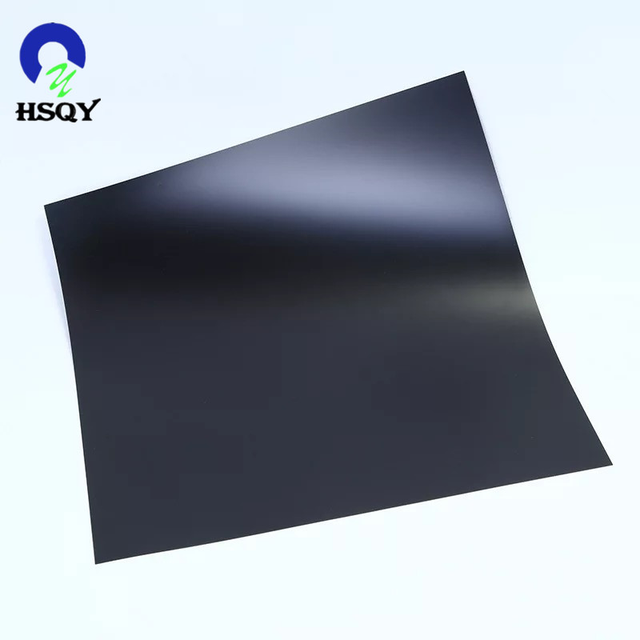
CPET Sheet Roll Manufacturer for Ovenable Tray Thermoforming
HSQY supplies CPET sheet rolls and cut sheets for manufacturers of ovenable ready-meal trays, airline meal trays, bakery containers, frozen-food trays and other heat-resistant thermoformed packaging. Standard commercial options include black and white opaque sheet, custom widths, cut-sheet dimensions and application-specific thicknesses.
CPET is a nucleated PET material engineered to develop controlled crystallinity during thermoforming and heat setting. The resulting formed tray can provide greater heat resistance and dimensional stability than standard amorphous PET packaging when the sheet formulation, heating profile, mold temperature, cooling cycle and finished-part design are correctly matched.
Quick answer: CPET sheet is the semi-finished material used to thermoform freezer-to-oven and dual-ovenable food trays. Buyers should specify the finished tray requirement—not only sheet thickness—because oven performance depends on the complete grade, crystallization process, wall distribution and formed-part validation.
Current HSQY CPET Sheet Products
The current HSQY category contains three related product pages. They address black CPET sheet, heat-resistant CPET sheet and CPET film for thermoforming. The products overlap in application, so buyers should confirm the exact grade and specification instead of selecting by product title alone.
| Current Product | Published Positioning | Published Range | Recommended Buyer Check |
| Black CPET Sheet for Thermoplastic Products | Black or custom CPET sheet for microwaveable lunch boxes, aviation trays and thermoformed packaging. | Thickness information appears as 0.1–3 mm and 0.12–3 mm; roll width 80–1300 mm; cut sheets available. | Confirm approved grade, actual thickness range, color, roll dimensions, density and finished-tray temperature target. |
| Heat Resistant CPET Sheet | Thermoformable sheet for food trays, cups, clamshells, blisters and related heat-resistant packaging. | Published sheet sizes include 700 × 1000, 915 × 1830, 1000 × 2000 and 1220 × 2440 mm. | Confirm whether the application is ovenable food packaging, microwave-only packaging or another thermoformed product. |
| Heat Resistant CPET Film | Opaque black or white CPET material for food packaging and aviation meal trays. | Published thickness 0.1–3 mm and roll width 80–1300 mm. | Confirm whether the requested gauge is supplied as roll-fed sheet or cut sheet and whether it matches the thermoforming line. |
Typical CPET Sheet Specifications
The following table consolidates specifications currently published across HSQY product pages. Because some fields conflict between page headers and detailed descriptions, the final sales contract should reference an approved technical data sheet.
| Specification | Published HSQY Information | Procurement Guidance |
| Material | Modified or crystallizable PET / CPET. | Request the exact resin, nucleating system, pigment and recycled-content declaration. |
| Thickness | Published as 0.1–3 mm on detailed tables and 0.12–3 mm in some page headers. | Specify nominal gauge and tolerance; confirm the actual manufacturable range. |
| Roll Width | Approximately 80–1300 mm, customizable. | Provide usable web width, edge trim, tolerance and winding direction. |
| Standard Cut Sheets | 700 × 1000, 915 × 1830, 1000 × 2000 and 1220 × 2440 mm. | Confirm sheet flatness, stack quantity, interleaf or protective-film requirement. |
| Density | Approximately 1.35 g/cm³ on current product pages. | Use the approved grade density to calculate roll length and weight. |
| Colors | Black and white are the main CPET colors; custom opaque colors may be evaluated. | Do not assume a transparent option has the same crystallization and oven performance. |
| Surface | Glossy, matte or frosted options are referenced. | Confirm which surface contacts the mold, food and lidding-film seal. |
| Supply Format | Rolls or cut sheets. | Roll-fed production requires core, diameter, weight, splice and tension specifications. |
| Published MOQ | Current pages contain both 1000 kg and 2000 kg references. | Confirm MOQ by grade, thickness, color, width and packing format. |
| Published Lead Time | Approximately 10–14 days for selected quantities on one detailed product page. | Confirm after sample approval, raw-material availability and production scheduling. |
| Samples | A4 samples are referenced on current product pages. | Production-line trials require sufficient roll length, not only an A4 hand sample. |
What Is CPET Sheet?
CPET stands for crystallized or crystallizable polyethylene terephthalate. For thermoforming applications, the material is commonly formulated with nucleating and processing additives that allow PET to crystallize rapidly during controlled heating and molding.
The sheet is not automatically equivalent to the final ovenable tray. Finished performance depends on how the sheet is reheated, formed, crystallized or heat-set and cooled. A poorly controlled process can produce uneven wall thickness, low crystallinity, distortion or brittle areas even when the raw sheet specification is correct.
How CPET Sheet Becomes an Ovenable Food Tray
Material preparation: PET resin, nucleating additives, color and approved recycled content are blended according to the grade.
Drying and extrusion: Moisture is controlled before the polymer is melted and extruded through a flat die.
Sheet calibration: Roll-stack cooling controls thickness, surface and flatness before winding or cutting.
Sheet reheating: The thermoformer heats the web to a forming condition matched to the gauge and cavity depth.
Forming: Vacuum, pressure or plug-assist forming distributes material over the mold.
Crystallization and heat setting: Controlled mold temperature and dwell time develop the crystallinity required for heat resistance.
Cooling and release: The finished tray must be cooled enough to retain shape and release consistently.
Trimming and inspection: Trays are trimmed, stacked and checked for dimensions, wall distribution and performance.
Why Crystallinity Matters
| Process Variable | Effect on the Finished Tray | Risk if Poorly Controlled |
| Nucleation | Promotes faster and more uniform crystallization. | Slow cycles, uneven crystallinity or inconsistent heat resistance. |
| Sheet Temperature | Allows the material to stretch and conform to the mold. | Web sag, incomplete forming, excessive thinning or tearing. |
| Mold Temperature | Supports crystallization and dimensional stabilization. | Low heat resistance, sticking or excessive cycle time. |
| Dwell Time | Provides time for forming and crystallization. | Under-crystallized or over-processed parts. |
| Cooling | Locks in dimensions before ejection and stacking. | Warping, flange distortion or blocking. |
| Wall Distribution | Determines corner strength, base rigidity and oven performance. | Thin corners, cracking, deformation or seal failure. |
Service Temperature: Why 177°C and 220°C Both Appear
Current HSQY CPET sheet product pages mainly publish finished-use performance up to approximately 177°C, while other commercial CPET systems in the market are designed for applications reaching approximately 220°C. These figures should not be merged into one universal claim.
The approved maximum temperature must be linked to a defined tray grade, wall thickness, crystallinity, food load, oven type and maximum exposure time. A sheet datasheet alone cannot establish the safe heating instruction for the finished food package.
| Temperature Statement | Correct Interpretation |
| -40°C Cold-Side Reference | A common target for frozen ready-meal applications, subject to cold-impact and thermal-shock validation. |
| Up to Approximately 177°C | The main high-temperature value currently published on HSQY CPET sheet product pages. |
| Up to Approximately 220°C | Possible for selected CPET formulations and correctly crystallized finished trays; requires grade-specific confirmation. |
| Microwave Compatibility | Depends on the finished tray and food system; oil and sugar can create local hot spots. |
| Conventional Oven Compatibility | Requires a validated time-temperature profile and clearance from exposed heating elements. |
CPET Sheet Applications
Frozen ready-meal trays
Dual-ovenable supermarket food trays
Airline and railway meal trays
Bakery and dessert trays
Pasta, lasagna and casserole containers
Institutional and healthcare meal packaging
Meal-delivery and central-kitchen trays
One-, two- and three-compartment food trays
Custom thermoformed heat-resistant packaging
Medical, automotive and industrial applications appear on some current HSQY product pages, but these uses require independent material, regulatory and process validation. A food-packaging grade should not automatically be promoted as a medical sterilization or engineering grade.
CPET Sheet vs APET, PETG, PP and HIPS Sheet
| Material | Clarity | Heat Performance | Typical Packaging Use | Key Limitation |
| CPET Sheet | Usually opaque in black, white or custom colors. | Designed for higher-temperature finished trays after controlled crystallization. | Freezer-to-oven ready meals and airline trays. | Requires controlled thermoforming and heat setting. |
| APET Sheet | High clarity. | Primarily cold or ambient packaging; not intended for conventional oven use. | Clamshells, produce trays, lids and clear food packs. | Insufficient heat resistance for ovenable trays. |
| PETG Sheet | High clarity and good forming definition. | Better forming at lower temperatures, but conventional oven performance is grade-specific. | Display packaging, medical packaging and formed clear components. | Not a direct substitute for ovenable CPET. |
| PP Sheet | Translucent to opaque. | Commonly suitable for microwave and hot-fill applications; oven use is limited and grade-specific. | Microwave trays, cups and food containers. | Typically lower conventional-oven capability than CPET. |
| HIPS Sheet | Opaque. | Suitable for many chilled and ambient packs; heat range depends on grade. | Dairy cups, lids, inserts and general trays. | Not intended for freezer-to-conventional-oven applications. |
Black vs White CPET Sheet
| Selection Factor | Black CPET Sheet | White CPET Sheet |
| Food Presentation | Strong contrast with light-colored food and premium ready meals. | Clean appearance and good contrast with dark sauces or baked products. |
| Radiant Heat Absorption | Can absorb more radiant energy under some heating conditions. | May respond differently to radiant heating and visual browning. |
| Sorting and Recycling | Dark pigments may affect some optical sorting systems. | Acceptance depends on local PET tray sorting and recycling infrastructure. |
| Branding | Common for retail ready meals and airline trays. | Common for bakery, healthcare and institutional presentation. |
| Validation | Compare actual heating, color consistency and regulatory documentation. | Compare staining, color stability, heating and regulatory documentation. |
Transparent CPET and CPET-Light
Standard ovenable CPET food trays are commonly opaque because crystallinity scatters light. Specialized transparent or lightly crystallized PET systems can be engineered for lower-temperature hot-fill or other applications, but they should not be assumed to deliver the same oven performance as opaque CPET.
Where product visibility is required, define whether the target is a clear lid, transparent APET tray, PETG component or a specialized transparent heat-resistant PET grade. The supplier should confirm the exact temperature and forming window.
How to Select CPET Sheet Thickness
Sheet thickness should be selected from the finished tray load, cavity depth, draw ratio, flange width, oven requirement, stack load and target tray weight. A thicker sheet can improve rigidity but may increase material cost, heating time and cooling time.
| Selection Input | Why It Matters |
| Tray Footprint | Larger trays generally need more stiffness and controlled base support. |
| Draw Depth | Deep cavities stretch the sheet and reduce wall thickness in critical areas. |
| Corner Radius | Sharp corners increase thinning and stress concentration. |
| Compartment Layout | Dividers and junctions change material flow during forming. |
| Food Weight | Heavy meals increase base, rim and stack loads. |
| Heating Cycle | Longer or hotter use may require greater finished-wall robustness. |
| Sealing Flange | The flange must remain flat and dimensionally stable for lidding-film sealing. |
| Line Speed | Thicker material may require more heating and cooling capacity. |
Roll Specification for Thermoforming Lines
Nominal thickness and thickness tolerance
Usable roll width and edge-trim allowance
Roll weight and maximum roll diameter
Core material, inner diameter and core length
Winding direction and food-contact side
Surface finish and corona or other treatment where applicable
Maximum number and location of splices
Roll hardness, telescoping and edge alignment limits
Batch identification and traceability
Protective wrapping, pallet layout and moisture protection
Thermoforming Trial Information Required
A useful CPET sheet trial requires more than a small visual sample. HSQY should receive the thermoforming-machine and mold data needed to recommend an appropriate sheet grade and trial quantity.
Thermoforming machine brand and model
Roll-fed or cut-sheet processing method
Heater type and available heating zones
Vacuum, pressure and plug-assist capability
Mold material and mold-heating system
Cavity dimensions, draw depth and corner radii
Target cycle time and production speed
Trim method and stacking system
Finished tray weight and wall-thickness targets
Required microwave, oven, freezing and sealing performance
Common Thermoforming Problems and Corrective Actions
| Problem | Possible Causes | Recommended Checks |
| Excessive Web Sag | Sheet overheated, low melt strength or poor temperature zoning. | Adjust heater zones, support and heating time. |
| Incomplete Forming | Sheet too cold, insufficient vacuum or pressure, or blocked venting. | Increase controlled heating and inspect vacuum holes. |
| Thin Corners | High draw ratio, sharp radii or poor plug-assist timing. | Modify mold radii, plug design and material distribution. |
| Tray Sticks to Mold | Incorrect mold temperature, surface or release timing. | Review mold coating, crystallization dwell and cooling. |
| Low Heat Resistance | Insufficient crystallization or wrong grade. | Check nucleating formulation, mold temperature and dwell time. |
| Flange Warpage | Uneven heating, cooling or trim stress. | Balance temperature zones and verify cooling before trim. |
| Brittle Tray After Freezing | Poor impact balance, thin walls or excessive crystallinity. | Review grade, wall distribution and cold-impact testing. |
| Uneven Color or Gloss | Poor pigment dispersion, temperature variation or roll-surface inconsistency. | Inspect raw material, extrusion conditions and roll-stack settings. |
Lidding Film and Sealability of Finished CPET Trays
CPET sheet itself does not determine the final seal performance. The thermoformed flange, tray surface, lidding film and sealing machine must be matched. HSQY also supplies sealing films for CPET trays.
Maintain a flat and uncontaminated finished flange.
Define easy-peel or weld-seal behavior.
Confirm the lidding-film sealant layer.
Build a sealing window for temperature, pressure and dwell time.
Test peel force and package integrity after freezing and reheating.
Confirm whether the film remains, vents, is pierced or is removed before heating.
Validate printed film, anti-fog and barrier requirements where applicable.
Barrier and MAP Requirements
Standard CPET should not automatically be described as a high-gas-barrier sheet or as a material that guarantees a fixed shelf-life extension. MAP performance depends on the tray structure, wall thickness, optional barrier layer, lidding film, seal integrity, gas mixture, food hygiene and cold chain.
Where high barrier is required, specify target OTR, WVTR, test temperature and relative humidity, forming depth, post-forming barrier requirement and the intended shelf-life study. Barrier measurements on flat sheet do not replace testing on the finished thermoformed tray.
Food-Contact Compliance
Food-contact compliance must be confirmed for the exact CPET resin, nucleating additives, pigments, recycled content and intended time-temperature conditions. A general FDA, EU, SGS or ISO statement does not identify the scope of the test or establish compliance for every grade.
Destination market and applicable food-contact regulation
Food type, including fatty, acidic or alcoholic foods
Maximum contact temperature and duration
Chilled, frozen, microwave and oven conditions
Direct food-contact side of the sheet
Pigment and additive declarations
Recycled-content source and functional-barrier strategy where applicable
Migration testing or declaration of compliance
Batch traceability and change-control requirements
Recycled Content and Recyclability
CPET is PET-based, but actual recyclability depends on packaging design and local collection, sorting and reprocessing systems. Dark colors, labels, adhesives, lidding films, barrier layers and food residue can affect compatibility with PET thermoform recycling.
Recycled PET may be incorporated where the formulation, process and food-contact rules allow it. Buyers should request a documented recycled-content percentage, source, certification scope and food-contact compliance for the exact grade.
Avoid universal claims such as “fully recyclable everywhere.” The responsible statement is that CPET may support PET recycling strategies where the complete package is compatible with local systems and design-for-recycling requirements.
Quality Control for CPET Sheet Rolls
| Quality Check | Purpose |
| Material Identification | Confirms the approved PET resin, additives and pigment system. |
| Moisture Control | Reduces hydrolytic degradation and viscosity loss during extrusion. |
| Thickness Profile | Controls forming consistency and finished-wall distribution. |
| Width and Edge Quality | Prevents tracking problems and edge tears. |
| Roll Weight and Length | Supports production planning and cost control. |
| Surface Appearance | Checks contamination, scratches, gels, pits and gloss variation. |
| Color Consistency | Maintains tray appearance and heat-response consistency. |
| Density and Intrinsic-Viscosity Control | Supports batch stability and processing behavior where specified. |
| Thermoforming Trial | Validates sag, forming definition, release and cycle time. |
| Finished-Tray Testing | Confirms heat resistance, cold impact, stacking, sealability and food-contact performance. |
Packing and Export Logistics
HSQY product pages reference rolls, cut sheets, A4 samples, bagged sheet packs, pallets and container-scale supply. Final packing should be engineered around the sheet format and customer handling equipment.
Roll or cut-sheet supply format
Roll weight, diameter and core specification
Sheets per bag or pallet
Moisture-resistant inner wrapping
Edge and corner protection
Pallet dimensions and maximum stack height
Container loading quantity and weight distribution
Batch labels, barcodes and shipping marks
Storage temperature, humidity and stacking instructions
How to Evaluate CPET Sheet Samples
Review the technical data: Confirm grade, thickness, width, color and intended application.
Inspect the sheet: Check surface, color, flatness, edge quality and winding.
Run the actual thermoformer: Use the intended mold, heaters, vacuum or pressure and cycle speed.
Measure the formed tray: Check dimensions, weight and wall distribution.
Evaluate crystallization: Confirm the process produces the required dimensional and heat performance.
Test freezing: Include frozen impact and thermal shock.
Test heating: Use the final food load, microwave or conventional oven cycle.
Test sealing: Validate the formed flange with the selected lidding film.
Approve a golden sample: Link the sample to the final sheet and process specification.
Why Choose HSQY for CPET Sheet?
CPET sheet rolls and cut-sheet formats
Published thickness coverage around 0.1–3 mm
Published roll-width coverage around 80–1300 mm
Black, white and custom opaque-color capability
Standard and custom cut-sheet dimensions
Support for ovenable ready-meal and airline-tray applications
Sample supply and thermoforming application review
Related CPET tray and lidding-film manufacturing capability
Custom packing and international bulk supply
Related categories include PET sheet, APET sheet, PETG sheet, PET thermoforming sheet and finished CPET trays.
Request CPET Sheet Samples and Pricing
To receive an accurate grade recommendation and quotation, provide:
Finished tray drawing or physical sample
Required sheet thickness and tolerance
Roll width or cut-sheet dimensions
Roll weight, diameter and core size
Black, white or custom color
Surface finish and food-contact side
Thermoforming machine and mold information
Target tray weight, draw depth and cycle speed
Freezing, microwave and oven requirements
Lidding-film and sealing requirements
Monthly quantity and annual forecast
Destination market and compliance documentation
Packing, Incoterms and delivery schedule
Contact HSQY for CPET Sheet
FAQ About CPET Sheet
What is CPET sheet?
CPET sheet is a nucleated PET thermoforming material used to manufacture heat-resistant and ovenable trays.
What is the difference between CPET sheet and ordinary PET sheet?
CPET is designed to develop controlled crystallinity and higher heat resistance, while ordinary APET is mainly used for clear cold or ambient packaging.
Is CPET sheet already fully crystallized before thermoforming?
Not necessarily. Many thermoforming grades are formulated to crystallize rapidly during controlled forming and heat setting.
What thicknesses does HSQY publish for CPET sheet?
Current product pages show approximately 0.1–3 mm, while some headers show 0.12–3 mm. Confirm the exact grade and tolerance.
What roll widths are available?
Current HSQY pages publish roll widths of approximately 80–1300 mm, with custom widths subject to production review.
What cut-sheet sizes are available?
Published sizes include 700 × 1000, 915 × 1830, 1000 × 2000 and 1220 × 2440 mm, plus custom formats.
What colors are available?
Black and white are the main opaque CPET colors. Custom colors can be evaluated.
Is transparent CPET available?
Special transparent heat-resistant PET grades exist, but they may not provide the same temperature performance as standard opaque CPET.
What temperature can CPET sheet withstand?
Current HSQY product pages mainly publish finished-use performance up to approximately 177°C. Selected CPET systems can reach higher temperatures, but this must be confirmed by grade and finished-tray testing.
Can CPET sheet be used for freezer-to-oven trays?
Yes, when the grade and thermoforming process produce a finished tray validated for the intended freezing and heating cycle.
Can CPET sheet be used for microwave trays?
Yes, for qualified finished trays. The food, tray wall distribution and heating instruction must be tested together.
Can CPET sheet be used under a grill or open flame?
No. Finished CPET trays should not contact open flames, exposed broiler elements or uncontrolled radiant heat.
What products are made from CPET sheet?
Typical products include ready-meal trays, airline meal trays, bakery trays and one-, two- or three-compartment ovenable food trays.
Can CPET sheet be vacuum formed?
Yes. Depending on the line and product, it can be vacuum formed, pressure formed or plug-assist formed.
Why is mold temperature important?
Mold temperature helps control crystallization, dimensional stability, release and cycle time.
Why do CPET trays become brittle?
Possible causes include poor grade selection, thin walls, excessive crystallinity, cold impact or incorrect forming conditions.
Can CPET sheet be sealed directly?
The sheet is normally thermoformed first. The finished tray flange is then sealed with a compatible lidding film.
Can CPET sheet be used for MAP trays?
It can be part of a MAP system, but barrier and shelf-life performance depend on the tray structure, film, seal, gas and cold chain.
Is CPET sheet food grade?
Food-contact suitability depends on the exact resin, additives, pigments, recycled content and intended time-temperature conditions.
Can recycled PET be used in CPET sheet?
It may be used where the formulation, process and food-contact regulations permit it. Request product-specific documentation.
Is CPET sheet recyclable?
It may be recyclable where local systems accept the complete CPET thermoform package. Color, film, labels and additives affect compatibility.
What is the MOQ?
Current HSQY product pages contain both 1000 kg and 2000 kg references. Confirm MOQ by grade, thickness, width, color and packing.
Can I request a free sample?
Current product pages reference A4 samples. A production thermoforming trial normally requires a larger roll sample.
What information is needed for a quotation?
Provide thickness, width, roll or sheet format, color, thermoforming equipment, mold, temperature target, quantity, packing and compliance requirements.