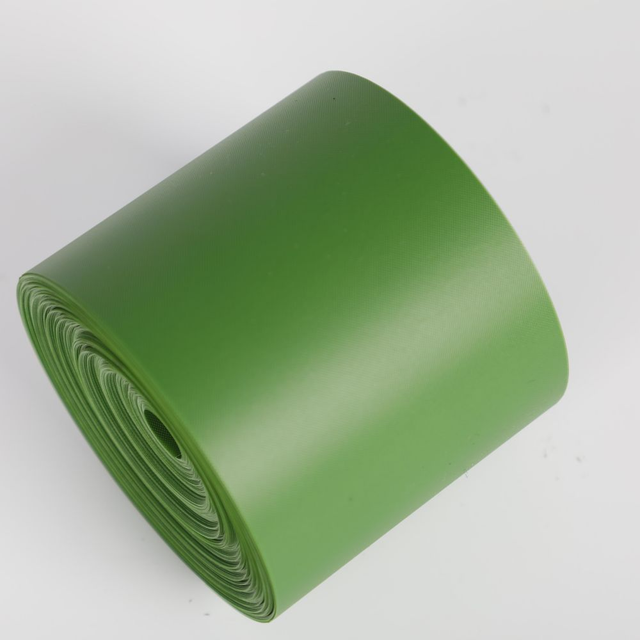
PVC Fence Grass Film Manufacturer for Artificial Hedge Production
HSQY supplies PVC fence grass film, also called green PVC rigid film, artificial grass fence film or PVC hedge film, for manufacturers of artificial grass fences, decorative hedge panels, balcony privacy screens, artificial leaves, wreaths and landscaping products.
The material is supplied as colored rigid PVC film in rolls or slit widths. It can be cut, embossed, shredded, twisted, woven, laminated or fixed to metal mesh and plastic substrates to create grass-like leaves and artificial hedge structures.
Quick answer: HSQY PVC fence film is a raw material for producing artificial grass fences and decorative foliage. It is not the same product as a finished PVC-coated privacy tape that consumers weave directly through a metal fence.
Current HSQY PVC Fence Film Product Range
The current category includes green, dark green and customizable PVC rigid films for artificial fences, artificial grass, turf decoration and related decorative foliage. Several products also overlap with the PVC film used for artificial Christmas tree leaves and wreaths.
| Representative Product | Main Positioning | Published Options | Recommended Buyer Check |
| Green PVC Film for Fence Grass and Artificial Trees | General-purpose green rigid PVC film for artificial grass, fences, trees and decorative leaves. | Green and dark green; customizable thickness, width, softness and surface. | Confirm outdoor UV package, final cutting method and grass-leaf stiffness. |
| Green PVC Rigid Sheet for Artificial Fence | Artificial fence and landscaping raw material. | Published header: 0.07–1.2 mm; detailed range: 0.15–1.2 mm; width from 15 mm to 1300 mm. | Confirm the final approved thickness range and tolerance. |
| Virgin PVC Rigid Film for Artificial Fence Grass | Virgin-grade PVC film for artificial fences, grass and foliage. | Green, dark green and customizable colors; matte or plain surface. | Confirm virgin-content declaration, additives, color and intended outdoor life. |
| UV-Resistant PVC Sheet for Artificial Grass Fence | Outdoor-oriented PVC film with optional UV stabilization. | Published detailed range: 0.15–1.2 mm; width 15–1300 mm. | Request UV test conditions instead of relying only on a general UV-resistant claim. |
| Light Green PVC Film for Artificial Grass Fence | Light-green decorative film for artificial fence and grass products. | Light green and custom shades. | Approve color under daylight and after accelerated weathering. |
Typical PVC Fence Grass Film Specifications
HSQY product pages contain a broad header range and a narrower detailed specification. The final quotation and technical data sheet should identify the actual production range for the selected formulation.
| Property | Published HSQY Information | Procurement Guidance |
| Material | Rigid polyvinyl chloride film. | Specify virgin, recycled or blended formulation and required regulatory limits. |
| Thickness | Some product headers state 0.07–1.2 mm; detailed descriptions commonly state 0.15–1.2 mm. | Define nominal thickness, tolerance and measuring method before ordering. |
| Width | Approximately 15–1300 mm, customizable. | Choose master-roll width or pre-slit width to match the cutting and grass-making equipment. |
| Colors | Green, dark green, brown and custom colors. | Approve a physical color standard; consider mixed light and dark green for a more natural effect. |
| Surface | Matte and plain are published; embossed or customized textures can be discussed. | Confirm gloss, emboss depth, two-side appearance and winding direction. |
| Density | Approximately 1.40 g/cm³ on current detailed product pages. | Use the approved formulation density when calculating roll length and cost. |
| Supply Format | Roll material, narrow slit rolls or customized packing. | Specify roll weight, core, diameter, splices and edge quality. |
| MOQ | Generally 1000 kg on current HSQY product pages. | Final MOQ depends on color, width, thickness, additive package and packing. |
| Published Capacity | Approximately 500,000 kg per month on selected product pages. | Confirm production allocation and delivery plan for repeat programs. |
| Published Lead Time | Approximately 7–15 days after deposit for selected specifications. | Confirm after color approval and raw-material scheduling. |
| Export Packing | Rolls, cartons and plywood pallets; selected pages reference 500–2000 kg per pallet. | Set pallet weight according to warehouse and unloading equipment. |
PVC Fence Grass Film vs Finished PVC Privacy Fence Tape
| Comparison | PVC Fence Grass Film Raw Material | Finished PVC Privacy Fence Tape |
| Product Form | Rigid or semi-rigid green PVC film roll used in manufacturing. | Finished strip or reinforced tape ready for fence installation. |
| Main Buyer | Artificial hedge factories, grass-fence manufacturers and decorative foliage producers. | Retailers, installers, homeowners and fence contractors. |
| Processing | Cutting, embossing, shredding, twisting, weaving, lamination or attachment to mesh. | Woven directly through a wire fence and secured with clips. |
| Typical Width | Can be narrow slits or master rolls up to approximately 1300 mm. | Often supplied in finished widths matched to specific fence-panel spacing. |
| Specification Focus | Thickness, stiffness, color, UV package, surface, slitting and roll quality. | Finished strip width, length, clips, wind load and installation compatibility. |
| HSQY Category Intent | Raw green film for artificial grass fence and decorative foliage production. | Not the primary product represented by this category. |
How Artificial Grass Fence Film Is Processed
Color and grade selection: The manufacturer selects green shades, PVC grade, UV package, stiffness and surface.
Roll slitting: Master rolls are slit to widths that match the leaf-cutting or fence-production equipment.
Embossing or texturing: A matte or embossed surface can reduce plastic-like glare and create a more natural appearance.
Leaf or grass cutting: The film is cut or shredded into strips, blades or leaf shapes.
Forming and twisting: Cut strips may be twisted, curled or shaped to add volume and visual density.
Assembly: The artificial foliage is woven, tied, laminated or attached to metal mesh, wire fencing or plastic backing.
Finished-product testing: The fence or hedge panel is checked for coverage, color, pull strength, outdoor durability and packaging stability.
Main Applications
Artificial grass fence rolls
Artificial hedge and privacy-screen panels
Balcony and terrace decorative screens
Garden and landscape fence decoration
Construction-site greening screens
Artificial grass wall and foliage panels
Artificial turf edging and decorative belts
Artificial Christmas tree leaves
Wreaths, garlands and seasonal foliage
Commercial display and event decoration
How to Select the Correct Thickness
| Thickness Selection Factor | Effect on Processing and Finished Product |
| Leaf Stiffness | Thicker material generally produces firmer leaves and stronger shape retention. |
| Cutting Speed | Very thick or hard film may require more cutting force and can increase blade wear. |
| Finished Fence Density | Thin film can produce more leaves per kilogram but may appear softer or less rigid. |
| Outdoor Wind | The finished fence structure must balance flexibility with tear and pull resistance. |
| Embossing | Texture depth and definition depend on gauge, temperature and surface formulation. |
| Cold-Weather Handling | The formulation and thickness affect flexibility and brittleness at low temperature. |
| Cost per Finished Panel | Gauge influences material consumption, processing speed and freight weight. |
A sample should be processed on the actual cutting, embossing or weaving equipment. Selecting thickness only from a catalog value can lead to leaves that are too soft, too stiff, difficult to cut or inconsistent in appearance.
How to Select Film Width and Roll Format
Match the master-roll or slit width to the production machine.
Include edge-trim allowance and usable-width tolerance.
Define roll weight and maximum roll diameter.
Specify paper-core or plastic-core inner diameter.
Confirm winding direction and which surface faces outward.
Set limits for splices, telescoping and edge misalignment.
Specify whether rolls require individual cartons, woven bags or pallet packing.
Confirm how operators will lift and load rolls onto the machine.
Green Color Matching for Artificial Fences
A realistic grass fence rarely depends on one green value alone. Light green, dark green, yellow-green and brown accents can be combined to create depth and reduce an artificial appearance.
Provide a physical color chip, finished fence sample or approved Pantone reference.
Evaluate color under daylight, indoor lighting and retail display lighting.
Approve both surface color and color through the film thickness.
Define acceptable lot-to-lot color variation.
Test color after UV exposure, heat and outdoor weathering.
Confirm whether recycled content changes color consistency.
Keep retained samples from every approved production batch.
Matte, Plain, Glossy and Embossed Surface Options
| Surface | Visual Effect | Processing Consideration |
| Matte | Reduces glare and can create a more natural foliage appearance. | Check scratch appearance, roll blocking and emboss consistency. |
| Plain / Smooth | Simple surface for cutting, twisting and general decoration. | May show more reflected light depending on gloss level. |
| Glossy | Produces stronger color saturation and a brighter decorative effect. | Can appear more plastic-like outdoors and may show surface marks. |
| Embossed | Adds texture and can simulate veins or grass patterns. | Requires controlled emboss depth, roll temperature and pattern registration. |
| Custom Texture | Supports differentiated artificial-leaf and fence designs. | New texture rollers, MOQ and sampling may be required. |
UV Resistance and Outdoor Weathering
UV resistance is not an automatic property of every green PVC film. It depends on the stabilizer package, pigment, film thickness, climate, exposure angle, temperature and finished fence construction.
Competitor pages commonly market three-to-five-year outdoor life, but such a period should only be stated when supported by a defined formulation, accelerated-weathering results and field conditions. HSQY buyers should request test conditions rather than an unsupported universal service-life promise.
Specify the destination climate and expected outdoor exposure.
Define whether the application is full sun, partial shade or indoor decoration.
Request accelerated UV or xenon-arc weathering data where required.
Check color change, gloss loss, cracking, tensile retention and brittleness.
Evaluate both light-green and dark-green colors.
Test the completed fence because mesh tension and wind affect performance.
Establish a warranty only after the formulation and test method are agreed.
Water, Humidity and Chemical Resistance
Rigid PVC has low water absorption and is commonly used for outdoor decorative products. The film formulation should still be tested against cleaning agents, fertilizers, pool chemicals, salt spray or industrial contaminants expected in the final environment.
Water resistance of the film does not automatically make the finished fence maintenance-free. Wire corrosion, attachment failure, dirt accumulation and wind damage depend on the completed fence system.
Virgin, Recycled and Blended PVC Grades
| Grade Concept | Possible Benefit | Buyer Consideration |
| Virgin PVC Grade | More controlled formulation, color consistency and traceability. | Usually higher raw-material cost; verify additive and compliance requirements. |
| Virgin/Recycled Blend | Can reduce virgin-material consumption and cost. | Color, odor, mechanical properties and outdoor aging require validation. |
| Higher Recycled Content | Supports selected cost or circularity targets. | May increase variation and should not be used for demanding claims without testing. |
| Custom Environmental Grade | Can target restricted-substance or market-specific requirements. | Define the regulation and test list rather than using the vague term “eco-friendly.” |
Do not describe PVC film as environmentally friendly solely because it may be recyclable or contain recycled material. Environmental claims should identify the recycled percentage, source, applicable test method and local recovery route.
Optional Flame-Retardant Formulations
PVC is naturally difficult to ignite compared with many hydrocarbon plastics, and suppliers may offer additional flame-retardant formulations. A specific B1, V-0, V-2, NFPA or other rating should only be used when the exact product has been tested to the named standard and thickness.
Outdoor artificial fence film and indoor decorative foliage may require different fire-performance specifications. Buyers should provide the intended location and required standard before formulation selection.
PVC Fence Grass Film vs PE and PET Film
| Material | Main Strength | Potential Limitation | Best Evaluation Point |
| PVC Rigid Film | Good colorability, embossing, stiffness control, welding and decorative processing. | Requires careful additive and recycling management. | Cutting, embossing, outdoor aging and finished-leaf appearance. |
| PE Film | Low density, flexibility and good moisture resistance. | Different stiffness, bonding and embossing behavior. | Leaf recovery, attachment method and UV formulation. |
| PET Film | Higher stiffness and dimensional stability in selected grades. | May be less ductile for certain twisting and artificial-leaf processes. | Cutting performance, leaf yield and crease behavior. |
Quality Control for PVC Fence Film Rolls
| Quality Check | Why It Matters |
| Material and Formulation | Confirms PVC grade, plasticizer level, pigments, stabilizers and recycled content. |
| Thickness Profile | Controls stiffness, leaf yield, cutting load and finished-product consistency. |
| Width and Slitting | Prevents tracking problems and uneven artificial-grass strips. |
| Color Difference | Maintains a consistent hedge appearance across panels and production lots. |
| Surface and Embossing | Controls natural appearance, gloss and pattern consistency. |
| Tensile and Tear Performance | Reduces breakage during cutting, twisting, weaving and outdoor use. |
| Shrinkage and Dimensional Stability | Prevents distortion during storage and production. |
| Roll Winding | Controls telescoping, wrinkles, blocking and machine feeding. |
| Outdoor Aging | Evaluates color change, cracking and retained mechanical properties. |
| Batch Traceability | Links the delivered roll to raw materials, production data and inspection records. |
Common Production Problems and Corrective Actions
| Problem | Possible Causes | Recommended Checks |
| Film Breaks During Cutting | Film too brittle, low temperature, inconsistent thickness or excessive recycled content. | Check formulation, gauge profile, storage temperature and cutter condition. |
| Leaves Are Too Soft | Gauge too thin or formulation too flexible. | Increase stiffness or thickness after line trials. |
| Leaves Are Too Stiff | Gauge too thick, hard formulation or cold processing. | Adjust thickness, formulation and processing temperature. |
| Green Color Varies | Pigment dispersion, recycled-material variation or batch-control issues. | Use approved color standards and batch testing. |
| Surface Looks Too Glossy | Incorrect surface formulation or embossing settings. | Specify matte level and approve a production sample. |
| Film Fades Outdoors | Insufficient UV package, unstable pigment or severe climate. | Review stabilizers and weathering test results. |
| Roll Telescopes | Uneven winding tension, poor core alignment or handling damage. | Control winding and pallet transport. |
| Film Sticks in the Roll | Excessive heat, pressure, surface tack or storage conditions. | Review formulation, winding pressure and warehouse temperature. |
Sample Evaluation for Artificial Grass Fence Manufacturers
Verify dimensions: Measure thickness, width, roll weight and core size.
Approve color: Compare the sample under daylight and with the completed fence design.
Run the actual machine: Test slitting, cutting, embossing, twisting or weaving at commercial speed.
Measure material yield: Record finished leaves or fence length per kilogram.
Test pull and tear performance: Evaluate breakage during production and assembly.
Build a finished panel: Check coverage, density, appearance and attachment strength.
Run outdoor testing: Include UV, rain, heat, cold and wind conditions appropriate to the market.
Test packing: Confirm that rolls and finished fence panels recover after transport compression.
Approve a golden sample: Link the sample to the color, thickness, width, surface and formulation specification.
Packing and Export Logistics
HSQY product pages reference small sample rolls, plastic wrapping, cartons, plywood pallets and container-scale shipments. Packing should be selected according to roll weight, customer equipment and unloading conditions.
Roll weight and roll length
Core inner diameter and core length
Maximum roll diameter
Plastic film, PE foam, carton or woven-bag protection
Plywood pallet dimensions and weight limit
Edge protection and anti-telescoping measures
Moisture and dust protection
Batch labels, barcodes and shipping marks
20-foot or 40-foot container loading plan
Storage temperature and maximum stacking height
Why Choose HSQY for PVC Fence Grass Film?
Green, dark green, brown and customizable PVC colors
Published thickness coverage from approximately 0.07 mm to 1.2 mm, subject to grade confirmation
Custom widths from approximately 15 mm to 1300 mm
Matte, plain and customizable surface options
Virgin, blended and recycled-grade project options
Optional UV-resistant and flame-retardant formulations
Slit rolls, master rolls and export packing
Sample support for cutting, embossing and artificial-fence production trials
Published MOQ around 1000 kg for standard projects
Bulk export supply for artificial hedge, fence and foliage manufacturers
Related material categories include PVC Christmas tree film, PVC lawn film, PVC color sheet and PVC sheet.
Request Samples and a Bulk Quotation
To receive an accurate recommendation and quotation, provide:
Finished artificial fence, hedge or leaf application
Required thickness and tolerance
Master-roll or slit-roll width
Roll weight, diameter and core size
Green shade or physical color sample
Matte, plain, glossy or embossed surface
Required stiffness or softness
Virgin, recycled or blended formulation
UV-resistance and outdoor-life target
Flame-retardant or restricted-substance requirements
Cutting, embossing, twisting or weaving equipment
Monthly order quantity and annual forecast
Packing method, destination port and Incoterms
Contact HSQY
FAQ About PVC Fence Grass Film
What is PVC fence grass film?
It is a colored rigid PVC film used as raw material for artificial grass fences, hedge panels, decorative foliage and related landscaping products.
Is this product a finished privacy fence tape?
No. This category mainly contains raw PVC film for artificial grass and hedge production, not a consumer-ready reinforced fence tape with installation clips.
What is PVC fence grass film used for?
It is used for artificial grass fences, hedge panels, balcony screens, grass walls, artificial leaves, wreaths and decorative greenery.
What thicknesses does HSQY offer?
Current HSQY headers show approximately 0.07–1.2 mm, while detailed specifications commonly show 0.15–1.2 mm. Confirm the final grade and tolerance.
What widths are available?
HSQY publishes customizable widths from approximately 15 mm to 1300 mm.
What colors are available?
Green, dark green, brown and custom colors are available. Mixed green shades can be developed for a natural grass effect.
Can the film be embossed?
Matte, plain and customized textured or embossed surfaces can be discussed according to the finished foliage design.
Is PVC fence grass film UV resistant?
UV-resistant formulations are available, but performance depends on the additive package, pigment, thickness, climate and test conditions.
How long does the film last outdoors?
Outdoor life cannot be stated universally. It depends on formulation, sunlight, climate, fence construction and the agreed weathering test.
Is the film waterproof?
Rigid PVC has low water absorption and is suitable for many outdoor applications, but the completed fence system must also be evaluated.
Can the film be used in cold climates?
It can be formulated for outdoor use, but low-temperature flexibility and impact resistance should be tested for the destination climate.
Can the film be slit into narrow rolls?
Yes. Custom slit widths can be supplied to match leaf-cutting, twisting, weaving and fence-production equipment.
What roll information is needed?
Provide width, roll weight, outer diameter, core size, winding direction, splice limit and packing requirements.
Can the film be made from virgin PVC?
Yes. Virgin-grade products are available, subject to the selected formulation and project requirements.
Can recycled PVC be used?
Recycled or blended grades can be considered, but color, odor, mechanical performance and outdoor aging must be validated.
Is PVC fence film recyclable?
PVC may be recyclable where suitable collection and processing systems exist. The actual recovery route depends on the complete product and local infrastructure.
Is the film flame retardant?
Optional flame-retardant formulations may be available. A specific rating should only be claimed after testing the exact grade to the named standard.
What is the difference between matte and glossy film?
Matte film reduces glare and often looks more natural, while glossy film produces brighter color and stronger reflections.
How do I choose the right thickness?
Base the decision on leaf stiffness, cutting speed, finished-fence density, wind exposure, embossing and target cost per panel.
Can HSQY match a custom green color?
Yes. Provide a physical sample or color reference and define the acceptable lot-to-lot color tolerance.
What is the MOQ?
HSQY product pages generally publish an MOQ of 1000 kg. Final MOQ depends on thickness, width, color, formulation and packing.
What is the typical lead time?
Selected HSQY pages reference approximately 7–15 days after deposit, subject to color approval, quantity and production scheduling.
Can I request samples?
Yes. A useful sample should be tested on the actual cutting, embossing or fence-production equipment.
What documents can be supplied?
Product specifications, quality records and applicable test documents can be discussed for the selected grade and order.
What information is needed for a quotation?
Provide application, thickness, width, color, surface, stiffness, UV target, formulation, roll packing, quantity and destination.