What Is Plain PET/BOPET Film?
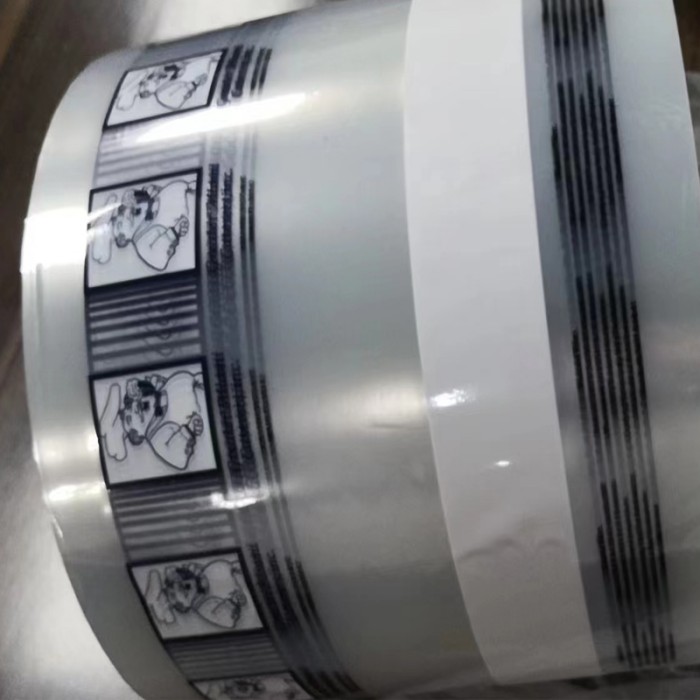
Plain PET/BOPET film is a clear biaxially oriented polyester base film supplied without a functional heat-seal coating, printing primer, release coating, metallized layer, or other specialty surface finish unless specifically requested. During production, the PET film is stretched in both the machine direction and transverse direction to improve tensile strength, stiffness, dimensional stability, clarity, and converting performance.
HSQY supplies plain clear BOPET film rolls for flexible packaging conversion, printing, adhesive lamination, extrusion lamination, industrial coating, metallizing, electrical insulation, holography, pressure-sensitive tapes, labels, release-film conversion, and other industrial applications.
Important: plain BOPET film is normally a base substrate rather than a finished heat-sealing film. Applications requiring direct heat sealing, easy peel, anti-fog, oxygen barrier, release performance, food-contact compliance, or strong ink adhesion may require corona treatment, chemical coating, coextrusion, metallization, lamination, or another specialty grade.

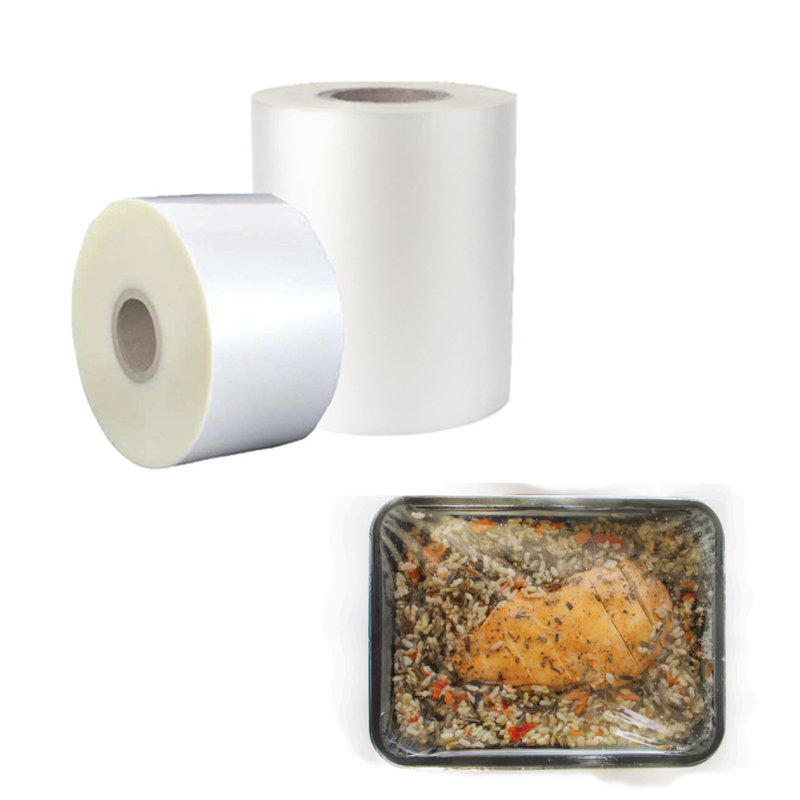
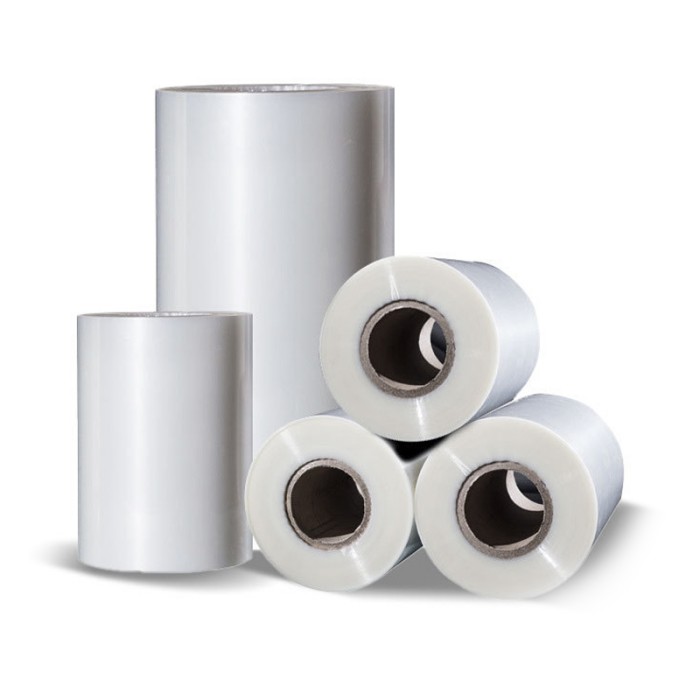
Plain Clear BOPET Base Film

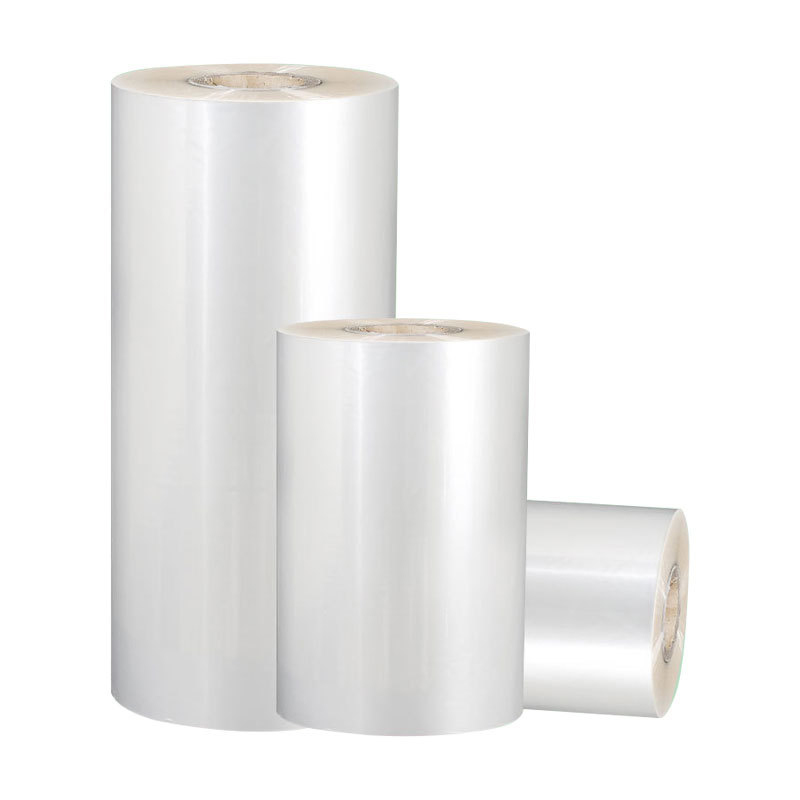
Custom Jumbo and Slit Rolls

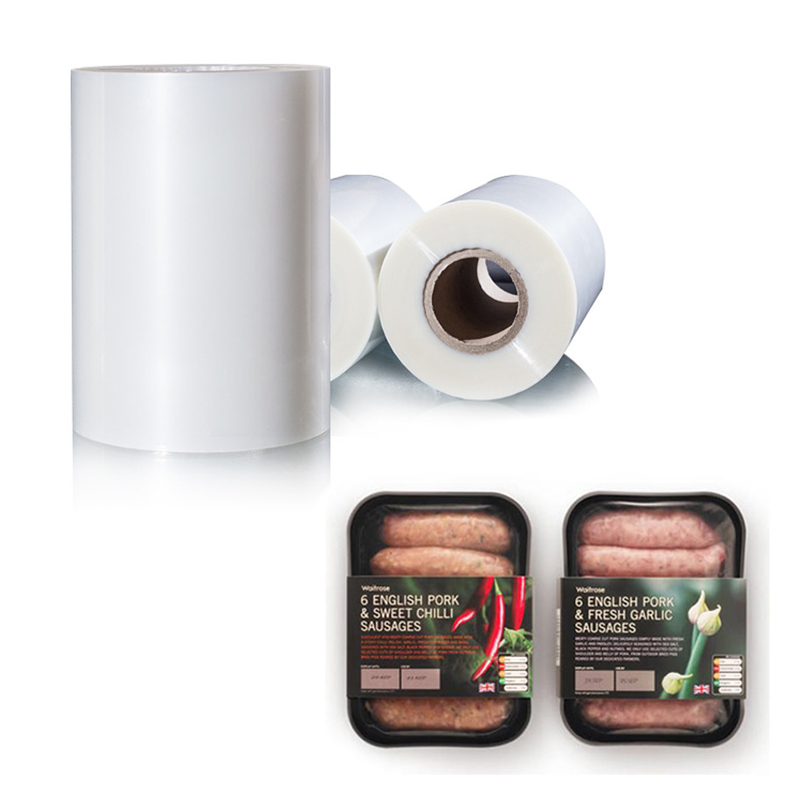
Printing, Lamination, and Coating Substrate
PET Film vs. BOPET Film
PET is the polymer name, polyethylene terephthalate. BOPET means biaxially oriented PET film. The orientation process aligns the polymer structure in two directions and gives the film improved mechanical strength, stiffness, dimensional stability, optical properties, and processing performance compared with non-oriented PET film.
In commercial searches, the terms PET film, polyester film, BOPET film, and biaxially oriented polyester film are often used for similar roll-film products. Buyers should still confirm whether they require plain untreated film, corona-treated film, chemically coated film, heat-sealable film, metallizable film, release film, or another specialty grade.
Key Properties of Plain Clear BOPET Film
High tensile strength: Supports high-speed printing, lamination, coating, slitting, and rewinding.
Dimensional stability: Helps maintain web registration and shape during downstream conversion.
Optical clarity and gloss: Suitable for transparent packaging structures, labels, graphic applications, and decorative conversion.
Chemical resistance: Offers useful resistance to many oils, greases, and common converting chemicals, subject to application testing.
Good gas and aroma barrier: Provides a useful base layer in flexible packaging laminates, although final barrier depends on the complete structure.
Surface consistency: Supports controlled coating weight, metallization, lamination, and printing after appropriate treatment.
Electrical insulation: Suitable grades can be used for electrical, electronic, cable, and insulation applications.
Custom conversion: Thickness, width, length, core, winding direction, roll weight, and surface treatment can be configured.
Plain BOPET Film Specifications
The following table combines the current commercial information on this product page with recommended purchasing specifications. Final guaranteed values, tolerances, and test methods should be confirmed in the approved technical data sheet and purchase order.
| Property |
Standard or Available Option |
Purchasing Note |
| Product Type |
Plain clear PET/BOPET polyester base film |
Not a finished sealing film unless a special heat-seal grade is ordered |
| Material |
Biaxially oriented polyethylene terephthalate |
Virgin, recycled-content, or specialty resin options require confirmation |
| Current Nominal Size |
0.06mm × custom width |
0.06mm equals 60 microns; confirm the actual production grade |
| Available Thickness |
0.05–0.10mm currently listed; other gauges subject to production capability |
Specify thickness tolerance and profile requirements |
| Standard Roll Widths |
150mm, 230mm, 280mm, or customized |
Jumbo-roll and slit-roll widths should match the converting line |
| Standard Roll Length |
500m or customized |
Confirm roll weight, maximum diameter, and core ID |
| Appearance |
Clear / transparent |
Specify haze, gloss, clarity, gels, scratches, and contamination limits |
| Surface |
Plain untreated; optional corona treatment or customized coating subject to confirmation |
State which side requires treatment and the target dyne level |
| Heat-Seal Performance |
Not inherent in plain BOPET film |
Order a heat-sealable, coated, coextruded, or laminated grade for sealing applications |
| Printing |
Printable after suitable surface treatment, primer, or ink-system validation |
Confirm gravure, flexographic, UV, digital, or screen-printing process |
| Lamination |
Suitable as a base for adhesive, extrusion, and thermal lamination after process validation |
Specify adhesive chemistry, cure conditions, bond target, and partner substrate |
| Core and Winding |
Customized |
Provide core ID, core material, winding direction, and side identification |
| Minimum Order Quantity |
500kg |
Sample or trial quantities depend on available stock |
| Typical Lead Time |
Approximately 10–14 working days |
Subject to specification, treatment, slitting, quantity, and production schedule |
| Delivery Terms |
EXW, FOB, CIF/CNF, DDU, or door-to-door |
Confirm destination and shipment size |
Plain, Treated, Coated, and Heat-Sealable BOPET Film
Professional BOPET manufacturers separate plain film from treated, coated, metallizable, and heat-sealable grades because each downstream process requires different surface energy, adhesion, slip, thermal, optical, and sealing properties.
| Film Grade |
Surface Description |
Typical Uses |
Key Limitation |
| Plain BOPET Film |
No functional coating or special heat-seal layer |
General converting, industrial coating, lamination, insulation, and base-film applications |
Ink, adhesive, or seal performance may require treatment or primer |
| Corona-Treated BOPET |
One or both surfaces treated to increase surface energy |
Printing, adhesive lamination, extrusion coating, and general conversion |
Treatment level can decay during storage; dyne level must be verified |
| Chemically Coated BOPET |
Primer or functional coating applied for improved adhesion or performance |
Special inks, adhesives, silicone release, UV printing, metallization, and specialty conversion |
Coating must be compatible with the customer's chemistry and process |
| Metallizable BOPET |
Surface engineered for metal deposition and adhesion |
Barrier packaging, decorative films, insulation, and reflective applications |
Metal adhesion and barrier must be tested after vacuum deposition |
| Heat-Sealable BOPET |
Coextruded, coated, or laminated heat-seal layer |
Lidding, pouches, overwraps, and seal-to-self or seal-to-tray applications |
Sealant must match the tray or sealing substrate |
| Release BOPET Film |
Silicone or other low-surface-energy release coating |
Adhesive tapes, labels, die cutting, composites, and electronic processing |
Release force must match the adhesive and application |
Applications of Plain BOPET Film
Printing and flexible packaging lamination: Used as the outside print web or structural layer after suitable treatment.
Adhesive and extrusion lamination: Combined with PE, CPP, foil, paper, nylon, or other substrates to create functional laminates.
Vacuum metallization: Used as a base for aluminium deposition in barrier, decorative, and reflective films after grade verification.
Industrial coating: Supports primers, release coatings, adhesives, protective coatings, conductive coatings, and other functional layers.
Labels and graphic arts: Used for transparent labels, overlays, printing sheets, decorative media, and visual communication.
Electrical and thermal insulation: Used in cables, motors, transformers, electronics, and insulation laminates when the grade meets the required standards.
Pressure-sensitive tapes and release conversion: Serves as a strong, dimensionally stable backing or liner after coating.
Holography, hot stamping, and metallic yarn: Provides a stable substrate for embossing, coating, metallization, and slitting.
How to Select BOPET Film for Printing and Lamination
| Selection Item |
Why It Matters |
Information to Provide |
| Printing Method |
Different inks require different surface energy, primer, curing, and adhesion performance |
Gravure, flexo, UV offset, screen, digital, solvent, water-based, or UV ink |
| Lamination Process |
Adhesive chemistry and curing conditions affect bond strength and appearance |
Solvent-based, solvent-free, water-based, extrusion, or thermal lamination |
| Partner Substrate |
The laminate structure controls sealability, barrier, stiffness, puncture resistance, and recyclability |
PE, CPP, BOPP, aluminium foil, paper, nylon, PET, coated board, or another material |
| Surface Treatment |
Insufficient treatment can cause poor ink or adhesive adhesion |
Treated side, target dyne level, primer requirement, and treatment-retention period |
| Optical Requirements |
Clarity, haze, gloss, and visual defects affect package and graphic appearance |
Maximum haze, minimum gloss, transparency, color, and defect limits |
| Thermal Conditions |
Heat can cause shrinkage, distortion, curling, or loss of registration |
Drying temperature, dwell time, hot-fill, sterilization, retort, or processing cycle |
Critical Quality Requirements
Thickness profile: Affects roll build, coating weight, stiffness, and downstream registration.
Tensile strength and elongation: Determine web-break resistance and processability.
Heat shrinkage: Important for drying ovens, printing, lamination, coating, electronics, and high-temperature conversion.
Coefficient of friction: Influences unwinding, winding, web transport, blocking, and machine speed.
Surface tension: Controls ink, adhesive, primer, and coating adhesion.
Optical quality: Includes haze, gloss, clarity, color, gels, scratches, black spots, and contamination.
Roll quality: Includes edge alignment, telescoping, wrinkles, core condition, roll hardness, joints, and winding direction.
Information Required for an Accurate Quotation
Provide the following details so HSQY can recommend the correct plain BOPET grade and roll configuration:
Final application and converting process
Required thickness and thickness tolerance
Jumbo-roll width or finished slit width
Roll length, roll weight, core ID, and maximum roll diameter
Plain untreated, one-side treated, two-side treated, or coated surface
Required dyne level and which side will be printed, laminated, coated, or metallized
Optical, mechanical, shrinkage, COF, barrier, electrical, or cleanliness requirements
Food-contact, electrical, industrial, or destination-market compliance documents required
Trial quantity, annual demand, destination port, and requested delivery date
Request BOPET Film Samples and Pricing
Custom Plain BOPET Film Services
Custom thickness, jumbo-roll width, and slit-roll width
Custom roll length, roll weight, core, and outer diameter
Plain, corona-treated, or customized coated surface options
Custom winding direction and treated-side identification
Custom cartons, roll labels, pallet marks, and private-label export packaging
Sample evaluation and converting-trial support
EXW, FOB, CIF/CNF, DDU, and door-to-door delivery support
Quality and Compliance Documentation
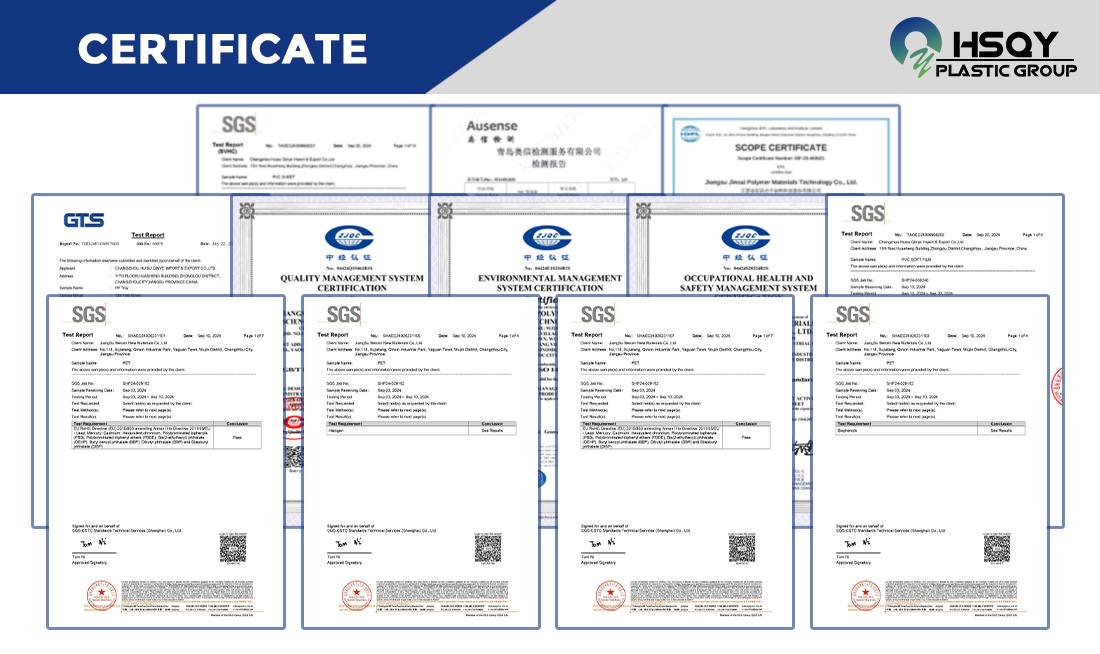
HSQY can provide available quality-management, inspection, and material documents for the supplied BOPET grade. Buyers should request the technical data sheet, certificate of analysis, safety data sheet, roll inspection criteria, and any application-specific declarations required for food packaging, electrical insulation, electronics, printing, or industrial use.
ISO 9001 is a quality-management-system certification and should not be presented as a substitute for product-specific food-contact, electrical, or application compliance documentation.
![HSQY PET BOPET film certificates and quality documentation]()
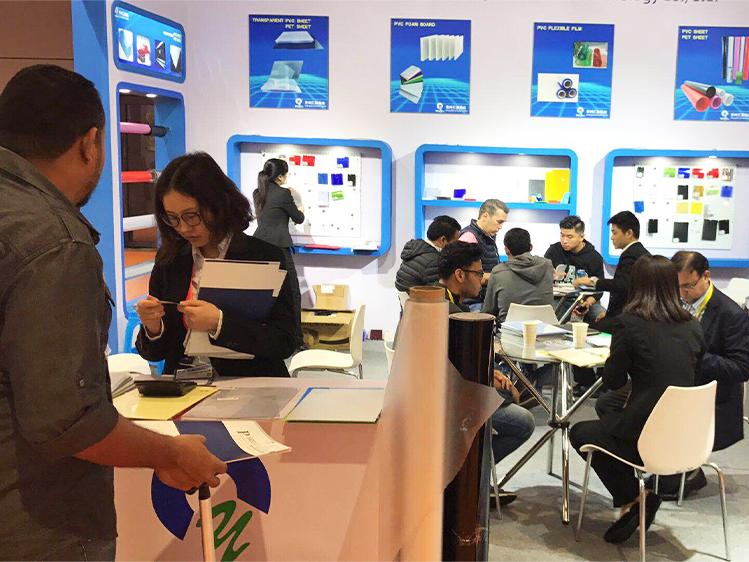
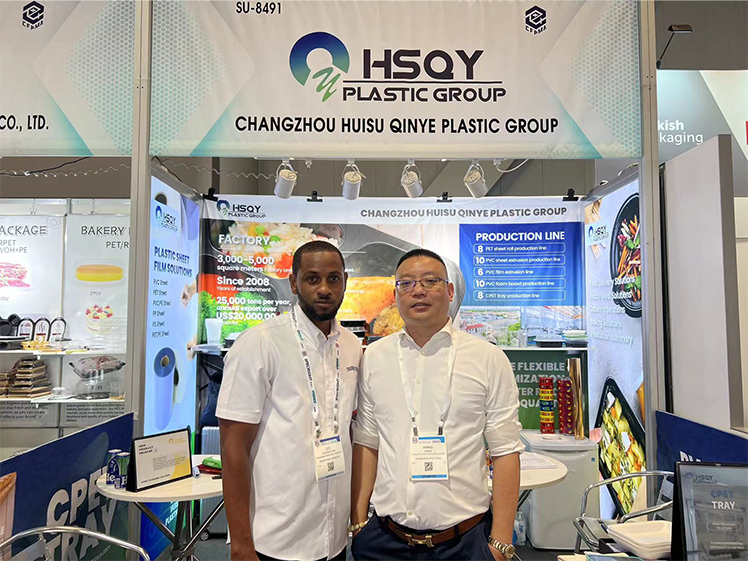
HSQY International Exhibitions
Production and Packing
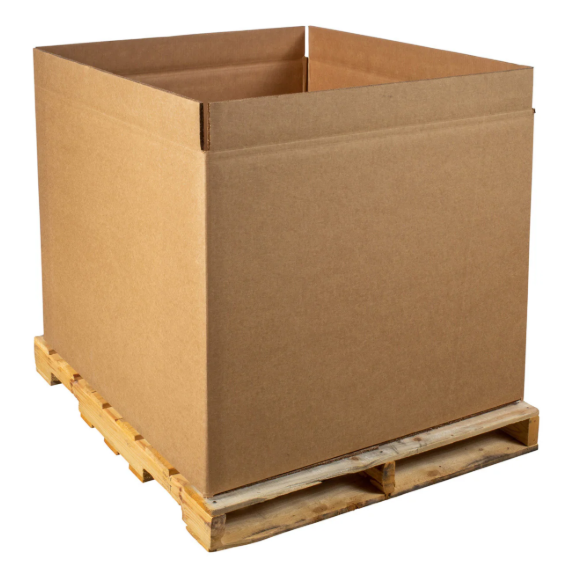
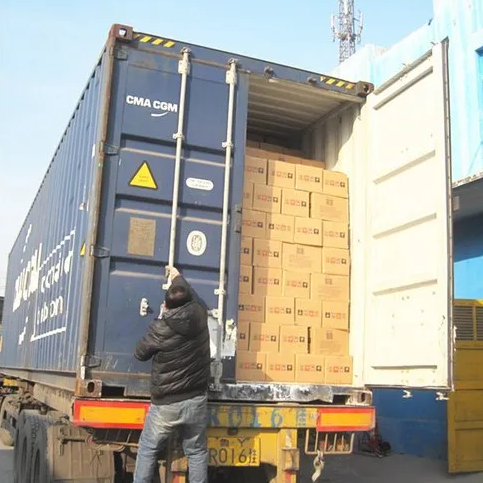
Packing and Delivery
Sample Packaging: Film samples or small rolls are protected against dust, moisture, scratching, creasing, and edge damage.
Bulk Roll Packing: Rolls are wrapped in protective PE film, kraft material, cartons, or another suitable export format.
Pallet Packing: Approximately 500–2000kg per plywood pallet may be used depending on width, diameter, roll weight, and transport requirements.
Roll Identification: Labels can show grade, thickness, width, length, lot number, net weight, treated side, winding direction, and production date.
Delivery Terms: EXW, FOB, CIF/CNF, DDU, and door-to-door delivery can be discussed.
Lead Time: Generally 10–14 working days after deposit and final specification approval, subject to slitting, treatment, quantity, and production schedule.
Frequently Asked Questions
What does plain BOPET film mean?
Plain BOPET film is a biaxially oriented polyester base film without a special heat-seal layer, metallized surface, release coating, anti-fog coating, or other functional coating unless those features are ordered separately.
Is PET film the same as BOPET film?
PET identifies the polymer. BOPET is PET film that has been biaxially oriented in two directions. In the film industry, “polyester film,” “PET film,” and “BOPET film” are often used interchangeably, but the exact film construction and treatment should always be confirmed.
Is plain BOPET film heat sealable?
Plain BOPET film is generally not directly heat sealable. A heat-sealable coating, coextruded layer, or laminate such as PET/PE or PET/CPP is normally required for lidding, pouch sealing, or seal-to-self applications.
Can plain BOPET film be printed?
Yes, after confirming surface treatment, primer, ink chemistry, curing process, and adhesion requirements. Corona-treated or chemically coated film may provide more reliable ink adhesion than untreated film.
What is the difference between untreated and corona-treated BOPET film?
Untreated film has its natural surface energy. Corona treatment increases surface energy to improve wetting and adhesion for inks, adhesives, coatings, and extrusion polymers. The required treated side and dyne level should be stated in the order.
Can plain BOPET film be laminated with PE or CPP?
Yes. BOPET is commonly laminated with PE, CPP, BOPP, aluminium foil, paper, nylon, and other substrates. The film treatment, adhesive system, cure conditions, bond strength, and final package requirements must be validated.
Can the film be used for metallizing?
A suitable metallizable BOPET grade can be used for vacuum deposition of aluminium or other layers. Plain film should be evaluated for metal adhesion, barrier performance, winding quality, and the metallizer's process conditions before commercial use.
Is 60 micron BOPET film available?
The current page lists a nominal size of 0.06mm, which equals 60 microns. Buyers should confirm the final thickness tolerance, width, length, surface, and mechanical requirements before ordering.
Can HSQY customize the roll width and length?
Yes. Width, length, core ID, roll weight, maximum roll diameter, winding direction, and treated-side orientation can be customized subject to production and slitting feasibility.
Is plain BOPET film suitable for food packaging?
BOPET is widely used in packaging structures, but food-contact suitability must be confirmed for the exact resin, additives, coatings, inks, adhesives, laminate structure, intended food, temperature, and destination-market regulations. Request grade-specific documentation.
Is plain BOPET film recyclable?
BOPET is a PET-based material, but practical recyclability depends on local collection and recycling infrastructure and on whether the final product is a mono-material film or a multilayer laminate containing inks, adhesives, coatings, metals, or other polymers.
Which technical values should be confirmed before bulk ordering?
Confirm thickness profile, tensile strength, elongation, heat shrinkage, haze, gloss, coefficient of friction, surface tension, treatment retention, roll hardness, edge quality, allowable joints, cleanliness, and any application-specific barrier or electrical values.
What is the MOQ and lead time?
The current stated MOQ is 500kg. Typical lead time is approximately 10–14 working days after deposit and final specification approval. Special treatment, coating, slitting, or packaging may require additional time.
Can I request a sample for printing or lamination testing?
Yes, subject to stock and requested specification. Provide the printing, coating, lamination, metallizing, or industrial process; required thickness and width; treated side; core; and trial quantity so HSQY can evaluate the sample configuration.
How should BOPET film rolls be stored?
Store rolls in their original protective packaging in a clean, dry area away from direct sunlight, excessive heat, moisture, dust, solvents, and strong odors. Keep rolls properly supported and allow cold-stored material to acclimatize before opening to reduce condensation.
About HSQY Plastic Group
HSQY Plastic Group supplies PET and BOPET films, flexible packaging films, plastic sheets, thermoformed food trays, and related plastic materials for international B2B customers.
The team can support film-grade selection, surface treatment, roll conversion, custom dimensions, samples, inspection documentation, export packing, and international delivery for printing companies, flexible packaging converters, laminators, coaters, metallizers, distributors, and industrial manufacturers.
Contact HSQY for BOPET Film