PET/PE Laminated Thermoforming Film Video
Watch the video below to learn more about HSQY PET/PE laminated thermoforming film, roll specifications, material structure and food-packaging applications.
What Is PET/PE Laminated Thermoforming Film?
PET/PE laminated film is a multilayer rigid packaging material that combines an amorphous polyethylene terephthalate substrate with a polyethylene sealing layer. It is also described as APET/PE film, PET laminated PE sheet, PET/PE bottom web or PET/PE thermoforming rollstock.
The APET layer provides transparency, stiffness, impact resistance and thermoforming performance. The PE layer creates a heat-sealable surface and improves resistance to moisture, liquids and package leakage.
HSQY supplies clear PET/PE laminated film with a standard total thickness range of approximately 0.23 mm to 0.58 mm. The standard structure uses an APET substrate laminated with an approximately 50 μm LDPE sealing layer.
The material is supplied in rolls with customized widths, roll diameters and winding specifications. Standard paper-core options include 3-inch and 6-inch cores for compatibility with thermoforming and form-fill-seal packaging equipment.
PET/PE thermoforming film is commonly used for chilled and frozen meat, fish, seafood, cheese, dairy products, fresh pasta, prepared foods and other products that require a transparent rigid tray with a reliable heat-sealing surface.
Weld-seal and peelable structures can be developed according to the lidding film, tray-sealing equipment, storage conditions and required opening force.
Standard PET/PE film should not automatically be described as a high-oxygen-barrier material. Applications requiring extended shelf life or very low oxygen transmission may require PET/EVOH/PE or another tested high-barrier structure.
Request PET/PE Film Pricing Request Material Samples
PET/PE Laminated Film Images

Clear PET/PE Thermoforming Film Roll

APET/PE Laminated Food Packaging Film
PET/PE Laminated Film Technical Data Sheet
Download the available data sheet for preliminary evaluation. Buyers should confirm that the document applies to the exact thickness, PE-layer specification, sealing grade and production batch being ordered.
Download PET/PE Laminated Film Data Sheet
PET/PE Laminated Film Specifications
| Property |
Available Specification |
| Product Name |
PET/PE Laminated Film for Thermoforming and Food Packaging |
| Alternative Names |
APET/PE film, PET laminated PE sheet, PET/PE bottom web and PET/PE thermoforming rollstock |
| Standard Structure |
APET substrate with LDPE sealing layer |
| Standard PE Layer |
Approximately 50 μm LDPE |
| Custom PE Layer |
Subject to seal strength, peel performance, film compatibility and minimum-order requirements |
| Total Thickness |
Approximately 0.23-0.58 mm |
| Example Structures |
180/50 μm, 200/50 μm, 250/50 μm, 300/50 μm, 400/50 μm and customized combinations |
| PET Material Options |
Virgin APET or RPET-containing structure subject to clarity, compliance and recycling-content requirements |
| Appearance |
Clear, transparent, tinted or customized color |
| Surface |
Glossy, matte, silicone-coated, anti-block or customized treatment |
| Supply Form |
Thermoforming rolls, slit rolls or custom-cut sheets |
| Roll Width |
Customized according to thermoforming-machine and trim-tool requirements |
| Core Diameter |
3-inch or 6-inch core |
| Roll Diameter |
Customized according to machine capacity, roll weight, core and transportation requirements |
| Roll Weight |
Approximately 50 kg or customized for automatic production lines |
| Sealing Grade |
Weld-seal, lock-seal or peelable grade subject to lidding-film compatibility |
| Processing Methods |
Thermoforming, vacuum forming, pressure forming and form-fill-seal processing |
| Standard Applications |
Meat, fish, seafood, cheese, dairy products, fresh pasta, prepared foods and chilled or frozen products |
| High-Barrier Option |
PET/EVOH/PE or another tested multilayer structure for applications requiring lower oxygen transmission |
| Food-Contact Option |
Available using application-specific food-contact raw materials and documentation |
| Medical or Pharmaceutical Use |
Requires separate material, cleanliness, sealing and regulatory evaluation |
| Minimum Order Quantity |
Approximately 1,000 kg for standard specifications; custom structures may require a different MOQ |
| Sample |
A4 sheets or limited roll samples may be available; courier freight is normally collected |
| Payment Terms |
T/T, L/C and other terms subject to commercial confirmation |
| Trade Terms |
EXW, FOB, CNF, CIF and other agreed international trade terms |
| Typical Production Time |
Approximately 10-14 days after specification, payment and packaging confirmation |
| Packaging |
Protective roll wrapping and plywood pallets or customized export packaging |
Final thickness tolerance, roll width, winding direction, roll diameter, core, PE-layer specification, seal strength and food-contact requirements should be confirmed through an approved sample and written product specification.
PET/PE Laminated Film Layer Structure
| Layer |
Primary Function |
Key Control Points |
| APET Structural Layer |
Provides clarity, stiffness, impact resistance and thermoforming support |
PET grade, intrinsic viscosity, recycled content, clarity and thickness distribution |
| Lamination or Tie Interface |
Maintains adhesion between the PET and PE layers during forming, sealing and storage |
Bond strength, delamination resistance, food-contact status and recycling impact |
| PE Sealing Layer |
Provides heat sealing, liquid resistance, moisture resistance and compatibility with selected lidding films |
PE chemistry, coat thickness, seal-initiation temperature, peel strength and contamination resistance |
| Optional Surface Treatment |
Supports denesting, anti-block, anti-fog, printing or controlled coefficient of friction |
Treatment side, migration, food-contact compliance and thermoforming durability |
Why Combine APET with a PE Sealing Layer?
PET Provides Rigidity and Product Visibility
APET provides the structural stiffness needed to form trays and containers while maintaining clear product visibility. It also supports clean trimming and dimensional stability in chilled-food packaging.
PE Creates a Heat-Sealable Surface
Standard APET does not provide the same direct heat-sealing behavior as a purpose-designed PE sealing layer. The PE side can be matched with compatible top films to create a secure weld or controlled peel.
PE Improves Moisture and Liquid Resistance
The PE layer improves resistance to water vapor, meat juices, brine, oils and other liquids commonly found in chilled-food packaging.
The Combined Structure Supports Automated Packaging
PET/PE rollstock can be formed, filled and sealed on compatible automated lines, reducing separate tray handling and supporting continuous food-packaging production.
PET/PE vs. APET and PET/EVOH/PE
| Comparison |
Mono APET |
PET/PE |
PET/EVOH/PE |
| Transparency |
High |
High, depending on laminate quality |
High to moderate, depending on total structure |
| Rigidity |
High |
High |
High |
| Direct Heat-Sealing Surface |
Limited without a compatible coating or seal layer |
PE sealing layer |
PE sealing layer |
| Moisture Resistance |
Good |
Improved by the PE layer |
Improved by the PE layer |
| Oxygen Barrier |
Moderate and grade dependent |
Not normally considered a dedicated high-oxygen-barrier structure |
Designed for substantially lower oxygen transmission when correctly specified |
| Typical Applications |
Clamshells, lids, trays and cold-food packaging |
Heat-sealed meat, fish, cheese, dairy and FFS packaging |
MAP, extended-shelf-life meat, cheese and oxygen-sensitive products |
| Selection Requirement |
Select the structure according to product shelf life, OTR, WVTR, seal performance, forming depth, storage temperature and recycling requirements |
Key Features of PET/PE Laminated Film
High Transparency and Gloss
The APET layer provides clear product visibility and a glossy retail appearance for meat, seafood, cheese, prepared foods and other chilled products.
Reliable Thermoforming Performance
Properly specified PET/PE film can be vacuum formed or pressure formed into trays with defined corners, flanges and cavity depths.
Heat-Sealable PE Surface
The LDPE layer can be designed for strong weld seals or controlled peelable seals with compatible lidding films.
Moisture and Liquid Resistance
The PE sealing layer helps protect the package from moisture, product juices, brine and leakage during chilled or frozen storage.
Impact and Puncture Performance
APET provides practical toughness for formed trays, transportation and retail handling. Sharp bones, frozen edges and deep-draw corners should be evaluated using the actual product.
Weld-Seal and Peelable Options
Different PE formulations can be selected for permanent lock seals or consumer-friendly peel openings.
FFS Line Compatibility
Customized roll widths, cores, winding direction and roll diameters can support thermoform-fill-seal packaging lines.
Custom Functional Treatments
Anti-block, silicone, anti-fog, antistatic, tinted and other application-specific options can be discussed according to processing and packaging requirements.
Thermoforming and FFS Processing Guidelines
Confirm the PE Side Before Loading the Roll
The PE sealing surface must face the correct direction in the formed package. Roll winding and treated-side identification should be confirmed before production.
Control the Heating Profile
Heating should soften the PET sufficiently for forming without overheating, crystallizing or damaging the PE sealing layer.
Evaluate Deep-Draw Wall Distribution
Deep cavities, sharp corners and large draw ratios can thin the structure. The formed tray should be checked for minimum wall thickness, pinholes and seal-flange stability.
Control the Flange Surface
Wrinkles, uneven forming, food contamination and product liquids on the flange can reduce sealing reliability.
Match the Top Film and Bottom Web
The lidding film sealant must be compatible with the PE sealing layer. Seal temperature, pressure and dwell time should be established through production trials.
Test the Complete Packaging Process
Final approval should include forming, filling, sealing, chilling or freezing, transportation, storage, opening and shelf-life testing with the actual food product.
Weld-Seal vs. Peelable PET/PE Film
| Comparison |
Weld-Seal or Lock-Seal |
Peelable Seal |
| Opening Method |
Strong permanent seal that may require cutting or film tearing |
Film is designed to peel from the tray flange |
| Seal Strength |
Higher bond strength for demanding transport and leak-resistance requirements |
Controlled opening force for consumer convenience |
| Typical Use |
Industrial packs, high-leak-risk foods and packages not intended for easy hand opening |
Retail meat, cheese, prepared foods and consumer-ready packaging |
| Main Test |
Burst, leak, transport and seal-integrity testing |
Peel force, consistency, fiber tear and cold-storage performance |
PET/PE Film Sealing Parameters
Seal performance depends on the PE formulation, lidding-film sealant, tray-flange condition and packaging-machine settings.
Sealing temperature.
Sealing pressure.
Dwell time.
Tool temperature uniformity.
PE-layer thickness and chemistry.
Lidding-film sealant structure.
Product contamination on the flange.
Chilled or frozen storage conditions.
Required weld or peel strength.
Recommended tests include seal-strength measurement, dye-penetration testing, vacuum leak testing, burst testing, transport simulation and product-specific shelf-life trials.
Applications of PET/PE Laminated Film
Fresh Meat Packaging
PET/PE film can be formed into transparent trays and bottom webs for beef, pork, lamb, poultry and processed meat products requiring a heat-sealed package.
Fish and Seafood Packaging
Moisture resistance and seal integrity make the structure suitable for selected chilled fish, seafood and marinated-product applications.
Cheese and Dairy Packaging
PET/PE rollstock can be used for cheese portions, sliced cheese, dairy snacks and other refrigerated products when the required oxygen barrier and seal strength are validated.
Fresh Pasta Packaging
Formed PET/PE packages can support fresh pasta, dumplings and refrigerated dough products requiring clear presentation and sealed storage.
Chilled Prepared Foods
The material may be used for salads, cold dishes, meal components and other chilled ready-to-eat products that do not require conventional-oven performance.
Frozen Food Packaging
Suitable PET/PE grades can be evaluated for frozen storage. Low-temperature impact, seal integrity and package brittleness should be tested with the actual product.
Pharmaceutical and Medical Packaging
Medical or pharmaceutical use requires a separately qualified grade, controlled production conditions, sealing validation and application-specific regulatory documentation.

PET/PE Film for Fresh Food Packaging

APET/PE Thermoformed Food Tray
Barrier Performance and Shelf-Life Considerations
PET/PE packaging should not be described as having a fixed oxygen, gas or water-vapor barrier without measured data for the exact material structure and thickness.
Oxygen transmission rate and water-vapor transmission rate depend on total thickness, PET grade, PE thickness, lamination quality, temperature, humidity and test method.
Standard PET/PE is primarily selected for clear thermoforming and heat sealing. It may provide adequate protection for many chilled foods, but it is not a substitute for a verified EVOH or other high-oxygen-barrier structure.
Shelf life depends on raw-product quality, hygiene, gas mixture, seal integrity, storage temperature, headspace, lidding film and distribution conditions. Shelf-life claims require testing with the actual food.
Temperature and Heating Limitations
Standard APET/PE thermoforming film is mainly designed for ambient, refrigerated and frozen food packaging. It should not automatically be described as microwave safe or conventional-oven safe.
Hot-fill suitability depends on the specific PET grade, PE layer, product temperature, fill duration and package support. The maximum hot-fill condition must be confirmed using grade-specific technical data.
For microwaveable or conventional-oven food packaging, consider an application-specific PP or CPET structure instead of assuming that standard APET/PE will remain dimensionally stable.
Food-Contact and Regulatory Requirements
Food-contact suitability depends on the exact PET resin, recycled content, PE sealing layer, tie layer, processing aids, surface treatment and manufacturing specification.
Buyers should provide the destination market, food type, storage temperature, contact duration, fatty or acidic content, freezing conditions and intended filling process.
SGS test reports can provide useful product-test information, but the report must match the exact material structure and intended application.
ISO 9001 is a quality-management-system standard and should not be used by itself as proof of food-contact compliance.
Recycling and Sustainability Considerations
PET/PE is a multi-material structure. Its compatibility with PET recycling depends on the PE proportion, laminate design, adhesives, inks, labels, food contamination and local recycling infrastructure.
The finished material should not be described as universally or completely recyclable unless its recycling performance has been evaluated for the target market.
An RPET-based structural layer can reduce virgin-PET consumption, but the permitted recycled content depends on food-contact regulations, clarity, mechanical performance and customer requirements.
Reducing total gauge, improving forming distribution and optimizing roll and pallet loading can reduce material and transportation impacts without making unsupported recyclability claims.
Recommended Material and Packaging Tests
Total thickness and individual layer thickness.
Roll width, roll diameter, core diameter and winding direction.
Transparency, haze, gloss and visible impurities.
Lamination bond and delamination resistance.
Coefficient of friction and roll-unwinding performance.
Thermoforming temperature and forming window.
Wall-thickness distribution after forming.
Flange flatness and sealing-surface consistency.
Seal initiation, seal strength and peel performance.
Leak, burst and transport resistance.
Low-temperature impact and frozen-storage performance.
OTR and WVTR where shelf life depends on barrier performance.
Food-contact migration or compliance testing for the exact structure.
Shelf-life testing using the actual food and lidding film.
Custom PET/PE Laminated Film Options
Total thickness from approximately 0.23 mm to 0.58 mm.
Standard 50 μm PE sealing layer.
Customized PE thickness and sealing formulation.
Virgin APET or RPET-containing substrate.
Clear, tinted and customized colors.
Weld-seal, lock-seal or peelable grade.
Anti-block, silicone-coated and anti-fog options.
Custom roll width and slit width.
3-inch or 6-inch paper cores.
Customized roll diameter and roll weight.
PET/EVOH/PE high-barrier structures.
Custom labels, cartons and pallet packaging.
Information Required for a PET/PE Film Quotation
Total material thickness.
Required PET and PE layer thicknesses.
Virgin APET or RPET-content requirement.
Roll width, roll diameter and core diameter.
Winding direction and PE sealing side.
Thermoforming-machine model and forming depth.
Food product, filling temperature and storage conditions.
Weld-seal or peelable opening requirement.
Lidding-film structure and sealing-machine parameters.
OTR, WVTR or MAP barrier requirements.
Anti-fog, anti-block, silicone or other surface treatment.
Food-contact and destination-market requirements.
Trial quantity, bulk order and annual demand.
Packaging, pallet, labels, destination port and delivery date.
Send Your PET/PE Film Requirements
Packing and Delivery Options
Sample packaging: A4 sheets or limited roll samples can be packed in protective bags and cartons.
Roll packaging: Standard rolls are approximately 50 kg or customized according to the buyer's machine-loading requirements.
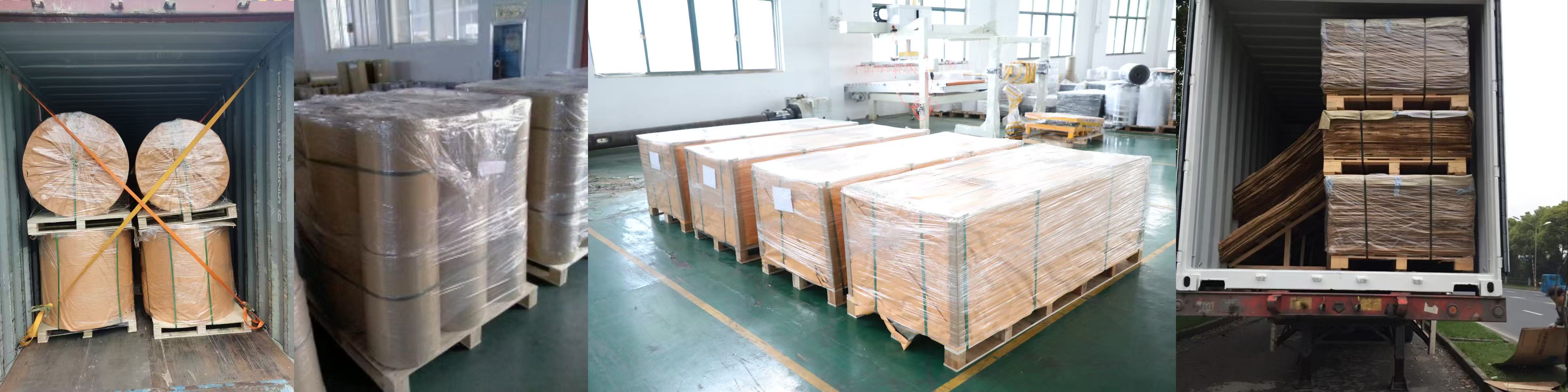
Roll protection: Rolls can be wrapped with PE film, moisture-resistant material, protective end caps and outer packaging.
Pallet packaging: Approximately 500-2000 kg can be loaded on a plywood pallet depending on roll width, diameter and warehouse-handling requirements.
Container loading: Typical loading is approximately 20 tons, subject to roll dimensions, pallet configuration and container-weight restrictions.
Delivery terms: EXW, FOB, CNF, CIF and other agreed trade terms.
Typical production time: Approximately 10-14 days after deposit and final specification confirmation.

Certifications and Quality Documentation
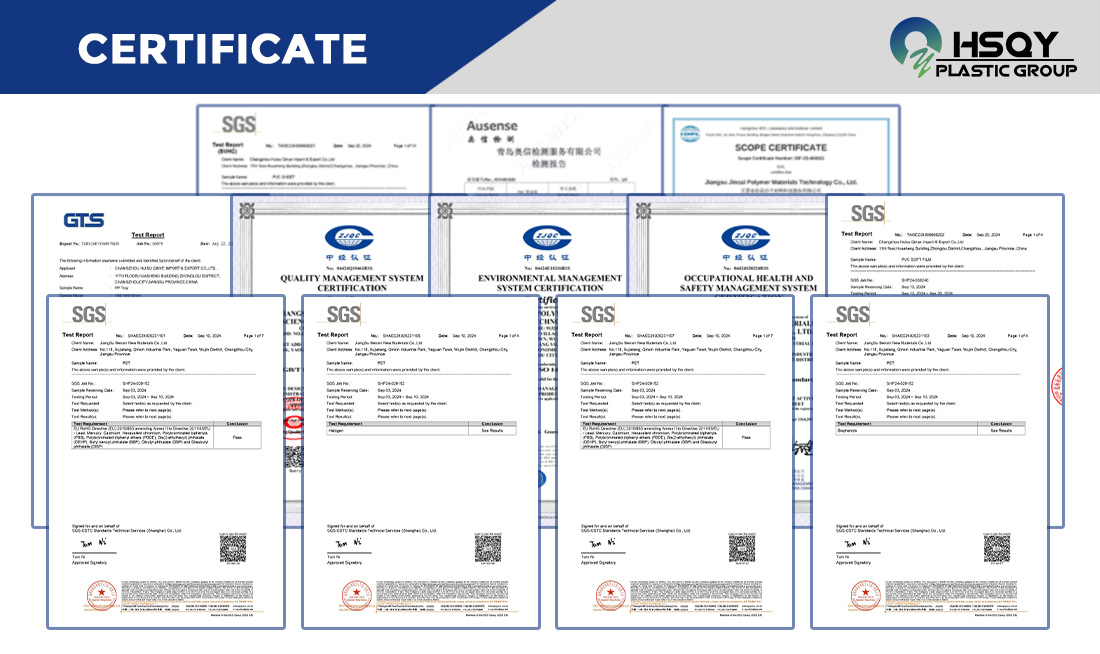
Available documents may include SGS product test reports and ISO management-system certificates. Required documents should be checked against the exact PET/PE structure, raw materials, thickness and intended application.
An ISO quality-management certificate does not by itself confirm that a film complies with food-contact, pharmaceutical, medical, microwave or recycling requirements.

Why Choose HSQY as Your PET/PE Film Supplier?
HSQY Plastic Group supplies PET, PET/PE, PET/EVOH/PE, PP, CPET and other thermoforming and food-packaging materials to packaging converters, food manufacturers, distributors and international buyers.
PET/PE laminated film from approximately 0.23 mm to 0.58 mm.
Standard approximately 50 μm LDPE sealing layer.
Weld-seal and peelable material options.
Customized widths, roll diameters and winding directions.
3-inch and 6-inch core options.
Virgin APET and RPET-content structures.
PET/EVOH/PE high-barrier alternatives.
Anti-block, silicone and anti-fog options.
Samples for forming, sealing and shelf-life evaluation.
Customized export packing and bulk-production support.
HSQY recommends testing the selected film on the buyer's actual forming, filling and sealing equipment before approving bulk production.
Contact HSQY for Samples and Pricing
HSQY Global Exhibition
HSQY Plastic Group presents thermoforming sheets, laminated packaging films, food trays and sealing solutions at international plastics and packaging exhibitions.

Frequently Asked Questions About PET/PE Laminated Film
What is PET/PE laminated film?
PET/PE laminated film combines a rigid APET structural layer with a polyethylene heat-sealing layer for thermoformed and form-fill-seal packaging.
What does APET/PE mean?
APET means amorphous polyethylene terephthalate, while PE means polyethylene. APET provides stiffness and clarity, and PE provides a heat-sealable surface.
Is PET/PE film the same as a flexible laminate?
This product is a rigid or semi-rigid thermoforming bottom web rather than a thin flexible pouch film. It is designed to form trays, cavities and rigid packaging bases.
What is the standard material structure?
The standard structure uses an APET substrate with an approximately 50 μm LDPE sealing layer. Customized structures can be discussed.
What total thicknesses are available?
HSQY's standard range for this product is approximately 0.23 mm to 0.58 mm. Other structures are subject to production confirmation.
Why is the PE layer usually around 50 μm?
A 50 μm PE layer provides a practical balance of heat-sealing performance, moisture resistance and forming behavior for many food-packaging applications.
Can the PE thickness be customized?
Yes. PE thickness and formulation can be reviewed according to seal strength, peel performance, lidding-film compatibility and order quantity.
Which side is the PE sealing side?
The PE side is the surface designed to contact the compatible lidding-film sealant. The roll should be labeled to identify the PE side and winding direction.
Can PET/PE film be thermoformed?
Yes. PET/PE film is designed for vacuum forming, pressure forming and thermoform-fill-seal packaging when the structure and heating process are correctly matched.
What is form-fill-seal packaging?
Form-fill-seal is an automated process in which the bottom web is formed into cavities, filled with product and sealed with a top film on the same production line.
What foods can be packed in PET/PE film?
Typical applications include meat, poultry, fish, seafood, cheese, dairy products, fresh pasta, prepared foods and chilled or frozen products.
Is PET/PE suitable for fatty and acidic foods?
A suitable food-contact grade may be used for fatty or acidic foods when supported by the correct migration and compliance testing for the destination market.
Can PET/PE film be used for frozen food?
Selected grades can be used for frozen storage after low-temperature impact, seal strength and package integrity are tested with the actual product.
Can PET/PE film be used in a microwave?
Standard APET/PE film should not automatically be considered microwave safe. A separately validated microwaveable structure should be selected where required.
Can PET/PE film be used in a conventional oven?
Standard APET/PE film is not normally selected for conventional-oven packaging. CPET is more suitable for validated ovenable food trays.
Is PET/PE film a high-oxygen-barrier material?
Standard PET/PE is not normally classified as a dedicated high-oxygen-barrier structure. PET/EVOH/PE should be evaluated when very low oxygen transmission is required.
What is the difference between PET/PE and PET/EVOH/PE?
PET/PE provides stiffness, transparency and heat sealing. PET/EVOH/PE adds a dedicated EVOH oxygen-barrier layer for oxygen-sensitive and extended-shelf-life products.
Can PET/PE be used for MAP packaging?
It may be used for selected MAP applications, but the required OTR, gas retention, lidding film and product shelf life must be tested. High-barrier MAP often requires an EVOH structure.
What is a weld-seal PET/PE film?
Weld-seal material is designed to form a strong, relatively permanent bond with a compatible top film.
What is a peelable PET/PE film?
Peelable material is designed to provide package integrity while allowing consumers to remove the top film with a controlled opening force.
What lidding film can be used?
The lidding film must have a sealant compatible with the PET/PE bottom web. Easy-peel, anti-fog, high-barrier and MAP top films can be evaluated.
Is anti-fog PET/PE film available?
Anti-fog coatings or additives can be discussed for chilled packaging. Performance depends on temperature, humidity, food moisture and storage time.
Are anti-block and silicone treatments available?
Yes. Anti-block masterbatch or silicone treatment may be used to improve roll handling, denesting and thermoforming-line performance.
Can recycled PET be used?
RPET-containing structures may be available. The recycled-content level depends on food-contact regulations, clarity, mechanical performance and customer requirements.
Is PET/PE laminated film recyclable?
PET/PE is a multi-material structure. Recycling acceptance depends on its design, PE proportion, lamination system and local PET-recycling infrastructure.
What core sizes are available?
Standard options include 3-inch and 6-inch cores. Core material, wall thickness and width should be matched to the roll weight and machine.
Can roll width and diameter be customized?
Yes. Roll width, diameter, weight and winding direction can be customized according to the thermoforming or FFS machine.
What is the MOQ?
The standard MOQ in the detailed specification is approximately 1,000 kg. Customized structures, colors and coatings may require a different quantity.
Are samples available?
A4 sheets or limited roll samples may be available for forming, sealing, clarity and barrier evaluation. Courier freight is normally paid by the buyer.
What is the production lead time?
Typical production takes approximately 10-14 days after the specification, quantity, packaging and payment are confirmed.
What information is needed for a quotation?
Provide the total thickness, PET and PE layers, roll width, core, diameter, product type, sealing method, lidding film, barrier requirement, quantity and destination.
Get a Custom PET/PE Film Quote