PET/PE Laminated Thermoforming Film Manufacturer
HSQY PET/PE Laminated Thermoforming Film is a rigid or semi-rigid multilayer packaging material designed for thermoformed trays, form-fill-seal packaging, food packaging and selected pharmaceutical or medical-related packaging applications.
The material combines a PET or APET structural layer with a polyethylene sealing layer. The PET layer provides transparency, rigidity, dimensional stability and forming support, while the PE layer provides heat-sealing capability, flexibility and moisture resistance.
The published reference construction uses an approximately 50 μm PE layer. PET/PE rollstock is available in clear form with 3-inch or 6-inch cores, and weld-seal or peelable structures can be evaluated according to the intended lidding film and package-opening requirements.
Typical applications include thermoformed food trays, fresh meat packaging, fish and seafood trays, cheese packaging, chilled foods and form-fill-seal packaging. Selected PET/PE structures can also be evaluated for pharmaceutical and medical-related packaging when the required material compatibility and documentation have been confirmed.
Product Highlights: PET/PE Laminated Structure | Approx. 50 μm Reference PE Layer | Clear Rollstock | 3-Inch & 6-Inch Cores | Thermoforming | Form-Fill-Seal | Weld or Peel Seal | Food Packaging | Meat & Fish Trays | Custom Roll Specifications
Request PET/PE Film Samples and Pricing
PET/PE Laminated Film Video
PET/PE Laminated Film Specifications
The following information summarizes the published product construction and common purchasing requirements. Total thickness, PET thickness, PE thickness, width, roll weight, roll diameter, winding direction, barrier performance and sealing parameters should be confirmed in the approved production specification before bulk manufacturing.
| Property |
Details |
| Product Name |
PET/PE Laminated Thermoforming Film |
| Brand |
HSQY |
| Material Structure |
PET or APET structural layer laminated with a PE sealing layer |
| Reference PE Layer |
Approximately 50 μm according to the published reference construction; confirm the actual production structure |
| Total Thickness |
Customized according to tray rigidity, forming depth, sealing and package-performance requirements |
| Appearance |
Clear / Transparent |
| Supply Format |
Rollstock; sample sheets or trial material subject to availability |
| Roll Width |
Customized according to the thermoforming or form-fill-seal machine |
| Core Options |
3-inch or 6-inch core |
| Roll Weight & Diameter |
Confirm according to web width, thickness, machine capacity and material-handling limits |
| Winding Direction |
Confirm PE sealing side orientation according to packaging-machine requirements |
| Seal Options |
Weld seal or peelable grade according to application and compatible lidding film |
| PET Layer Function |
Transparency, rigidity, impact resistance, dimensional stability and thermoforming support |
| PE Layer Function |
Heat sealing, flexibility and moisture resistance |
| Processing |
Thermoforming, vacuum forming, form-fill-seal, trimming and heat sealing |
| Barrier Performance |
Application-specific; request measured OTR and WVTR when quantitative gas or moisture barrier performance is required |
| High-Barrier Alternative |
PET/EVOH/PE or another validated multilayer structure for applications requiring significantly lower oxygen transmission |
| Food Applications |
Meat, poultry, fish, seafood, cheese, dairy, deli foods and other thermoformed chilled-food packaging |
| Other Applications |
Selected pharmaceutical and medical-related packaging subject to material and documentation confirmation |
| Minimum Order Quantity |
Confirm the current MOQ according to total thickness, width, PE structure and customization requirements |
| Samples |
A4-size samples, cut samples or limited trial rolls may be discussed according to availability |
Specification Note: The approximately 50 μm PE layer is a published reference construction. Buyers should confirm the complete PET/PE structure, total thickness and sealing grade for the actual production order.
Request Current PET/PE Specifications
What Is PET/PE Laminated Film?
PET/PE laminated film is a multilayer rigid or semi-rigid packaging material consisting of a PET-based structural substrate and a polyethylene heat-sealing layer.
It may also be described as APET/PE film, PET/PE bottom web, PET laminated PE sheet, PET/PE composite sheet or PET/PE thermoforming rollstock.
This product is primarily designed as a thermoforming bottom web rather than a thin flexible pouch film. During production, the web can be heated and formed into trays or cavities before filling and sealing with a compatible lidding material.
How the PET/PE Structure Works
PET Structural Layer
The PET layer provides the structural body of the material. It supports transparency, rigidity, impact resistance and dimensional stability during thermoforming, filling, sealing, transportation and retail handling.
PE Heat-Sealing Layer
The PE layer provides a sealable surface that can bond with compatible PE-based lidding films under controlled heat, pressure and dwell time. It also contributes flexibility and moisture resistance.
Laminated Construction
Combining PET and PE allows the bottom web to provide forming rigidity and heat-sealing functionality in one structure. The appropriate layer ratio depends on tray depth, product weight, sealing system and package-performance requirements.
PET/PE Technical Data Sheet
Download the available PET technical data sheet for preliminary material evaluation. For purchasing and qualification, request the current PET/PE laminate specification applicable to the selected total thickness, PE layer and sealing grade.
![PDF icon]() PET Data Sheet.pdf
PET Data Sheet.pdf
Key Features of PET/PE Laminated Film
Clear Product Visibility
The PET layer provides a transparent package structure suitable for applications where the packaged product needs to remain visible.
Thermoforming Capability
PET/PE film can be processed on suitable vacuum, pressure and form-fill-seal equipment. Heater profile, forming temperature, draw depth and cooling conditions should be optimized for the selected material structure.
Heat-Sealable Surface
The PE layer supports sealing to a compatible top web or lidding film. Final seal strength depends on the sealant formulation, lidding-film structure, temperature, pressure, dwell time and flange condition.
Weld-Seal and Peelable Options
Weld-seal structures can be evaluated for stronger permanent closure, while peelable structures are suitable when controlled opening is required.
Moisture Resistance
The PE layer contributes resistance to moisture and liquid contact, supporting chilled-food and other sealed-packaging applications.
Mechanical Strength
The PET structural layer contributes rigidity and impact resistance during forming, filling, sealing, stacking and transportation.
PET/PE Laminated Film Applications
Fresh Meat and Poultry Packaging
PET/PE bottom web can be formed into clear trays or cavities for beef, pork, lamb, poultry and processed-meat packaging requiring rigidity and PE-compatible heat sealing.
Fish and Seafood Packaging
The laminate can be evaluated for fish and seafood packs requiring clear presentation, moisture resistance and a compatible sealing surface.
Cheese and Dairy Packaging
PET/PE film can be used for suitable cheese, dairy and delicatessen packaging applications requiring a formed rigid base and heat-sealed top web.
Prepared and Chilled Foods
The material can also be evaluated for chilled meals, fresh pasta, produce and other food products packaged on thermoforming or form-fill-seal lines.
Pharmaceutical and Medical-Related Packaging
Selected PET/PE structures can be evaluated for pharmaceutical and medical-related packaging. The material structure, packaged product compatibility, sealing system and applicable documentation should be confirmed for the exact application.
Explore the HSQY PET/PE laminated film range for additional food, pharmaceutical and thermoforming packaging structures.
PET/PE Film Application Images
![PET PE laminated thermoforming film]()
PET/PE laminated thermoforming film for rigid and semi-rigid packaging.
![PET PE film for meat packaging]()
PET/PE film for fresh meat, poultry and chilled-food packaging.
![PET PE laminated food tray film]()
Clear PET/PE material for thermoformed trays and heat-sealed packaging.
PET/PE vs. PET/EVOH/PE
Standard PET/PE and high-barrier PET/EVOH/PE are designed for different packaging requirements. The correct structure should be selected according to oxygen sensitivity, shelf-life target, gas environment, sealing system and storage conditions.
| Selection Factor |
PET/PE |
PET/EVOH/PE |
| Structure |
PET structural layer + PE sealing layer |
PET structural layer + EVOH barrier layer + PE sealing layer |
| Heat Sealing |
PE-compatible sealing |
PE-compatible sealing |
| Oxygen Barrier |
Application-specific; confirm measured OTR |
Designed for significantly lower oxygen transmission when correctly specified |
| Typical Use |
General thermoformed and chilled-food packaging |
High-barrier, MAP and extended-shelf-life applications |
| Selection Basis |
Forming, sealing, moisture resistance and standard shelf-life requirements |
Defined OTR target, gas mix and extended shelf-life requirement |
If oxygen transmission is critical, provide the target OTR, storage temperature, humidity, gas mixture and shelf-life requirement so the appropriate standard or high-barrier structure can be evaluated.
Peelable vs. Weld-Seal PET/PE Film
Peelable Grade
A peelable structure is designed to maintain package integrity during storage and distribution while providing controlled opening by the user. Peel strength should be evaluated with the actual lidding film and sealing equipment.
Weld-Seal Grade
A weld-seal grade is intended for applications requiring a stronger permanent bond. Seal strength and package integrity should be validated using the actual lidding film, tray flange and sealing parameters.
Matched Lidding Film
The thermoformed bottom web and lidding film should be evaluated as one packaging system. Confirm sealant compatibility, sealing temperature, pressure, dwell time and required opening force before commercial production.
How PET/PE Film Is Used in Thermoform-Fill-Seal Packaging
Heating
The PET/PE bottom web is heated to an appropriate forming condition according to material thickness, PET grade, heater design and line speed.
Forming
Vacuum, pressure or plug-assisted forming draws the heated web into the mold. Tray depth and corner geometry influence the final wall-thickness distribution.
Filling
The formed cavities are filled with the intended food or packaged product.
Sealing
A compatible top web is sealed to the PE layer under controlled heat, pressure and dwell time.
Cutting and Separation
The sealed packs are trimmed and separated according to the thermoforming-line configuration.
How to Select PET/PE Laminated Film
Application: Specify meat, poultry, seafood, cheese, dairy, chilled food, pharmaceutical packaging or another intended use.
Total thickness: Provide the required total gauge and tolerance according to tray stiffness and forming depth.
Layer construction: Confirm the required PET and PE layer structure rather than specifying only the total thickness.
Roll width: Provide the exact web width required by the thermoforming machine and mold layout.
Core size: Specify 3-inch or 6-inch core according to the unwind system.
Roll weight and diameter: Provide preferred roll weight and maximum outside diameter according to line and material-handling limits.
Winding direction: Confirm the required orientation of the PE sealing surface.
Forming depth: Provide the cavity dimensions, draw depth, mold layout and forming method.
Seal type: Specify peelable or weld seal and provide the intended lidding-film structure.
Barrier requirement: Provide the target OTR and WVTR if barrier performance affects product shelf life.
Storage conditions: Specify chilled, frozen or ambient storage conditions and required shelf life.
Destination market: State the destination country or region so relevant documentation requirements can be reviewed.
Discuss Your PET/PE Film Application
How to Validate PET/PE Film Before Bulk Production
Thermoforming Trial
Run the sample material on the actual production line and mold. Evaluate heating uniformity, cavity definition, wall-thickness distribution, flange flatness, shrinkage and trimming performance.
Seal-Window Test
Test the intended lidding film across an appropriate range of sealing temperatures, pressures and dwell times to establish a stable processing window.
Seal Integrity Test
Evaluate seal strength and package integrity using test methods suitable for the intended package. Include realistic flange contamination and cold-storage conditions where relevant.
Barrier Verification
When shelf life depends on oxygen or moisture barrier, verify OTR and WVTR using the complete selected laminate and relevant test conditions.
Shelf-Life Evaluation
Validate the finished package using the actual product, lidding material, storage temperature and intended shelf-life period before commercial approval.
PET Sheet and Roll Packing Details
Sample Packing: Published information references A4-size rigid PET samples packed in a protective bag and carton. Confirm the current sample format and freight terms before shipment.
Sheet Packing: Published information references approximately 30 kg per bag for some sheet specifications. Actual packing depends on thickness, sheet size and project requirements.
Roll Packing: Confirm roll width, roll weight, outside diameter, core size, winding direction, protective wrapping and pallet configuration before production.
Pallet Packing: Older published information references approximately 500–2000 kg per plywood pallet. Current pallet weight should be confirmed according to the actual roll specification, handling method and destination requirements.
Container Loading: Older published information references approximately 20 tons for some shipments. Actual loading depends on roll dimensions, pallet configuration, container type, route and legal shipment-weight limits.
Production Lead Time: Published reference information indicates approximately 10–14 working days for some orders. Confirm current timing after structure, quantity, sample approval and packing requirements are finalized.
Delivery Terms: Published options include EXW, FOB, CNF and DDU. Confirm the applicable commercial terms with the current quotation.
![HSQY PET PE laminated film roll packing]()
PET/PE laminated film rolls prepared for protective packing and bulk shipment.
![PET PE thermoforming film export packing]()
Export packing for PET/PE thermoforming rollstock and international bulk supply.
Request Packing and Shipping Details
Frequently Asked Questions About PET/PE Laminated Film
What is PET/PE laminated film?
PET/PE laminated film combines a PET-based structural layer with a polyethylene heat-sealing layer. It is commonly used as a rigid or semi-rigid thermoforming bottom web.
What does APET/PE mean?
APET means amorphous polyethylene terephthalate and PE means polyethylene. APET provides clarity and structural rigidity, while PE provides heat-sealing capability and moisture resistance.
What is the PE layer thickness?
The published reference construction uses an approximately 50 μm PE layer. The actual PE thickness should be selected according to sealing, moisture resistance and packaging requirements.
Can PET/PE film be thermoformed?
Yes. PET/PE film can be evaluated for vacuum forming, pressure forming and thermoform-fill-seal packaging. The exact forming conditions depend on total thickness, material structure and tray geometry.
Is PET/PE film heat sealable?
Yes. The PE layer provides a heat-sealable surface. Final seal performance depends on the lidding film, PE formulation, sealing temperature, pressure and dwell time.
What is the difference between peelable and weld seal?
Peelable grades provide controlled opening, while weld-seal structures provide a stronger permanent bond. The selected structure should be validated with the actual lidding film and sealing line.
Which roll core sizes are available?
The published product information lists 3-inch and 6-inch core options. Buyers should also specify maximum roll diameter and preferred roll weight.
Can the roll width be customized?
Yes. Roll width can be customized according to thermoforming-machine width, mold layout and trim requirements, subject to production confirmation.
Can PET/PE film be used for meat and fish packaging?
Yes. The material can be evaluated for meat, poultry, fish, seafood, cheese and other chilled-food trays requiring clear presentation and PE-compatible heat sealing.
Is standard PET/PE a high oxygen-barrier material?
Standard PET/PE should not automatically be considered an ultra-high oxygen-barrier structure. When oxygen transmission affects shelf life, request measured OTR data for the exact laminate.
When should PET/EVOH/PE be considered?
PET/EVOH/PE or another high-barrier laminate should be evaluated when the package requires significantly lower oxygen transmission, modified-atmosphere performance or an extended shelf life that standard PET/PE cannot provide.
Can PET/PE be used for pharmaceutical packaging?
Selected PET/PE structures can be evaluated for pharmaceutical packaging. Suitability depends on the material construction, packaged product, compatibility requirements, sealing process and applicable documentation.
What barrier data should I request?
If barrier performance is critical, request OTR and WVTR values for the exact laminate under the test temperature and humidity conditions relevant to the packaged product.
Can I request a sample before bulk production?
Yes. Cut samples or trial material can be discussed according to availability. Production-machine testing is recommended when thermoforming and sealing performance are critical.
What should I test before approving PET/PE film?
Evaluate thermoforming behavior, wall-thickness distribution, tray rigidity, flange flatness, seal window, peel or weld strength, package integrity, barrier performance where required and final shelf-life performance.
What information should I provide for a quotation?
Provide total thickness, PET and PE layer requirements, roll width, core size, roll weight, maximum roll diameter, winding direction, peel or weld requirement, packaging application, barrier requirement, quantity and destination market.
About HSQY Plastic Group
HSQY Plastic Group supplies PET sheet, laminated PET/PE materials, thermoforming rollstock and other plastic packaging materials to commercial buyers, thermoforming companies, food manufacturers, packaging converters, distributors and importers.
HSQY supports material selection, sample evaluation, customized roll specifications, packaging requirements and international bulk supply for food, thermoforming and selected pharmaceutical packaging projects.
HSQY at International Industry Exhibitions
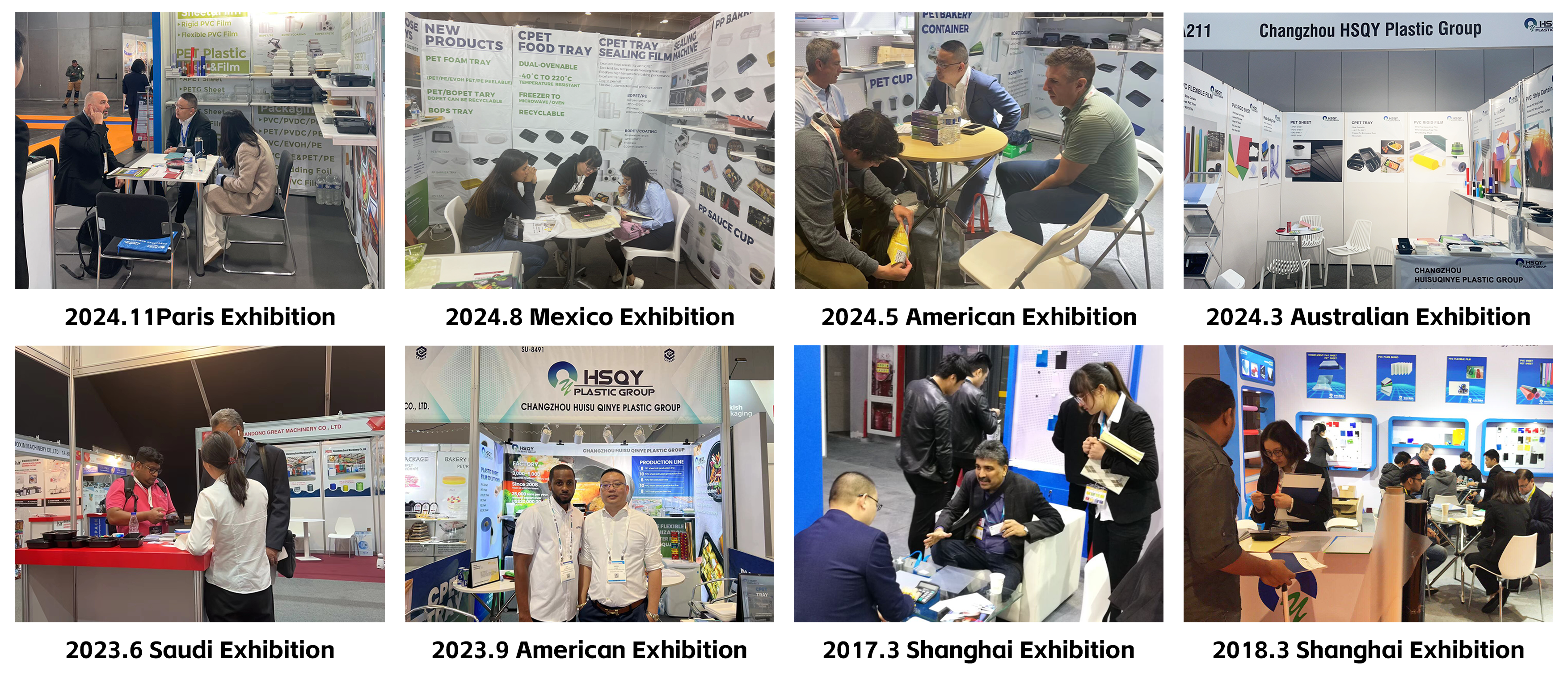
![HSQY plastics and packaging exhibition]()
HSQY participates in international plastics and packaging industry events and works with packaging converters, distributors and industrial buyers in global markets.
Quality and Product Documentation
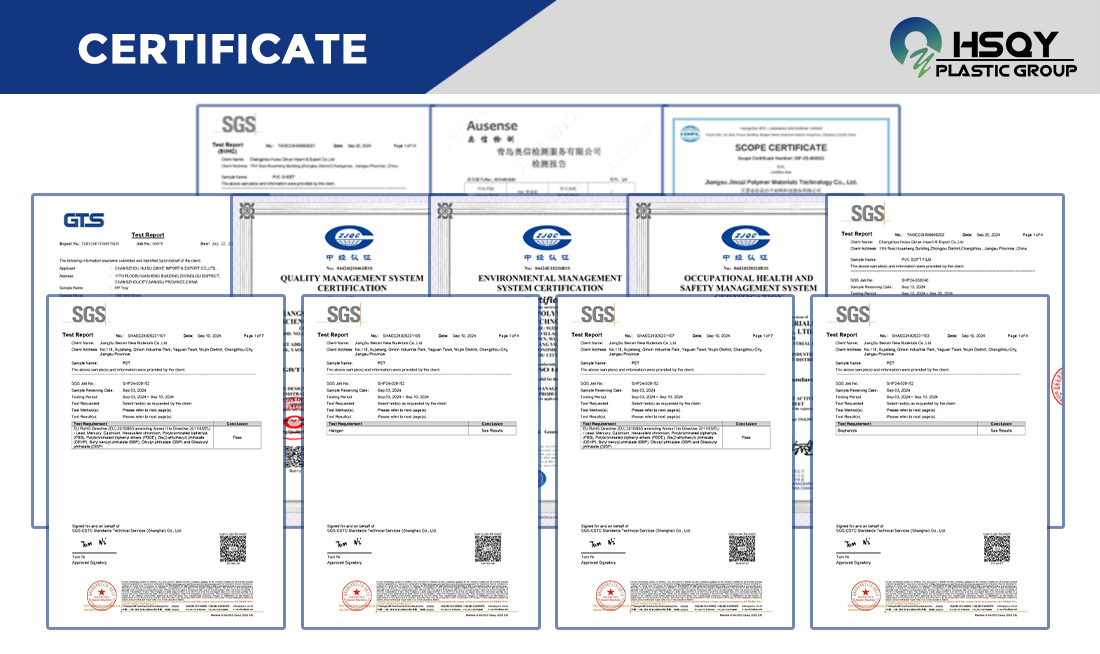
![HSQY quality and product documentation]()
HSQY quality and product documentation. Request current documents applicable to the exact PET/PE structure, application and destination market.
Request a Quote for PET/PE Laminated Film
Looking for PET/PE laminated film for thermoforming, food trays, meat, fish, cheese or form-fill-seal packaging? Send HSQY your required total thickness, PE layer, roll width, core size, roll weight, winding direction, sealing grade, barrier requirement, quantity and destination market.
Contact HSQY for Samples and Bulk Pricing