Clear Polypropylene Sheet Video
Watch the video below to learn more about HSQY clear polypropylene sheets, available thicknesses, surface appearance and typical packaging, printing and thermoforming applications.
What Is a Clear Polypropylene Sheet?
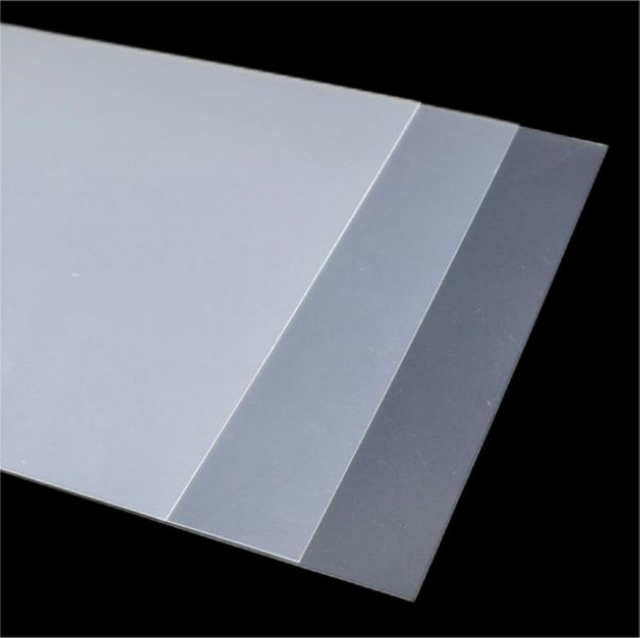
A clear polypropylene sheet is a lightweight extruded PP plastic material designed to provide improved transparency or translucency while retaining the low density, moisture resistance, chemical resistance and fatigue performance associated with polypropylene.
HSQY supplies clear and high-clarity polypropylene sheets in featured thicknesses of 0.5 mm, 0.8 mm and 1 mm. A broader customized thickness range from approximately 0.08 mm to 3 mm is available according to the required width, supply format, surface finish, processing method and order quantity.
Natural polypropylene is normally translucent rather than optically transparent like acrylic, polycarbonate or high-clarity PET. Material formulation, crystallization, sheet thickness, surface texture and extrusion conditions all influence the final haze, gloss and visibility.
High-clarity PP is suitable for applications where product visibility, low weight, flexibility, chemical resistance or heat resistance is required, but crystal-clear optical performance is not the primary requirement.
Typical applications include thermoformed food containers, packaging inserts, stationery, printed folders, retail displays, medical and laboratory packaging, electronic-component packaging and fabricated industrial parts.
Request Clear PP Sheet Pricing Request a Material Sample
Clear Polypropylene Sheet Images

Clear Polypropylene Plastic Sheet

Clear PP Sheet for Packaging

High-Clarity PP Sheet Applications
Clear Polypropylene Sheet Specifications
| Property |
Available Specification |
| Product Name |
Clear Polypropylene Sheet / High-Clarity PP Sheet |
| Material |
Polypropylene / PP |
| Featured Thicknesses |
0.5 mm, 0.8 mm and 1 mm |
| Customized Thickness Range |
Approximately 0.08 mm-3 mm, subject to width, supply format and production confirmation |
| Width |
Customized according to thickness, equipment and order requirements |
| Length |
Standard sheets, custom-cut lengths or continuous rolls |
| Supply Form |
Flat sheets, rolls, slit rolls and custom-cut pieces |
| Manufacturing Process |
Extrusion or application-specific co-extrusion |
| Color |
Natural clear, translucent, tinted clear and customized colors |
| Transparency |
Translucent to high clarity; exact optical performance depends on grade, thickness and surface |
| Surface Finish |
Glossy, matte, frosted, smooth or customized texture |
| Typical Density |
Approximately 0.90-0.92 g/cm³, depending on formulation |
| Printing Treatment |
Corona-treated, flame-treated, primer-coated or untreated options subject to printing requirements |
| Processing Methods |
Thermoforming, vacuum forming, cutting, slitting, punching, die-cutting, creasing, folding, welding and printing |
| Functional Options |
Antistatic, conductive, anti-fog, UV-stabilized and application-specific formulations |
| Multilayer Options |
PP/PE, PP/EVOH/PE, PP/EVOH/PP or other structures subject to barrier and sealing requirements |
| Main Applications |
Food packaging, thermoformed trays, printing, stationery, medical packaging, electronics packaging and industrial components |
| Protective Film |
Available for selected specifications and scratch-sensitive applications |
| Samples |
Limited-size samples may be available for clarity, printing and processing tests |
| Minimum Order Quantity |
Confirmed according to thickness, width, color, surface treatment and functional grade |
| Lead Time |
Confirmed according to specification, quantity and current production schedule |
| Packaging |
PE film, kraft paper, cartons, roll wrapping and wooden pallets according to supply format |
Final thickness tolerance, dimensions, clarity, haze, gloss, surface treatment and functional properties should be confirmed through an approved sample, technical specification or purchase agreement.
Differences Between 0.5 mm, 0.8 mm and 1 mm PP Sheets
Thickness affects sheet flexibility, stiffness, transparency, forming behavior, finished-product weight and the depth of a thermoformed component.
| Thickness |
General Characteristics |
Typical Applications |
| 0.5 mm |
Lightweight and relatively flexible; suitable for folding, shallow forming and light-duty packaging |
Folders, covers, packaging windows, light trays, inserts, labels and lightweight displays |
| 0.8 mm |
Balanced stiffness and flexibility for packaging and general thermoforming |
Thermoformed trays, packaging components, stationery, dividers and retail displays |
| 1 mm |
Greater rigidity and structural support with reduced flexibility |
Rigid inserts, protective panels, stronger trays, medical packaging and fabricated components |
The correct thickness also depends on sheet width, part dimensions, forming depth, food weight, stacking load, service temperature and the selected polypropylene grade.
Clear PP, High-Clarity PP and Translucent PP
| Description |
Visual Appearance |
Typical Use |
| Natural PP |
Milky or translucent appearance with visible haze |
Industrial parts, folders, dividers and packaging where full visibility is unnecessary |
| Clear PP |
Improved visibility and gloss while retaining some natural PP haze |
Packaging, printed covers, formed trays and retail products |
| High-Clarity PP |
Optimized formulation and processing for lower haze and better product visibility |
Food display packaging, medical packaging and premium clear applications |
| Frosted PP |
Diffused, low-glare or textured appearance |
Stationery, decorative packaging, privacy panels and premium covers |
Buyers requiring a specific visual result should define the acceptable haze, gloss, light transmission and sample appearance rather than relying only on the word “clear.”
Key Features of Clear Polypropylene Sheet
Lightweight Material
Polypropylene has a relatively low density, helping reduce the weight of packaging, formed trays and fabricated components compared with many other rigid plastics of equal thickness.
Improved Product Visibility
High-clarity formulations improve visibility through the sheet, making them suitable for packaging applications where consumers or inspectors need to see the contents.
Chemical Resistance
PP resists many acids, alkalis, detergents, oils and commonly encountered chemicals. Compatibility should still be tested using the actual substance, concentration, temperature and exposure duration.
Low Moisture Absorption
Polypropylene absorbs very little moisture under normal conditions, making it suitable for packaging, folders, trays and components exposed to humid environments.
Impact and Flex-Fatigue Performance
Suitable PP grades provide useful toughness and resistance to repeated flexing. Actual performance depends on whether homopolymer, random copolymer, block copolymer or another modified grade is selected.
Thermoforming Capability
Clear PP sheets can be vacuum formed or pressure formed into trays, covers, containers and other packaging components when the grade and heating process are correctly matched.
Printing and Decoration
Corona-treated or otherwise prepared PP sheets can support screen printing, UV printing, offset printing, hot stamping and labeling after process compatibility is verified.
Heat-Sealing and Welding Options
PP components can be joined using compatible heat sealing, hot-air welding, ultrasonic welding or other thermal methods. The selected joining process depends on the sheet structure and final product.
Custom Functional Grades
Antistatic, conductive, anti-fog, UV-stabilized and high-barrier co-extruded structures may be developed according to the target resistance, barrier, forming and compliance requirements.
Printing on Clear Polypropylene Sheet
Polypropylene has relatively low surface energy. Untreated PP may provide poor wetting and adhesion for inks, coatings, labels and adhesives, so surface treatment is frequently required.
Corona Treatment
Corona treatment increases the surface energy of PP and can improve ink and coating wetting. Buyers should specify the required dyne level, treated side and expected printing date.
Screen Printing
Screen printing is suitable for logos, text, solid colors and graphic designs. Ink should be selected for polypropylene and tested for adhesion, curing and scratch resistance.
UV and Digital Printing
UV and digital printing require testing of surface energy, ink wetting, curing energy, flexibility and post-print cutting or folding.
Offset Printing
Specially formulated printable PP can be used for offset printing, folders, covers and packaging. Static control, ink drying and sheet feeding should be evaluated.
Treatment Aging
Corona-treatment effectiveness may decrease during storage. Surface energy should be checked before printing, particularly after long transportation or warehouse storage.
Thermoforming Clear PP Sheet
Clear PP can be used for vacuum forming and pressure forming, but its forming window, shrinkage and heating behavior differ from PET, PVC and HIPS.
Use a PP grade developed for the required forming depth and part stiffness.
Heat the sheet uniformly to reduce uneven wall thinning and optical distortion.
Control sheet sag and transfer timing before forming.
Allow for PP shrinkage when designing molds and trim dimensions.
Optimize mold temperature and cooling to reduce distortion after forming.
Check wall-thickness distribution in corners and deep-draw areas.
Evaluate stacking, denesting and compression after the parts have fully cooled.
Test the formed part using the actual filling, sealing, storage and heating process.
Production trials should use the actual thermoforming machine, mold, heating zones and cycle time before a bulk material specification is approved.
Processing and Fabrication Methods
Cutting and Slitting
PP can be knife cut, slit, routed, punched or mechanically cut. Tool condition, sheet temperature, thickness and cutting speed affect edge quality.
Die-Cutting
Thin and medium-gauge sheets can be die cut into packaging profiles, inserts, folders, labels and dividers. Cutting pressure and die clearance must match the thickness.
Creasing and Folding
Suitable PP grades can be creased and folded for folders, boxes and reusable packaging. Crease direction, depth and radius affect whitening and fatigue life.
Welding
Compatible PP parts can be joined using ultrasonic welding, hot-air welding, heat sealing or other thermal processes.
Adhesive Bonding
Untreated polypropylene is difficult to bond with many conventional adhesives. Surface activation, primer or an adhesive designed for low-surface-energy plastics may be required.
Applications of Clear Polypropylene Sheet
Thermoformed Food Packaging
Clear PP sheet can be formed into trays, cups, lids, deli containers, produce packaging, bakery containers and microwaveable packaging when the correct food-contact and heat-resistant grade is selected.
Medical and Laboratory Packaging
Selected medical-grade PP materials can be used for thermoformed trays, device packaging, specimen components and laboratory packaging after regulatory, cleanliness and sterilization compatibility are confirmed.
Stationery and Binding
Applications include document folders, notebook covers, dividers, wallets, ring-binder components and reusable stationery products.
Printing and Signage
Treated clear PP can be used for menu covers, promotional graphics, printed overlays, retail displays, tags and point-of-purchase components.
Electronics Packaging
Antistatic or conductive grades may be formed into trays, separators and protective packaging for electronic components. Required surface resistance must be specified.
Retail and Cosmetic Packaging
High-clarity PP can be used for protective sleeves, product boxes, display inserts, cosmetic packaging and transparent promotional components.
Industrial Components
Clear PP sheets may be fabricated into protective liners, inspection covers, separators, templates and chemical-resistant components where moderate visibility is sufficient.
Clear PP vs. PET, PVC and Polycarbonate Sheet
| Selection Factor |
Clear PP |
PET |
PVC |
Polycarbonate |
| Transparency |
Translucent to high clarity, normally with more haze |
High clarity for packaging and display |
Clear grades available with practical optical quality |
High optical clarity |
| Material Weight |
Relatively lightweight |
Heavier than PP |
Heavier than PP |
Heavier than PP |
| Heat Resistance |
Suitable for selected hot-fill and microwave applications |
Standard APET is mainly used for cold or moderate-temperature packaging |
Depends strongly on formulation and application |
Higher heat resistance for engineering applications |
| Chemical Resistance |
Strong resistance to many common chemicals |
Suitable for many packaging environments |
Varies according to chemical and formulation |
Can be affected by selected chemicals and solvents |
| Printing |
Usually requires surface treatment |
Surface treatment or suitable inks may be required |
Widely used for printing |
Printing requires compatible ink and surface preparation |
| Typical Selection |
Lightweight packaging, microwaveable trays, folders and chemical-resistant parts |
Clear clamshells, blisters and retail packaging |
Printing, folding boxes, covers and thermoforming |
Guards, glazing and high-impact engineering components |
Food Packaging and Compliance Considerations
Polypropylene is widely used in food packaging, but a standard clear PP sheet should not automatically be described as approved for every food-contact application.
Food-contact suitability depends on the exact resin, clarifying agent, color masterbatch, additives, recycled-content level, multilayer structure and production conditions.
Buyers should specify the food type, contact temperature, contact duration, hot-fill conditions, microwave use, forming process and destination-market regulations.
Supporting documents should be confirmed against the exact material grade, thickness, color and manufacturing specification being ordered.
Medical and Laboratory Application Requirements
Medical packaging requires more than a general description of polypropylene. The application may require controlled resin selection, cleanliness, biocompatibility information, sterilization compatibility, traceability and validated packaging performance.
Buyers should identify whether the material will contact a medical device, pharmaceutical product, laboratory specimen or only the outside of a secondary package.
Sterilization methods such as steam, ethylene oxide, electron beam or gamma radiation can affect PP grades differently. Compatibility must be verified using the exact material and finished package.
Outdoor Use and Temperature Considerations
Standard clear PP sheet is normally intended for indoor or controlled applications. Long-term ultraviolet exposure can cause color, surface and mechanical changes unless a UV-stabilized grade is specified.
UV stabilization can improve outdoor durability but does not create an unlimited outdoor service life. Exposure intensity, weather, thickness, stress and required appearance must be considered.
The usable temperature range depends on resin grade, load, thickness, part design and exposure time. Critical hot-fill, microwave, freezing or industrial-temperature applications require grade-specific test data.
Clear PP Sheet Recycling Considerations
Polypropylene is commonly identified by resin identification code 5. This indicates the polymer family but does not guarantee that every local recycling program accepts the finished product.
Actual recyclability depends on collection systems, product size, food contamination, printing, labels, coatings, fillers, multilayer structures and regional sorting infrastructure.
Claims such as “100% recyclable” should only be used when they are appropriate for the complete product and verified for the target market.
Recommended Sample and Quality Checks
Thickness, width, length and dimensional tolerances.
Transparency, haze, gloss and visual impurities.
Surface smoothness, matte finish or embossed texture.
Sheet stiffness, flexibility and impact performance.
Surface-treatment level and printing adhesion.
Cutting, slitting and die-cutting edge quality.
Creasing, folding and repeated-flex performance.
Thermoforming temperature, shrinkage and wall-thickness distribution.
Welding, heat-sealing or adhesive-bonding strength.
Hot-fill, microwave, chilled or frozen performance where applicable.
Antistatic, conductive, UV or anti-fog performance where required.
Food, medical or other compliance documentation for the exact grade.
Custom Clear Polypropylene Sheet Options
Featured 0.5 mm, 0.8 mm and 1 mm thicknesses.
Customized thicknesses from approximately 0.08 mm to 3 mm.
Flat sheets, rolls, slit rolls and custom-cut pieces.
Natural clear, high clarity, translucent and tinted colors.
Glossy, matte, frosted and textured surfaces.
One-side or two-side corona treatment.
Printing-grade and thermoforming-grade formulations.
Antistatic, conductive, anti-fog and UV-stabilized options.
PP/PE and PP/EVOH-based multilayer structures.
Protective film and customized surface protection.
Custom roll cores, roll diameter, labels and export packaging.
Samples for clarity, printing, forming and compliance evaluation.
Information Required for a Clear PP Sheet Quotation
Required thickness and thickness tolerance.
Sheet width, length, roll width or cut-piece dimensions.
Required transparency, haze, gloss or approved visual sample.
Glossy, matte, frosted or textured surface.
Printing, folding, die-cutting or thermoforming process.
Required corona-treatment side and dyne level.
Hot-fill, microwave, chilled or frozen conditions.
Antistatic, conductive, anti-fog, UV or barrier requirements.
Food-contact, medical or other compliance documents.
Sample quantity, trial order, bulk order and annual demand.
Packaging, pallet, roll-core and labeling requirements.
Destination port, trade term and required delivery date.
Send Your Clear PP Sheet Requirements
Packaging and Delivery
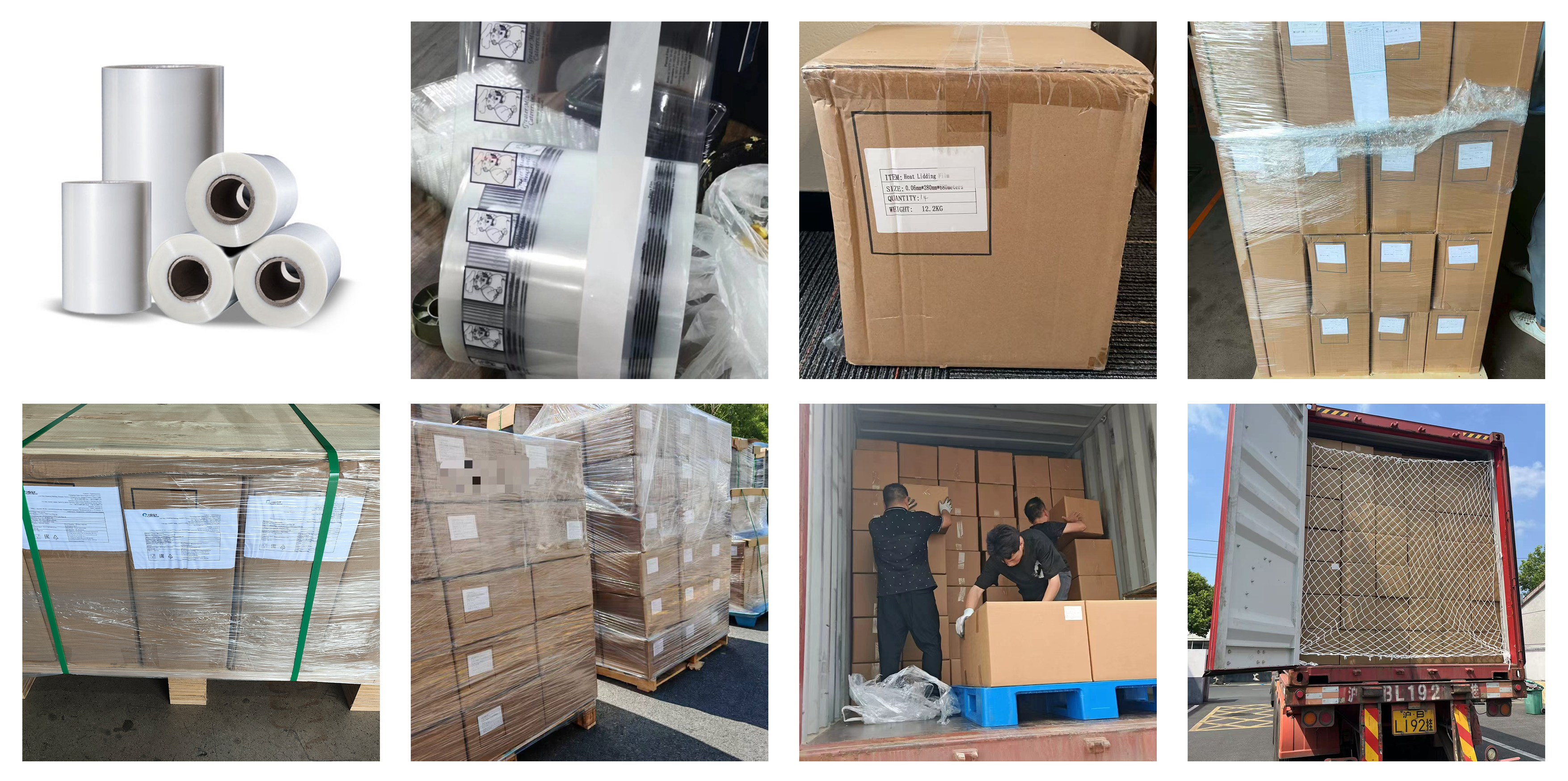
Sheet packaging: Flat sheets can be protected using PE film, kraft paper, cartons, corner protection and wooden pallets.
Roll packaging: Rolls can be wrapped with kraft paper or PE film and supplied on customized paper or plastic cores.
Surface protection: Protective film or interlayer material may be used for gloss-sensitive, printed or high-clarity surfaces.
Pallet packaging: Pallet weight, sheet count, roll count and reinforcement can be customized according to unloading and warehouse requirements.
Custom labels: Product name, thickness, dimensions, batch number, quantity, barcode and customer-specific shipping marks can be added.
Delivery time: Production timing is confirmed according to material grade, dimensions, surface treatment, quantity and current production schedule.
Why Choose HSQY as Your Clear PP Sheet Supplier?
HSQY Plastic Group supplies PP, PVC, PET, CPET and other plastic sheet and packaging materials to thermoforming companies, printers, packaging converters, stationery manufacturers, distributors and industrial buyers.
Featured 0.5 mm, 0.8 mm and 1 mm clear PP sheets.
Customized thickness range from approximately 0.08 mm to 3 mm.
Sheets, rolls, slit rolls and custom-cut pieces.
Clear, high-clarity, translucent and tinted appearances.
Printing and thermoforming material options.
Corona-treated and customized surface finishes.
Antistatic, conductive, anti-fog and UV-stabilized grades.
Food-packaging and multilayer co-extrusion project support.
Samples for clarity, printing and forming evaluation.
Customized export packaging and bulk-production support.
Before mass production, HSQY recommends testing the selected sheet with the buyer's actual printing ink, die-cutting tool, thermoforming mold, filling process, sealing system and service conditions.
Explore more high-transparent PP sheet products, or contact HSQY for a customized material specification.
Contact HSQY for Samples and Pricing
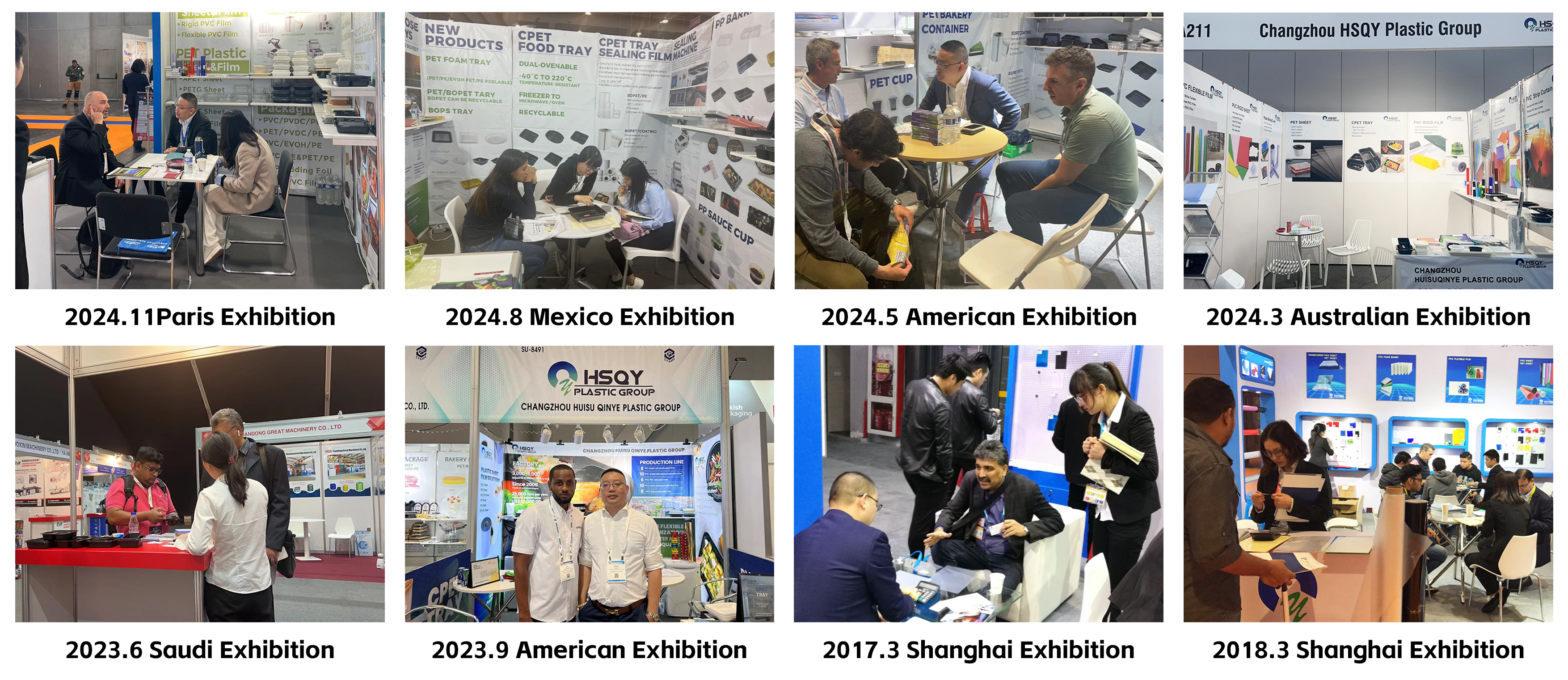
HSQY Global Exhibition
HSQY Plastic Group participates in international packaging and plastics exhibitions to present clear PP sheets, thermoforming materials, food-packaging solutions and customized plastic products to global buyers.

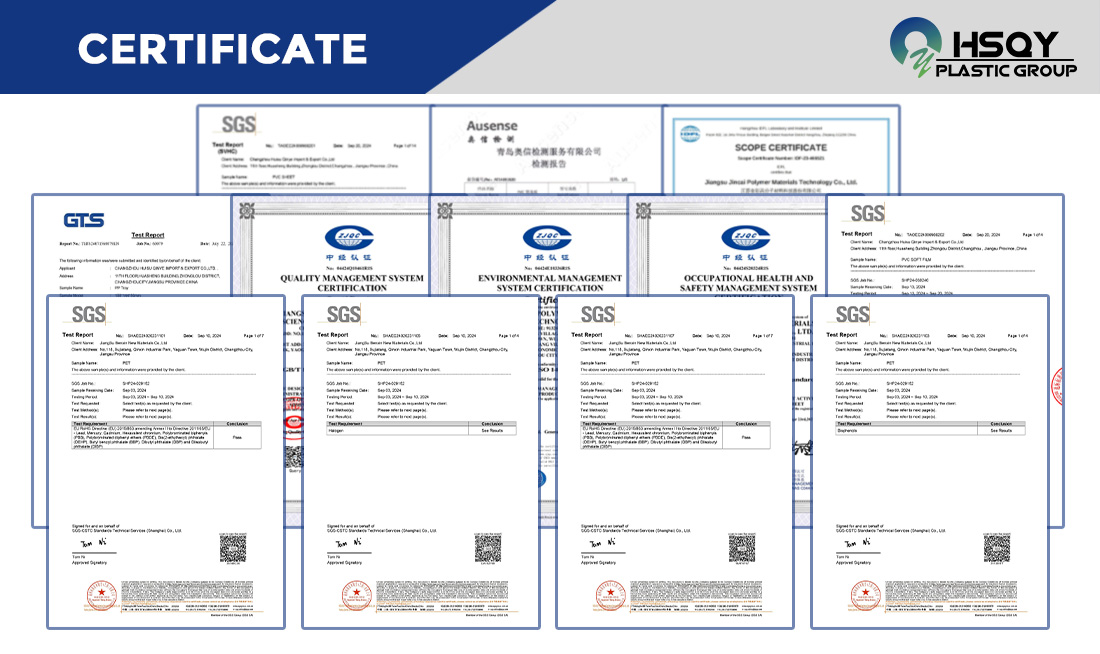
Certifications and Quality Documentation
Available documentation may include applicable product test reports and ISO management-system certificates. Buyers should confirm which report applies to the exact polypropylene grade, additives, thickness and intended application.
ISO 9001 and ISO 14001 relate to management systems and should not be presented as direct proof that every PP sheet is approved for food, medical, outdoor or electrical use.

Frequently Asked Questions About Clear Polypropylene Sheet
What is a clear polypropylene sheet?
It is an extruded polypropylene sheet formulated and processed to provide improved clarity or translucency for packaging, printing, thermoforming and fabricated products.
Is clear polypropylene completely transparent?
PP is normally translucent to high clarity rather than optically transparent like acrylic or PET. Exact visibility depends on formulation, thickness, surface and processing.
What is the difference between clear PP and natural PP?
Natural PP usually has a milky or translucent appearance. Clear or high-clarity PP uses optimized resin, additives and processing to reduce haze and improve visibility.
What thicknesses are available?
Featured thicknesses are 0.5 mm, 0.8 mm and 1 mm. Customized production from approximately 0.08 mm to 3 mm can be discussed.
What is 0.5 mm clear PP sheet used for?
A 0.5 mm sheet is suitable for lightweight packaging, folders, covers, inserts, shallow forming and applications requiring more flexibility.
What is 0.8 mm clear PP sheet used for?
A 0.8 mm sheet provides a balance of stiffness and flexibility for thermoformed trays, retail packaging, stationery and general converted products.
What is 1 mm clear PP sheet used for?
A 1 mm sheet offers greater rigidity for stronger trays, protective inserts, medical packaging and fabricated components.
Can clear PP sheet be supplied in rolls?
Yes. Sheets, rolls and slit rolls can be supplied according to thickness, width, roll diameter and converting-equipment requirements.
Can clear polypropylene sheet be thermoformed?
Yes. Suitable grades can be vacuum formed or pressure formed into trays, cups, lids, covers and other packaging components.
Does PP require drying before thermoforming?
Polypropylene absorbs relatively little moisture, but storage conditions, surface contamination and the exact forming process should still be controlled. Follow grade-specific processing recommendations.
Can clear PP sheet be printed?
Yes, but PP has low surface energy. Corona treatment, flame treatment, primer or a compatible ink system may be required.
What printing methods can be used?
Screen printing, UV printing, digital printing, offset printing, hot stamping and labeling may be possible after surface and ink compatibility testing.
What is corona-treated PP sheet?
Corona treatment increases surface energy to improve ink, coating and adhesive wetting. The required treated side and dyne level should be specified.
Does corona treatment last permanently?
Treatment effectiveness can decline during storage. The surface should be checked before printing, particularly after long shipping or warehousing periods.
Can clear PP sheet be folded?
Suitable PP grades can be creased and folded. Thickness, sheet direction, crease depth and bend radius influence whitening and fatigue life.
Can polypropylene sheet be welded?
Yes. Compatible PP components can be joined using hot-air, ultrasonic, heat-sealing or other thermal-welding processes.
Can clear PP sheet be glued?
Untreated PP is difficult to bond with many adhesives. Surface treatment and an adhesive designed for low-surface-energy plastics may be required.
Is clear PP sheet suitable for food packaging?
Food-contact suitability depends on the exact resin, additives, color, multilayer structure and target regulations. The intended food and contact conditions must be specified.
Can clear PP sheet be used for microwaveable containers?
Suitable PP grades can be used for microwaveable packaging after the formed container, food load, heating time and temperature have been validated.
Is clear PP suitable for medical packaging?
Selected grades may be suitable, but medical packaging requires confirmation of cleanliness, traceability, sterilization compatibility and applicable regulatory requirements.
Are antistatic clear PP sheets available?
Antistatic and conductive options can be developed. Buyers should state the required surface-resistance range, test method and intended application.
Is anti-fog PP sheet available?
Anti-fog formulations or coatings may be available for food-display packaging. Performance depends on temperature, humidity, food moisture and storage time.
Can clear PP sheet be used outdoors?
Standard PP is mainly intended for indoor use. Outdoor applications may require UV stabilization and testing for sunlight, weather and expected service life.
Is polypropylene sheet recyclable?
Polypropylene is resin code 5, but actual recycling depends on local collection, product size, contamination, coatings and recycling infrastructure.
Can the width and length be customized?
Yes. HSQY supports customized sheet dimensions, roll widths, slit widths and cut lengths according to production feasibility.
Are clear PP sheet samples available?
Limited-size samples may be available for checking clarity, thickness, flexibility, printing, forming and welding. Courier freight is normally paid by the buyer.
What information is needed for a quotation?
Provide the thickness, dimensions, quantity, clarity requirement, surface finish, treatment, application, processing method, functional properties, packaging and destination.
Get a Custom Clear PP Sheet Quote