238×136×25mm PET/PE Meat Tray for Fresh Meat Packaging
HSQY 238×136×25mm PET/PE meat tray is a clear top-sealable food packaging tray designed for chilled beef, pork, poultry, fish, seafood, sausages, deli products and other fresh foods. The PET-based structural layer provides rigidity and product visibility, while the PE sealing layer provides a compatible surface for heat-sealing with suitable lidding films.
The tray measures approximately 9.37 × 5.35 × 0.98 inches and is available in PET/PE or project-specific rPET/PE structures. HSQY supports clear and customized colors, compatible lidding-film selection, tray samples and custom meat-tray development for food processors, meat packers, supermarket suppliers and packaging distributors.
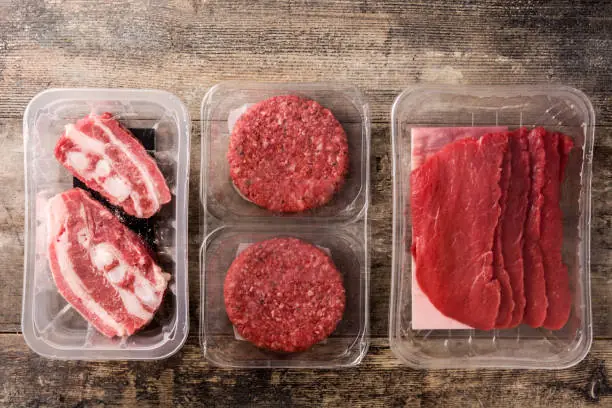
PET/PE Meat Tray Product Image
What Is a PET/PE Meat Tray?
A PET/PE meat tray is a multilayer thermoformed food tray combining a PET-based structural layer with a polyethylene sealing layer. PET provides the main rigidity, shape retention and clear retail presentation, while the PE layer creates a heat-sealable surface around the tray flange.
When a compatible PE-sealant lidding film is applied under controlled temperature, pressure and dwell time, the tray can form a closed package for chilled meat, poultry, seafood and other fresh foods.
PET/PE should not automatically be treated as the same material as PET/EVOH/PE. Projects requiring validated high oxygen barrier or long-duration MAP gas retention should specify the required barrier performance separately.
238×136×25mm PET/PE Meat Tray Specifications
| Property |
Details |
| Product Name |
PET/PE Meat Packaging Tray |
| Material |
PET/PE; project-specific rPET/PE option available |
| Metric Size |
238 × 136 × 25mm |
| Imperial Size |
Approximately 9.37 × 5.35 × 0.98 inches |
| Color |
Clear and customized colors |
| Reference Temperature Range |
-40°C to +60°C (-40°F to +140°F) according to the current product specification; validate the complete package for the intended food and storage process |
| Sealing Surface |
PE-based heat-sealing layer |
| Lidding Options |
Compatible PET/PE or other PE-sealant lidding film; easy-peel, lock-seal and anti-fog options require separate film selection and validation |
| Main Applications |
Fresh meat, poultry, fish, seafood, sausages, deli food, fruit, vegetables and selected chilled foods |
| MAP Use |
Requires evaluation of tray barrier, lidding-film barrier, gas retention and complete package performance; consider PET/EVOH/PE where higher oxygen barrier is required |
| Microwave / Oven |
Not positioned as a microwave or conventional-oven tray under the current specification |
| MOQ |
30,000 pieces according to current product information |
| Customization |
Color, size, depth, tray weight, flange geometry, absorbent-pad matching, packaging and custom mold subject to project evaluation |
| Payment Terms |
T/T, L/C, Western Union or PayPal according to order agreement |
| Delivery Terms |
EXW, FOB, CNF and DDU according to order agreement |
| Reference Lead Time |
Approximately 7-15 days after final specification and order confirmation, subject to quantity and production schedule |

Why the PE Sealing Layer Matters
A major reason food processors choose PET/PE rather than a standard mono-PET tray is the PE sealing surface on the flange. The sealant layer allows the tray to be paired with compatible PE-based lidding films on heat-sealing equipment.
Reliable sealing depends on more than the tray material. Flange flatness, contamination from meat juice or fat, film sealant chemistry, sealing temperature, pressure and dwell time all influence package integrity.
HSQY recommends evaluating the selected tray and lidding film together on the customer's actual tray-sealing equipment before commercial approval.
Key Features of PET/PE Meat Trays
Clear Retail Presentation: The PET-based structure provides high product visibility for fresh beef, poultry, seafood and deli products.
Heat-Sealable Flange: The PE surface enables sealing with a suitably matched PE-compatible lidding film.
Tray Rigidity: The PET structure provides support for food during filling, sealing, transport and chilled retail display.
Cold-Chain Application: The current product specification lists a reference range from -40°C to +60°C, making the tray relevant to selected chilled and frozen-food projects after complete-package validation.
Custom Packaging Development: Tray color, dimensions, depth, flange design, absorbent pad and lidding-film combination can be discussed for qualified B2B projects.
Applications of PET/PE Meat Packaging Trays
Fresh Beef and Steak Packaging
Clear PET/PE trays can be used for steaks, sliced beef, minced beef, burgers and other chilled beef products where retail visibility and heat-sealed closure are required.
Poultry Packaging
Chicken breasts, wings, drumsticks, sliced poultry and other chilled poultry products can be packed in appropriately sized trays. Product purge and absorbent-pad requirements should be evaluated before final tray selection.
Fish and Seafood Packaging
PET/PE trays can provide transparent chilled presentation for fish fillets, shrimp, shellfish and other seafood products. Sharp shells or bone edges should be considered when selecting the lidding film and puncture resistance.
Sausage and Processed Meat Packaging
The tray can also be evaluated for sausages, meatballs, processed meat portions and selected chilled deli products using compatible top-seal films.
Produce and Deli Food
The same clear tray format can also be considered for selected fruit, vegetables and deli products. Respiring produce requires separate evaluation of film permeability, perforation and package atmosphere.
PET/PE Tray vs PET/EVOH/PE High-Barrier Tray
PET/PE and PET/EVOH/PE trays should not be treated as interchangeable. The correct structure depends on sealing requirements, oxygen sensitivity, packaging atmosphere and target shelf life.
| Comparison |
PET/PE Tray |
PET/EVOH/PE Tray |
| Main Structure |
PET structural layer + PE sealing layer |
PET structure + EVOH oxygen-barrier layer + PE sealing layer |
| Heat Sealing |
Good with compatible PE sealant film |
Good with compatible PE sealant film |
| Oxygen Barrier |
Structure-dependent; do not assume high-barrier performance |
Designed for higher oxygen-barrier requirements |
| Typical Packaging |
Heat-sealed chilled-food packaging and selected validated systems |
High-barrier MAP and oxygen-sensitive chilled-food packaging |
| Typical Selection |
Fresh meat, fish, seafood, deli food and general chilled applications |
Products requiring validated oxygen barrier and MAP gas retention |
Can This PET/PE Meat Tray Be Used for MAP?
Modified atmosphere packaging requires more than a tray that can be heat sealed. The complete package must provide the required gas retention and oxygen transmission performance for the selected meat product and target shelf life.
A MAP system should evaluate the tray structure, lidding-film OTR, tray OTR, seal integrity, gas mixture, headspace, residual oxygen, meat type and chilled-distribution conditions.
If the project requires a defined high oxygen barrier, HSQY recommends discussing a dedicated PET/EVOH/PE tray rather than assuming that a standard PET/PE tray will provide the required barrier.
Easy-Peel vs Lock-Seal Lidding Film for PET/PE Trays
| Seal Type |
Main Characteristic |
Typical Selection |
| Easy Peel |
Designed for controlled consumer opening with lower peel force |
Retail chilled foods where easy opening is important |
| Lock Seal |
Stronger permanent or weld-style seal |
Packages prioritizing leakage resistance and transport security |
| Anti-Fog |
Separate surface function that helps reduce visible condensation droplets |
Chilled meat, poultry, seafood and other high-moisture foods |
Film selection should be based on the actual PE sealing surface, tray-sealing machine, required peel strength, food product and storage conditions.
Absorbent Pads for Fresh Meat Packaging
Fresh meat, poultry and seafood can release purge during chilled storage. An appropriately selected absorbent pad can help retain liquid and improve package presentation.
The pad should fit inside the tray without extending onto the sealing flange. Pad dimensions and absorption capacity should be selected according to the meat type, product weight, storage duration and expected liquid release.
HSQY can discuss tray and absorbent-pad matching for qualified fresh-meat packaging projects.
Tray-Sealing Machine Compatibility
Industrial buyers should check the tray against the existing tray-sealer tooling rather than selecting a tray only by approximate external dimensions.
Important machine-related parameters include external tray length and width, flange dimensions, corner radius, tray depth, nesting geometry, denesting performance and tooling cavity dimensions.
Providing the tray-sealing machine manufacturer, machine model and existing tray drawing can help HSQY evaluate compatibility before samples are shipped.
Custom PET/PE Meat Tray Manufacturing
HSQY supports custom fresh-meat tray projects for food processors, meat packing plants, supermarket supply chains, packaging distributors and private-label packaging companies.
Custom external length, width and depth.
Custom internal usable dimensions.
Clear or customized tray colors.
PET/PE or project-specific rPET/PE structure.
Custom tray weight and rigidity.
Flange dimensions and sealing geometry.
Stacking and denesting design.
Absorbent-pad matching.
Compatible lidding-film development.
New thermoforming mold development.
Carton and pallet configuration.
Food Contact and Packaging Compliance
Food-contact suitability should be confirmed for the exact PET/PE or rPET/PE structure, additives, recycled-content configuration and destination market. General SGS or ISO documentation alone should not be interpreted as universal food-contact approval.
Buyers should provide the destination country, food type, contact conditions and applicable regulatory requirements so that relevant material declarations, migration testing or other supporting documentation can be reviewed for the selected product.
PET/PE Tray Recycling Considerations
PET and recycled PET can support circular packaging strategies, but a PET/PE tray is a multilayer structure rather than a pure mono-PET package. Actual recyclability depends on the PE layer, adhesives or tie layers, tray design, labels, absorbent pads and the collection and sorting infrastructure in the destination market.
Sustainability claims should therefore be based on the exact tray structure and local recycling guidelines rather than describing every PET/PE tray as universally recyclable.
Information Required for a PET/PE Meat Tray Quote
| Quote Information |
What to Provide |
| Tray Size |
Required external and usable internal dimensions |
| Food Product |
Beef, pork, poultry, seafood, sausage, deli food or other product |
| Packed Weight |
Food weight per tray and maximum product height |
| Packaging Method |
Heat-sealed atmospheric pack, MAP, skin pack or other method |
| Seal Type |
Easy peel or stronger lock seal |
| Absorbent Pad |
Required size and absorption capacity if used |
| Storage |
Chilled, frozen or other temperature condition |
| Packaging Machine |
Manufacturer, model and tooling dimensions where available |
| Quantity |
Initial order and estimated annual volume |
| Destination |
Country, port and applicable food-packaging requirements |
Packing and Delivery
Sample Packaging: Tray samples can be packed in protective bags or boxes for evaluation.
Bulk Packaging: Trays are nested to reduce shipping volume and can be packed in protective bags and export cartons. Final tray count and carton weight depend on the tray model and packing configuration.
Pallet Packaging: Export pallets can be arranged according to carton dimensions, customer warehouse requirements and container loading plan.
Container Loading: Container utilization depends strongly on tray nesting pitch, carton dimensions and pallet configuration. A loading plan should be prepared for the actual tray order.
Delivery Terms: EXW, FOB, CNF and DDU options can be discussed according to the order.
Reference Lead Time: Approximately 7-15 days for standard projects after specification and order confirmation, subject to production schedule and quantity.
HSQY Food Tray Manufacturing
HSQY supplies PET/PE, PET/EVOH/PE, PP, CPET and other thermoformed food packaging trays together with compatible lidding-film solutions. This allows food processors and packaging distributors to discuss tray geometry, sealing performance and packaging method within the same sourcing project.

HSQY Plastic Group Global Exhibitions
HSQY Plastic Group meets food processors, packaging converters, distributors and international buyers at global exhibitions to discuss fresh-meat trays, sealing films, MAP and VSP packaging projects, custom molds and long-term supply programs.

HSQY Plastic Group Global Exhibition Highlights
Frequently Asked Questions About PET/PE Meat Trays
What is a PET/PE meat tray?
A PET/PE meat tray combines a PET-based structural layer with a PE heat-sealing layer. PET provides rigidity and clear product visibility, while PE allows the tray flange to seal to a compatible lidding film.
What is the size of this PET/PE meat tray?
The tray measures approximately 238 × 136 × 25mm, equivalent to about 9.37 × 5.35 × 0.98 inches.
What foods can be packed in this tray?
It can be evaluated for chilled beef, pork, poultry, sausages, fish, seafood, deli products and selected fresh produce according to product size, storage conditions and packaging method.
Can PET/PE meat trays be heat sealed?
Yes. The PE layer provides a heat-sealable flange when used with a compatible PE-based lidding film. Final seal performance should be tested on the actual tray-sealing machine.
Can I use easy-peel film on a PET/PE tray?
Yes, if a peelable lidding-film grade is specifically designed and validated for the tray's PE sealing surface. Easy-peel performance depends on film structure and sealing parameters.
Can this tray use anti-fog lidding film?
Yes. Anti-fog PET/PE lidding film can be evaluated for chilled meat and seafood applications where condensation may reduce product visibility.
Is PET/PE the same as a high-barrier MAP tray?
No. PET/PE provides a PET structure with a PE sealing layer, but high oxygen-barrier performance should not be assumed. Projects requiring defined MAP barrier performance should evaluate a high-barrier structure such as PET/EVOH/PE.
Can rPET be used in this meat tray?
Project-specific rPET/PE options are available according to the current product information. Recycled-content level, food-contact structure and applicable documentation should be confirmed for the destination market.
Are PET/PE trays recyclable?
PET/PE is a multilayer package, so recyclability depends on the exact structure and local collection, sorting and recycling systems. Buyers should verify local design-for-recycling guidance before making recycling claims.
Can an absorbent pad be added to the meat tray?
Yes. Pad matching can be discussed according to tray size, meat type, packed weight and expected purge. The pad should not interfere with the tray sealing flange.
What is the MOQ for this PET/PE meat tray?
The current listed MOQ is 30,000 pieces. Custom colors, tray structures or new molds may require a different commercial quantity.
Can I get samples for tray-sealer testing?
Sample availability can be confirmed for the required model. Testing samples with the actual food product, absorbent pad, lidding film and tray-sealing machine is recommended before bulk production.
Can HSQY develop a custom meat tray?
Yes. Custom dimensions, depths, colors, tray weights, flange geometry, molds and packaging configurations can be discussed for projects with suitable order volumes.
What information is required for a quotation?
Please provide tray dimensions, food type, packed weight, packaging method, lidding-film requirement, tray-sealing machine, absorbent-pad requirement, storage temperature, quantity, destination country and applicable food-contact requirements.
Why Buy PET/PE Meat Trays from HSQY?
HSQY supplies PET/PE meat trays together with easy-peel, lock-seal, anti-fog and high-barrier lidding-film options for food processors, meat packers, supermarkets and packaging distributors. Customers can discuss the tray and film specification as one packaging project rather than sourcing the components independently.
Send HSQY your food product, tray dimensions, packaging method, tray-sealing machine and annual volume. Our team can help evaluate whether standard PET/PE or a higher-barrier PET/EVOH/PE tray system is more appropriate and prepare samples for testing.


