Low Temperature PET/PE Food Tray for Frozen Food
HSQY low temperature PET/PE food trays are designed for frozen, refrigerated and cold-chain food packaging where tray toughness, product visibility and reliable heat sealing are important.
The current reference operating range is approximately -40°C to +60°C (-40°F to +140°F), subject to the exact tray structure, wall thickness, food load, freezing process, storage conditions and application validation.
Standard sizes include 220 × 170 × 32mm and 220 × 170 × 38mm, with clear and customized color options. Custom dimensions, tray depth, flange design and packing specifications can also be discussed for volume food-packaging programs.
Request PET/PE Tray Samples & Quote
Low Temperature PET Food Tray Images
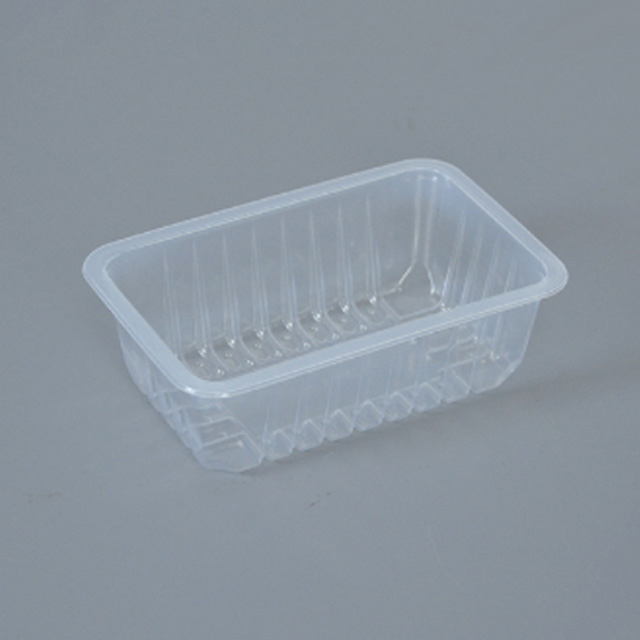 Clear PET Tray | 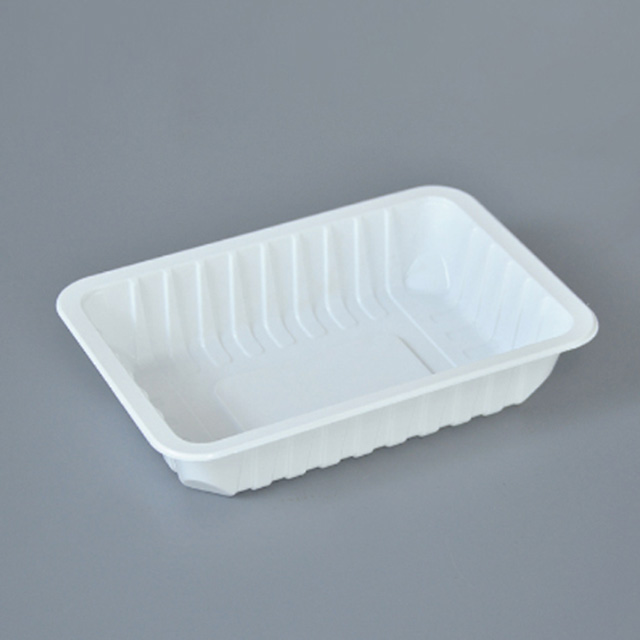 White PET Tray | 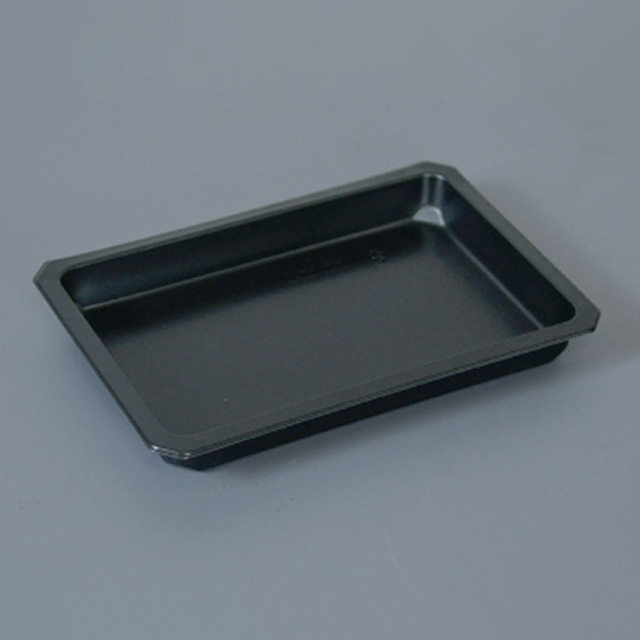 Black PET Tray |
Low Temperature PET/PE Tray Specifications
| Property | Current Specification |
| Product Name | Low Temperature PET/PE Food Tray for Frozen Food |
| Brand | HSQY |
| Product Type | Frozen and Chilled Food Packaging Tray |
| Material Structure | PET/PE according to the current product category; exact material structure should be confirmed for the selected order specification |
| Standard Sizes | 220 × 170 × 32mm / 220 × 170 × 38mm / Custom |
| Approximate Inch Sizes | 8.66 × 6.69 × 1.26 in. / 8.66 × 6.69 × 1.50 in. |
| Color | Clear / White / Black / Custom Color subject to specification |
| Reference Temperature Range | Approximately -40°C to +60°C (-40°F to +140°F), subject to the exact tray structure, food load and application validation |
| Storage Applications | Frozen / Refrigerated / Chilled / Cold-Chain Packaging |
| Heat Sealing | Compatible sealing systems can be evaluated with suitable lidding film; sealing temperature, pressure and dwell time must be tested |
| Oxygen Barrier | Standard PET/PE structure is not positioned as a high-oxygen-barrier tray; use a qualified PET/EVOH/PE structure where higher barrier performance is required |
| Microwave Use | Not intended for microwave heating unless a specific tray structure has been separately qualified |
| Conventional Oven | Not intended for conventional-oven use; consider qualified CPET trays for freezer-to-oven applications |
| Typical Foods | Frozen Meat / Poultry / Seafood / Dumplings / Frozen Prepared Foods / Chilled Foods / Deli Products / Refrigerated Desserts |
| Customization | Size / Depth / Color / Flange Design / Material Gauge / Packing Configuration subject to project requirements |
| MOQ | 30,000 Pieces |
What Is a Low Temperature PET/PE Food Tray?
A low temperature PET/PE food tray is a rigid food-packaging tray designed for chilled, frozen and cold-chain applications where ordinary packaging can experience increased brittleness during low-temperature handling.
The PET-based structure provides tray stiffness and product presentation, while a compatible sealing surface can support heat sealing with suitable lidding films.
The complete package should be validated under the actual food load, freezing process, storage temperature, transportation conditions and handling method because frozen impact performance depends on more than material name alone.
Designed for Frozen and Cold-Chain Packaging
Low-temperature food packaging must remain functional during filling, freezing, cold storage, distribution and retail handling.
The current HSQY reference range extends to approximately -40°C, making this tray suitable for evaluation in deep-freeze and frozen-food projects where the selected tray design has been validated for the intended load and handling conditions.
Buyers should define the lowest storage temperature, freezing method, product weight, stacking configuration and expected transport conditions when requesting samples.
Reference Temperature Range: -40°C to +60°C
The published reference operating range for this low-temperature PET tray system is approximately -40°C to +60°C (-40°F to +140°F).
This range should not be interpreted as an unconditional guarantee for every custom tray. Material gauge, tray geometry, food weight, freezing rate, impact load, sealing structure and exposure time can all influence performance.
A filled-product freezer trial is recommended before commercial launch, especially for products that will experience automated handling, stacking or distribution at sub-zero temperatures.
Low-Temperature Toughness and Frozen Impact
Plastic materials can become more brittle as temperature decreases. For frozen-food projects, tray performance should therefore be assessed under realistic cold conditions rather than only at room temperature.
Important validation points include filled-tray drop behavior, corner and flange integrity, stacking strength and resistance to cracking during packing, cold storage and transportation.
Where a specific frozen-impact or drop-test requirement is used by your company, include the test method, temperature and acceptance criteria when requesting a quotation.
Heat-Sealable PET/PE Tray
PET/PE tray structures are commonly selected where reliable compatibility with PE-sealable lidding films is required.
The final seal depends on the tray flange, sealing layer, lidding-film sealant, sealing temperature, pressure, dwell time and tray-sealing equipment.
Buyers should test the actual tray and lidding film together on the intended production line before confirming lock-seal, easy-peel or other sealing performance.
Lidding Film Selection
| Requirement | What Buyers Should Confirm |
| Seal Compatibility | Tray sealing surface and lidding-film sealant must be compatible |
| Seal Type | Lock seal or easy peel according to opening requirements |
| Anti-Fog | Useful for refrigerated display where condensation may reduce product visibility |
| Freezer Performance | Seal integrity should be checked after freezing and cold storage |
| Barrier Requirement | Select film structure according to oxygen, moisture and shelf-life requirements |
| Sealing Window | Test temperature, pressure and dwell time on the actual tray sealer |
Clear Product Presentation
Clear PET-based trays provide product visibility for retail packaging where consumers or quality-control personnel need to inspect the packed food.
For clear trays, buyers can also specify appearance requirements such as haze, color tone, surface quality and allowable visual defects where these characteristics are important to the finished package.
Available Tray Colors
| Color | Typical Packaging Consideration |
| Clear | Maximum product visibility for retail display |
| White | Neutral food presentation and branded packaging programs |
| Black | Contrast for meat, seafood, deli and prepared-food presentation |
| Custom Color | Subject to color reference, material structure, order quantity and production confirmation |
Standard Sizes and Custom Tray Development
Current standard sizes include 220 × 170 × 32mm and 220 × 170 × 38mm.
When selecting between the 32mm and 38mm depths, buyers should consider food volume, fill weight, headspace, lidding-film clearance and the dimensions required by existing tray-sealing equipment.
Custom size, depth, corner geometry, flange width, color and packing configuration can be discussed for commercial-volume projects.
Tray Flange and Sealing Machine Compatibility
For automated tray-sealing lines, overall dimensions alone are not sufficient. Flange width, flange flatness, corner radius, tray height and tooling fit can affect line performance and sealing consistency.
Buyers replacing an existing tray should provide a drawing, physical sample or tray-sealer tooling dimensions whenever possible.
Denesting and Automated Filling Lines
Commercial food factories often require trays to denest consistently and feed reliably through automated filling and sealing equipment.
For automated lines, buyers should provide the tray denester type, line speed and any critical stacking or nesting requirements so tray geometry and packing can be reviewed during sample evaluation.
Frozen Food Packaging Applications
| Food Application | Main Packaging Consideration |
| Frozen Meat & Poultry | Frozen impact, tray rigidity, seal integrity and product weight |
| Frozen Seafood | Seal integrity, moisture exposure, tray stiffness and cold-chain handling |
| Frozen Dumplings & Prepared Foods | Tray depth, product arrangement, freezer storage and lidding-film compatibility |
| Frozen Side Dishes | Fill weight, stacking, sealing and distribution handling |
| Refrigerated Deli Foods | Product visibility, sealing and chilled shelf presentation |
| Chilled Desserts & Bakery Products | Clarity, tray geometry and retail presentation |
PET/PE vs. PET/EVOH/PE vs. CPET Trays
| Tray Type | Best Suited For | Key Difference |
| PET/PE | Chilled and qualified frozen food packaging requiring reliable sealing | PET-based tray with PE sealing functionality; not positioned as high oxygen barrier |
| PET/EVOH/PE | Meat, seafood and chilled foods requiring higher oxygen barrier | Adds an EVOH barrier layer for applications requiring controlled oxygen transmission |
| CPET | Frozen ready meals requiring qualified microwave or conventional-oven reheating | Crystallized PET structure designed for higher-temperature applications |
Not Intended as an Ovenable PET Tray
This low-temperature PET/PE tray is positioned for chilled and frozen packaging rather than high-temperature cooking.
Do not use the published +60°C reference value as evidence of microwave or conventional-oven suitability.
For freezer-to-oven or freezer-to-microwave ready-meal packaging, a qualified CPET tray should be evaluated instead.
Barrier Requirements and Shelf Life
A standard PET/PE tray should not automatically be presented as a high-oxygen-barrier package.
Where meat, seafood, cheese or another oxygen-sensitive food requires a defined oxygen-transmission target or extended shelf-life program, a qualified high-barrier structure such as PET/EVOH/PE may be more appropriate.
Final shelf life must be established using the complete packaging system, including food formulation, hygiene, tray, lidding film, sealing process, gas composition where applicable and storage conditions.
Food-Contact Documentation
Food-contact suitability should be confirmed for the exact tray material structure, colorants, additives and production specification supplied for the order.
Buyers should provide the destination market, food type, contact conditions, storage temperature and required regulatory documentation before the final tray specification is approved.
Recycling Considerations
PET is widely used in recycling systems, but actual recyclability of a finished food tray depends on the complete tray structure, labels, lidding film, contamination, local collection rules and recycling infrastructure.
For PET/PE multilayer constructions, buyers should verify acceptance under the recycling rules applicable in the destination market rather than assuming that every PET-based tray enters the same recycling stream.
Important Quality Parameters for Frozen Food Trays
| Parameter | Why It Matters |
| Frozen Impact Performance | Evaluates tray resistance to cracking during handling at low temperature |
| Minimum Operating Temperature | Must match the actual freezing and cold-chain program |
| Tray Weight / Material Gauge | Influences rigidity, impact performance and material usage |
| Flange Flatness | Important for consistent sealing on automatic tray sealers |
| Seal Strength | Helps confirm package integrity after filling, freezing and transport |
| Seal Window | Supports stable production across temperature, pressure and dwell-time variation |
| Stacking / Denesting | Important for automated food filling and packaging lines |
| Clarity / Haze | Important for transparent retail packaging |
| Dimensional Tolerance | Affects tooling fit, denesting and sealing-machine compatibility |
Information Required for a PET/PE Tray Quote
Please provide the food product, fill weight and whether the tray will be used for chilled, refrigerated or frozen storage.
Specify the lowest storage temperature, freezing method, storage duration and expected cold-chain handling conditions.
Provide the required tray dimensions, depth, color, flange design and an existing tray sample or drawing where available.
If heat sealing is required, provide the lidding-film structure, sealing-machine model and preferred lock-seal or easy-peel performance.
Also provide the required food-contact documentation, estimated order quantity, annual demand and destination country or port.
Send Frozen Food Tray Requirements
Frozen and Chilled Food Applications
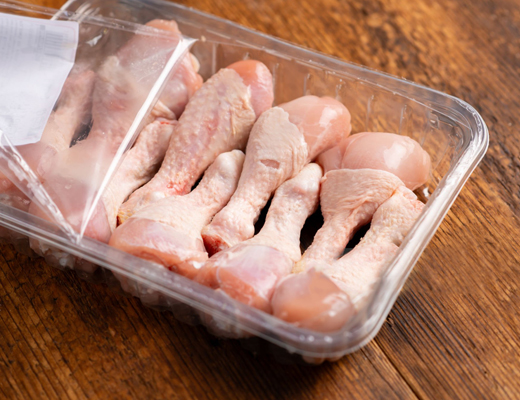
Low temperature PET/PE trays can be evaluated for frozen meat, poultry, seafood, dumplings, frozen prepared foods, refrigerated snacks, deli products, chilled desserts and other foods distributed through refrigerated or frozen supply chains.
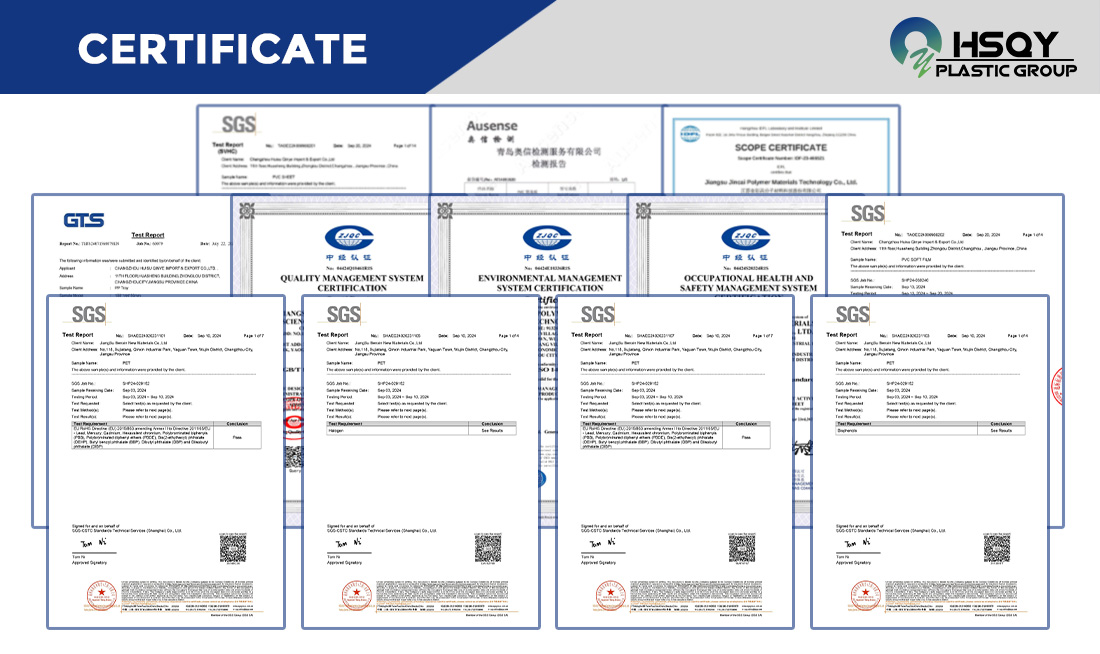
Quality and Compliance Documents
Available food-contact declarations, test reports and other compliance documents should be confirmed for the exact tray material structure, color and destination market before ordering.
HSQY Global Exhibitions
HSQY meets food manufacturers, packaging converters, distributors and professional buyers at international packaging and plastics exhibitions.
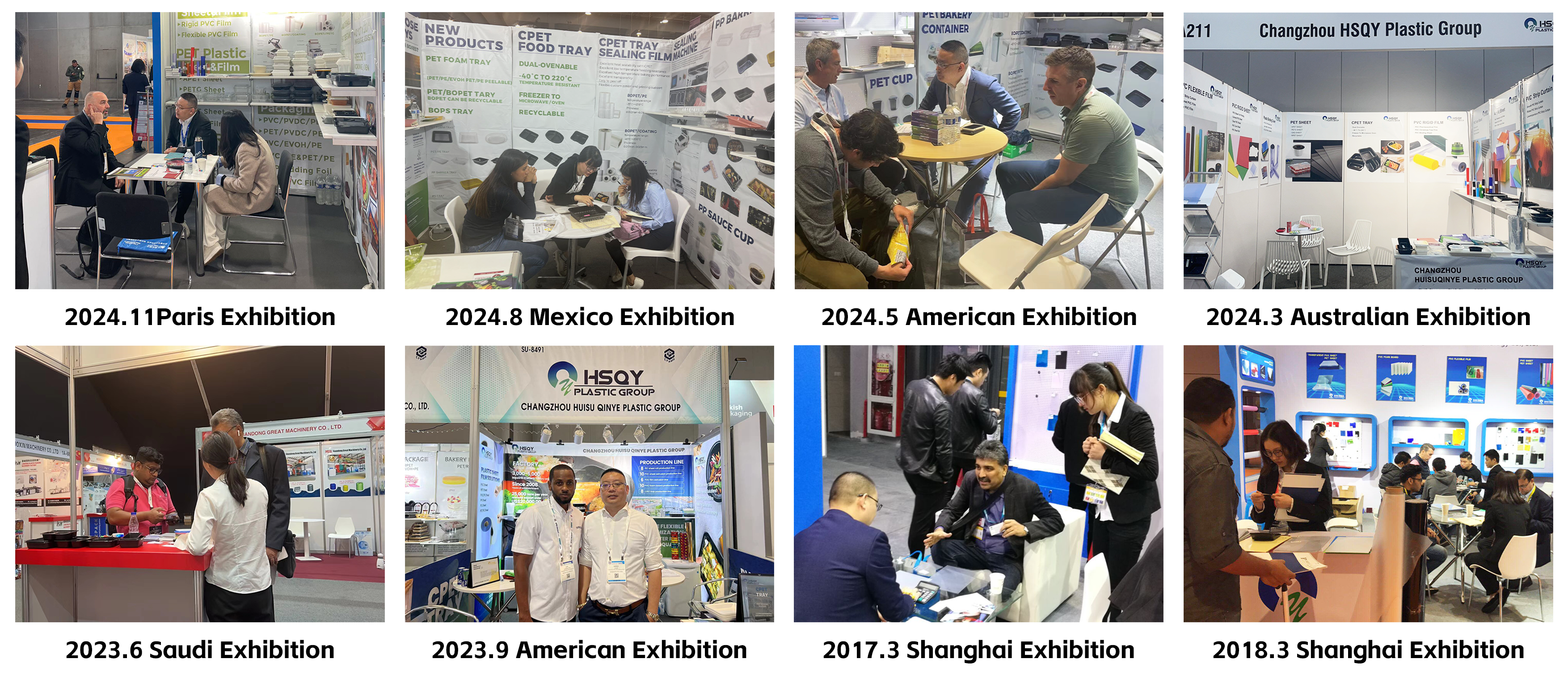
HSQY Plastic Group – International Packaging & Plastics Exhibitions
About HSQY Plastic Group
HSQY Plastic Group supplies PET, PET/PE, PET/EVOH/PE, CPET, PP and other food-packaging trays together with compatible lidding-film solutions for food processors, packaging converters, distributors and international buyers.
Standard and customized tray projects can be reviewed according to food type, temperature cycle, tray dimensions, sealing system, packaging line and annual demand.
Frequently Asked Questions About Low Temperature PET Trays
1. What temperature range is listed for this low temperature PET tray?
The current reference range is approximately -40°C to +60°C (-40°F to +140°F). Final suitability depends on the actual tray structure, product load, freezing process and handling conditions.
2. Can the tray be used for frozen food packaging?
Yes. The tray is designed for evaluation in frozen-food and cold-chain packaging. A filled-product freezer and handling trial is recommended before commercial launch.
3. Is the tray suitable for deep-freeze storage at -40°C?
The published reference range extends to approximately -40°C. Performance should still be validated using the actual tray geometry, food weight, freezing method, storage duration and impact conditions.
4. What material is the tray made from?
The product is currently listed within HSQY's PET/PE tray range. The exact PET/PE construction and material specification should be confirmed when the order is placed.
5. Can the PET/PE tray be heat sealed?
Compatible PET/PE trays can be heat sealed with suitable lidding films. The tray, film and sealing-machine parameters should be tested together before production.
6. Which lidding film should I use?
The lidding film should match the actual tray sealing surface and required seal type. Provide your tray sealer, seal requirement, storage temperature and barrier requirements so compatibility can be reviewed.
7. Are easy-peel lidding films available?
Easy-peel sealing systems can be evaluated with a compatible tray and lidding film. Peel performance must be tested using the actual sealing conditions.
8. Is the tray suitable for MAP packaging?
MAP suitability depends on the complete tray structure and required oxygen barrier. For products requiring a high oxygen barrier, PET/EVOH/PE should be evaluated rather than assuming a standard PET/PE tray provides equivalent barrier performance.
9. What is the difference between PET/PE and PET/EVOH/PE trays?
PET/PE provides PET-based structure with a sealing layer, while PET/EVOH/PE adds an EVOH layer for applications requiring higher oxygen-barrier performance.
10. Can this tray be used in a microwave?
This low-temperature PET/PE tray should not be presented as microwave-safe unless the exact tray has been specifically designed and validated for that use.
11. Can this tray be used in a conventional oven?
No general conventional-oven claim should be made for this PET/PE tray. Qualified CPET trays are the appropriate HSQY product family for higher-temperature freezer-to-oven applications.
12. What sizes are available?
Current standard sizes are 220 × 170 × 32mm and 220 × 170 × 38mm. Custom dimensions can be discussed according to the project and order volume.
13. What colors are available?
The current product range includes clear and colored options. White, black and other custom colors should be confirmed according to the selected specification and order quantity.
14. Can the tray size and flange be customized?
Custom dimensions, depth and flange design can be discussed for suitable production volumes. Provide a drawing, existing tray or sealing-tool dimensions where possible.
15. Are these trays suitable for automatic tray-sealing lines?
They can be evaluated for automated packaging lines. Tray dimensions, flange geometry, denesting behavior and tooling compatibility should be checked on the actual equipment.
16. Are PET/PE trays recyclable?
Recyclability depends on the complete PET/PE structure and local collection and recycling systems. Buyers should confirm acceptance under the rules applicable in their target market.
17. What is the MOQ?
The current listed MOQ is 30,000 pieces. Custom colors, tooling or special structures may require different commercial quantities.
18. What information should I provide for a quotation?
Please provide the food type, fill weight, tray size, color, lowest storage temperature, freezing process, lidding-film requirement, tray-sealing machine, expected quantity, destination market and required food-contact documentation.
Request a Low Temperature PET/PE Tray Quote
HSQY supplies low temperature PET/PE trays for frozen, refrigerated and cold-chain food packaging, with standard and customized tray formats for commercial food processors and packaging distributors.
Send your food product, temperature cycle, tray dimensions, sealing system and expected annual volume so our team can review the appropriate tray specification and provide samples and pricing.
Contact HSQY for Samples and Pricing

 English
 简体中文
 繁體中文
 العربية
 Français
 Русский
 Español
 Português
 Deutsch
 italiano
 日本語
 한국어
 Nederlands
 Tiếng Việt
 ไทย
 Polski
 Türkçe
 አማርኛ
 ພາສາລາວ
 ភាសាខ្មែរ
 Bahasa Melayu
 ဗမာစာ
 தமிழ்
 Filipino
 Bahasa Indonesia
 magyar
 Română
 Čeština
 Монгол
 қазақ
 Српски
 हिन्दी
 فارسی
 Kiswahili
 Slovenčina
 Slovenščina
 Norsk
 Svenska
 українська
 Ελληνικά
 Suomi
 Հայերեն
 עברית
 Latine
 Dansk
 اردو
 Shqip
 বাংলা
 Hrvatski
 Afrikaans
 Gaeilge
 Eesti keel
 Māori
 සිංහල
 नेपाली
 Oʻzbekcha
 latviešu
 অসমীয়া
 Aymara
 Azərbaycan dili
 Bamanankan
 Euskara
 Беларуская мова
 भोजपुरी
 Bosanski
 Български
 Català
 Cebuano
 Corsu
 ދިވެހި
 डोग्रिड ने दी
 Esperanto
 Eʋegbe
 Frysk
 Galego
 ქართული
 guarani
 ગુજરાતી
 Kreyòl ayisyen
 Hausa
 ʻŌlelo Hawaiʻi
 Hmoob
 íslenska
 Igbo
 Ilocano
 Basa Jawa
 ಕನ್ನಡ
 Kinyarwanda
 गोंगेन हें नांव
 Krio we dɛn kɔl Krio
 Kurdî
 Kurdî
 Кыргызча
 Lingala
 Lietuvių
 Oluganda
 Lëtzebuergesch
 Македонски
 मैथिली
 Malagasy
 മലയാളം
 Malti
 मराठी
 ꯃꯦꯇꯥꯏ (ꯃꯅꯤꯄꯨꯔꯤ) ꯴.
 Mizo tawng
 Chichewa
 ଓଡ଼ିଆ
 Afaan Oromoo
 پښتو
 ਪੰਜਾਬੀ
 Runasimi
 Gagana Samoa
 संस्कृत
 Gaelo Albannach
 Sepeti
 Sesotho
 chiShona
 سنڌي
 Soomaali
 Basa Sunda
 Wikang Tagalog
 Тоҷикӣ
 Татарча
 తెలుగు
 ትግንያውያን
 Xitsonga
 Türkmençe
 संस्कृत
 ئۇيغۇرچە
 Cymraeg
 isiXhosa
 ייִדיש
 Yorùbá
 isiZulu


