Polycarbonate Overlay Film for ID Cards & Card Manufacturing
HSQY polycarbonate overlay film is a thin PC film designed for plastic card manufacturing, laminated card structures, laser-personalized cards, printed cards and other precision card applications.
The current product specification lists transparent, porcelain-white and milk-white polycarbonate film with smooth, frosted, glossy and matte surface options. Source-listed thicknesses include 0.05mm, 0.06mm, 0.075mm, 0.10mm, 0.125mm, 0.175mm and 0.25mm, with customized specifications available for qualified B2B projects.
Printing and personalization requirements should be specified before ordering. Standard printable PC film, clear overlay film and laserable polycarbonate film are not automatically the same grade, and buyers should confirm the required layer position, lamination process and laser-personalization method.
HSQY can discuss custom thickness, sheet or roll format, color, surface texture and printing requirements according to the customer's card construction and production equipment.
Polycarbonate Overlay Film Specifications
| Property |
Current Source Specification |
Buyer Should Confirm |
| Product |
Polycarbonate Overlay Film / PC Card Material |
Overlay, core, printable or laserable layer |
| Material |
Polycarbonate / PC |
Exact PC resin and functional grade |
| Material Source |
Current source states 100% new polycarbonate material |
Required resin documentation |
| Source-Listed Thicknesses |
0.05 / 0.06 / 0.075 / 0.10 / 0.125 / 0.175 / 0.25mm |
Thickness tolerance and actual production range |
| Page Title Range |
Current legacy title references 0.18-0.8mm |
Must be reconciled with the actual SKU before publication |
| Current Top Attribute |
Existing website currently displays 0.8-15mm |
This conflicts with the card-film specification and should be corrected |
| Colors |
Transparent, Porcelain White, Milk White |
Opacity, transmission and custom-color requirement |
| Surface Options |
Smooth, Frosted, Glossy, Matte |
One-side / two-side surface combination and roughness requirement |
| Manufacturing Process |
Current source lists calendering |
Confirm applicable production process for final grade |
| Printing Options |
CMYK Offset Printing, Silk-Screen Printing, Security Printing, Laser Printing |
Ink system, print side, curing process and adhesion requirement |
| Laser Personalization |
Laser-card applications are referenced in the source |
Laserable grade, wavelength, card layer and required image contrast |
| Supply Format |
Custom sizes |
Sheet or roll, width, length, core and roll OD |
| Main Application |
Plastic card making, laser engraving cards, laser printing cards |
Final card construction and lamination conditions |
What Is Polycarbonate Overlay Film?
Polycarbonate overlay film is a thin PC layer used in laminated plastic-card structures. Depending on the card design, it can function as a transparent protective outer layer, a printable layer or part of a laser-personalized card construction.
During card production, compatible polycarbonate layers are assembled and processed using controlled heat and pressure. The finished multilayer structure can then proceed through printing, personalization, die cutting, punching and other card-production steps according to the card program.
The exact film grade matters. Transparent overlay, white card-core film, standard printable PC and laserable PC can have different formulations, textures and processing requirements.
Laserable vs Non-Laserable Polycarbonate Film
| Grade |
Main Function |
Buyer Should Specify |
| Clear Non-Laserable Overlay |
Transparent protective or functional card layer where laser marking is not required in that layer |
Thickness, transparency, surface combination and lamination process |
| Laserable PC Film |
Supports laser-generated text, images or personalization when a suitable laser-reactive grade is used |
Laser system, wavelength, target contrast, film position and card construction |
| White / Opaque PC Core Film |
Provides opacity and a printable or structural layer inside the card |
Opacity, whiteness, thickness and printing requirement |
Buyers should not assume that every transparent polycarbonate film is laserable. Laser personalization requires a compatible PC grade and should be validated using the actual laser equipment and complete card structure.
Surface Finish Options for PC Card Film
Surface structure affects appearance, printing, handling, lamination and final card feel. The source specification lists smooth, frosted, glossy and matte options.
| Surface |
Typical Purpose |
| Glossy / Smooth |
High-gloss visual appearance, transparent card layers and selected printed applications |
| Matte |
Reduced surface glare and controlled visual texture |
| Frosted |
Diffused or textured appearance where full optical clarity is not required |
| Custom Surface Combination |
One-side or two-side surface combinations should be specified according to printing and card-construction requirements |
Printing on Polycarbonate Card Film
The current HSQY source lists CMYK offset printing, silk-screen printing, security printing and laser printing as applicable card-production processes.
Offset Printing
Offset printing can be used for card graphics where the PC surface, ink system and curing process are compatible. Buyers should specify whether printing occurs before or after lamination.
Screen Printing
Screen printing can be used for opaque colors, security graphics, functional inks and selected decorative layers. Ink adhesion and lamination behavior should be tested using the actual printing system.
Security Printing
Security-card manufacturers may require specialized printed elements. The film supplier should receive the required substrate, surface, ink and processing specifications without assuming that all security-printing systems behave identically.
Laser Personalization
Laserable card film must be specifically selected for the personalization system. Standard transparent PC overlay should not automatically be marketed as laser-reactive unless the exact grade has been designed and tested for that purpose.
Polycarbonate Film for Laminated Card Construction
A polycarbonate card can use multiple PC film layers with different functions. A typical project may combine transparent outer layers, printed layers, opaque white layers, laser-personalization layers and chip or antenna inlays according to the card design.
Successful lamination depends on the compatibility of all layers, lamination temperature, pressure, dwell time, surface condition and total card construction.
For new projects, provide the complete layer stack and current material specification rather than selecting overlay film only by thickness.
Card Applications
ID Cards
Polycarbonate film can be used in multilayer identification-card structures where durability, dimensional stability, printing and personalization requirements are important.
Driver Licenses and Access Cards
Card manufacturers can specify clear overlay, white core and laserable PC layers according to document design and personalization requirements.
Smart Cards
Smart-card constructions may combine printed PC films with contact or contactless components. Layer structure and lamination conditions should be validated with the complete card design.
Security Documents
Security-document applications require tightly controlled materials, card design and personalization processes. Film suitability must be evaluated against the customer's technical and regulatory requirements.
Polycarbonate Film Product Images

Polycarbonate Film for Card Manufacturing

Polycarbonate Film Applications

PC Film Application Examples
Transparent vs White Polycarbonate Card Film
| Film Type |
Main Function |
Important Specification |
| Transparent PC Film |
Clear overlay, transparent card layers and selected printable layers |
Transmission, haze, surface and thickness tolerance |
| Porcelain White PC Film |
Opaque card layer and printed card construction |
Whiteness, opacity, printability and layer position |
| Milk White PC Film |
Semi-opaque or visual-design card layers depending on specification |
Transmission, opacity and color tolerance |
Optional Functional Polycarbonate Film Grades
Standard card overlay film should not automatically be described as UV-resistant, flame-retardant, hard-coated, scratch-resistant or laserable. These are grade-specific functions.
| Optional Grade |
When to Specify |
| Laserable PC |
When permanent laser-generated text, images or personalization are required |
| Flame-Retardant PC |
When a specified flammability standard and rating are required |
| UV-Protected PC |
When the finished application requires defined UV exposure resistance |
| Hard-Coated PC |
When improved scratch, abrasion or chemical resistance is required |
| Optical-Grade PC |
When tighter haze, transmission or optical-defect requirements apply |
Critical Quality Requirements for PC Card Film
Thickness and thickness tolerance.
Film width and dimensional tolerance.
Flatness and curl.
Surface combination and texture consistency.
Transparency, haze or opacity.
Print adhesion and ink compatibility.
Lamination compatibility with the complete card stack.
Laserability where required.
Surface defects, scratches and contamination limits.
Sheet or roll packing specification.
Information Required for a PC Overlay Film Quote
Final card type: ID card, access card, smart card, driver license or other.
Required PC layer: clear overlay, white core, printable or laserable.
Required film thickness and tolerance.
Sheet dimensions or roll width.
Surface finish on each side.
Transparent, porcelain white, milk white or custom color.
Required haze, transmission or opacity if controlled.
Printing method and ink system.
Laser-personalization requirement.
Lamination temperature, pressure and dwell time.
Complete card layer construction if available.
Required functional grade such as FR, UV or hard coating.
Trial quantity and annual demand.
Packing requirement and destination country.
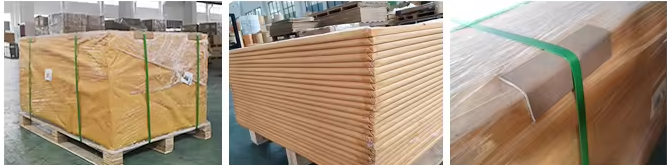
Packing
Polycarbonate card film should be packed to protect the surface from scratches, dust, moisture and handling damage during storage and transportation.
Buyers should specify sheet or roll format, protective interleaving or masking requirements, carton dimensions, pallet configuration and labeling requirements when appearance or clean handling is critical.

Polycarbonate Film Packing
Frequently Asked Questions About Polycarbonate Overlay Film
What is polycarbonate overlay film used for?
Polycarbonate overlay film is used as a thin functional or protective layer in laminated plastic cards, including ID cards, access cards, smart cards and other card constructions.
What thicknesses are available?
The supplied product specification currently lists 0.05, 0.06, 0.075, 0.10, 0.125, 0.175 and 0.25mm. The existing page title and top product attributes contain conflicting thickness ranges, so HSQY should confirm and standardize the final production range before publication.
Is every polycarbonate overlay film laserable?
No. Laserable PC film is a specific functional grade. Buyers should specify whether laser-generated text or images are required and provide the laser system and card-construction information.
What is the difference between clear overlay and white PC film?
Clear overlay is typically selected where transparency is required, while white or opaque PC film can be used as an internal card layer or printing substrate. The exact function depends on the complete card construction.
Can polycarbonate film be offset printed?
The current HSQY specification lists CMYK offset printing. Ink compatibility, curing conditions, print side and lamination performance should be tested with the actual production process.
Can PC overlay film be screen printed?
Yes, screen printing is listed among the current applications. Buyers should approve the exact film surface, ink and curing process before mass production.
What surface finishes are available?
The source specification lists smooth, frosted, glossy and matte finishes. If different finishes are required on each side, specify the required surface combination in the quotation.
Is all polycarbonate film flame retardant?
No. A specific flame-retardant grade should be selected when a defined fire classification is required. Provide the test standard, required rating and film thickness.
Is standard PC card film UV resistant?
UV performance is grade-specific. If long-term UV exposure is important, request a UV-protected polycarbonate grade with applicable test data.
Can HSQY supply custom thicknesses?
The source states that customized thicknesses can be discussed. Production feasibility, tolerance and MOQ should be confirmed for the required gauge.
Can the film be supplied in sheets or rolls?
Custom sizes are supported by the current product information. Buyers requiring rolls should specify width, core diameter, maximum roll OD and roll weight; sheet buyers should specify length, width and tolerance.
What should I provide for a new ID card project?
Provide the complete card layer structure, thickness of each layer, printing process, laser-personalization requirement, lamination settings, surface finish, dimensions and annual demand.
Should samples be tested before mass production?
Yes. Card-film samples should be evaluated using the actual printing, lamination, laser-personalization, die-cutting and card-testing process before bulk approval.
Why Choose HSQY Polycarbonate Film?
HSQY supplies polycarbonate films in transparent, white, colored and customized specifications for card manufacturing, printing, electronics, optical applications and other industrial converting projects.
Buyers can discuss film thickness, dimensions, surface finish, color and application-specific functionality according to their processing requirements.
Explore the complete HSQY Polycarbonate Film range for clear, flame-retardant, optical-grade and tinted PC film options.