750ml 3 Compartment Cornstarch Lunch Box with Lid
HSQY 750ml 3 compartment cornstarch lunch box with lid measures 215×187×46mm and uses beige Cornstarch + PP material for portion-separated takeaway meals, catering, canteens and meal delivery.
The rectangular three-section design helps organize a main dish and two side portions in one disposable food container. It is suitable for restaurants, cloud kitchens, catering companies, school meals, corporate canteens and prepared-food programs that require simple meal separation.
The current product information lists the container as suitable for hot and cold food and as microwave and freezer safe. Because the published material composition is Cornstarch + PP, compostability and biodegradability claims should be confirmed against the exact formulation and applicable product documentation.
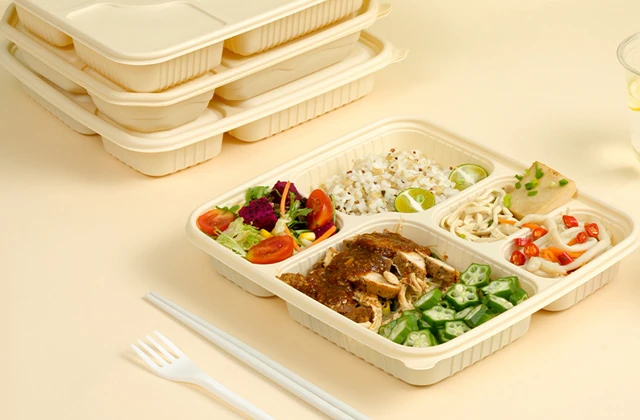
750ml 3 Compartment Cornstarch Lunch Box for Takeaway Meals
3 Compartment Cornstarch Lunch Box Specifications
| Property |
Specification |
| Product Item |
3 Compartment Cornstarch Lunch Box with Lid |
| Material |
Cornstarch + PP |
| Color |
Beige |
| Compartments |
3 Compartments |
| Capacity |
750ml |
| Shape |
Rectangular |
| Dimensions |
215 × 187 × 46mm |
| Lid |
Product is marketed with lid; exact lid material, closure structure and packing should be confirmed |
| Food Use |
Hot and Cold Food |
| Microwave Use |
Listed as microwave safe in current product information |
| Freezer Use |
Listed as freezer safe in current product information |
| Typical Applications |
Takeaway Meals, Catering, Bento Meals, Canteens, School Lunches, Meal Prep and Food Delivery |
Specification Note: The current product details do not publish unit weight, individual compartment volumes, lid material, pieces per carton, carton dimensions, MOQ, exact Cornstarch/PP ratio, maximum operating temperature or specific food-contact documentation. Confirm these parameters before commercial ordering.
750ml Capacity for Individual Meals
The current HSQY specification lists a nominal capacity of 750ml. This positions the container for individual lunch portions rather than the larger full-meal formats used by HSQY's 5- and 6-compartment lunch boxes.
The three-section format is suitable for a main dish together with two side portions, such as rice with meat and vegetables, pasta with salad and fruit, or another balanced meal combination.
Nominal capacity should not automatically be treated as the recommended maximum food fill. Actual usable volume depends on the compartment layout, food shape and clearance required below the lid.
215 × 187 × 46mm Rectangular Meal Box
The published external dimensions are 215 × 187 × 46mm. The rectangular footprint provides three divided meal sections in a relatively compact package for individual takeaway portions.
For automated filling, meal-prep programs or distributor packing, buyers should also confirm dimensional tolerance, nesting height, lid dimensions and carton configuration because these details can affect storage and packing-line compatibility.
3 Compartments for Portion Separation
Three separate cavities allow foodservice operators to organize a main course and two side portions in one lunch box while reducing direct mixing between different dishes.
One common meal configuration is a staple food such as rice or noodles together with a protein portion and vegetables or another side dish.
The individual compartment capacities are not published in the current product information. Buyers with strict portion-control requirements should request a cavity drawing or physical sample before bulk approval.
3 Compartment Cornstarch Bento Box
The three-section layout can be used for bento-style and combination meals where several food items need to remain organized inside one package.
Compared with a single-compartment container, the divided format gives foodservice operators more control over meal presentation and portion placement without requiring several separate containers.
Cornstarch Lunch Box for Takeaway
Restaurants and takeaway kitchens can use the 750ml three-compartment container for individual meal sets where a main dish and side items need to remain separated.
Its smaller capacity compared with larger 5- and 6-compartment meal boxes makes it relevant to standard individual portions, light meals and controlled serving programs.
Before bulk use, takeaway buyers should test the selected tray and lid with the actual food, filling temperature and holding duration.
Cornstarch Lunch Box for Catering
Catering companies can use three-compartment lunch boxes for boxed meals, conferences, staff lunches, events and other group foodservice programs.
The three-section layout allows kitchens to prepare standardized meals with a main item and two sides while reducing the number of separate food packages required for each serving.
For large catering orders, request pieces per carton, carton dimensions, carton gross weight and pallet configuration before calculating landed cost.
Lunch Boxes for School & Canteen Meals
Three-compartment meal boxes can be considered for schools, colleges, factories and corporate canteens that serve standardized meals containing a main dish and side portions.
Institutional buyers should specify required food-contact documentation, hygiene requirements, packing configuration and traceability requirements during the quotation stage.
Lunch Boxes for Meal Prep
The three-section layout is suitable for prepared-meal programs where portions are assembled in advance and need to remain organized until consumption.
Meal-prep operators should evaluate the container using the actual food, storage period, refrigeration or freezing conditions and reheating method.
Lunch Boxes for Cloud Kitchens & Food Delivery
Cloud kitchens and meal-delivery businesses can use a three-compartment format for rice meals, protein-and-vegetable combinations and other menus where side dishes should remain separated during transport.
Delivery programs should evaluate lid retention, stacking stability, condensation, deformation and leakage under realistic transportation conditions before approving the package.
Suitable for Hot & Cold Food
The original HSQY product information states that the lunch box can be used with both hot and cold food.
A specific maximum continuous-use temperature is not provided in the current specification. Buyers packing very hot, oily or wet meals should confirm performance under the intended food temperature and holding time.
Microwave-Safe Use
Microwave-safe use is listed in the current HSQY product information, making the container relevant to meals that may require reheating.
The current specification does not state a validated microwave power, heating duration or maximum food temperature. Buyers with defined reheating procedures should request the applicable test conditions for the exact container and lid.
Freezer-Safe Use
Freezer-safe use is also listed in the original product information.
For frozen or chilled prepared meals, buyers should confirm the required minimum storage temperature, storage duration and subsequent reheating conditions before approving the package.
Sturdy Construction for Foodservice
The original product description states that these food boxes are sturdy and can hold food without easily bending or breaking.
Actual rigidity depends on unit weight, wall thickness, rib design, material formulation, food load and serving temperature. Because unit weight is not currently published, buyers should request this parameter when comparing different suppliers.
Leak & Grease Performance
The original page describes the food boxes as leak-proof, but no standardized leakage or grease-resistance result is included in the current product details.
For curry, gravy, sauces, oily dishes or high-moisture meals, buyers should evaluate the complete tray-and-lid system using the actual food, temperature and delivery duration.
Lid & Closure Requirements
The product is marketed as a lunch box with lid, but the current public specification does not identify the lid material, lid weight or exact closure design.
For takeaway and delivery projects, confirm lid fit, closure retention, venting requirements, stacking performance and whether trays and lids are packed together or separately.
Understanding the Cornstarch + PP Material
The current HSQY technical specification identifies the material as Cornstarch + PP.
The public product information does not disclose the proportion of cornstarch and polypropylene or the complete compound formulation. Buyers requiring defined bio-based content or detailed material declarations should request the applicable technical documentation.
Compostable & Biodegradable Claims
The original HSQY description calls these lunch boxes compostable and biodegradable, while the technical specification identifies the material as Cornstarch + PP.
Commercial compostability or biodegradability claims should therefore be based on the exact supplied formulation and applicable product-specific test report or certification.
Industrial compostable, home compostable and biodegradable are different claims and should not be treated as interchangeable without the required documentation.
Carbon Footprint Claims
The original product description states that cornstarch lunch boxes significantly reduce carbon footprint. A quantified carbon-reduction claim requires comparative lifecycle or carbon-footprint data for the exact product.
Until product-specific comparative data is available, the safer commercial description is to identify the verified Cornstarch + PP composition and documented foodservice performance.
3 Compartment vs. 5 Compartment Lunch Boxes
| Selection Factor |
3 Compartment Box |
5 Compartment Box |
| Food Sections |
3 sections |
5 sections |
| Current HSQY Capacity |
750ml |
Separate HSQY 5-compartment range lists 1000-1450ml |
| Meal Direction |
Main dish plus two sides |
Larger meals requiring more separated food items |
| Best Fit |
Individual lunch, meal prep, light catering and takeaway |
Complete catering meals and larger multi-item portions |
Key B2B Purchasing Parameters
| Parameter |
What Buyers Should Confirm |
| Capacity |
750ml nominal capacity and actual usable fill volume |
| Dimensions |
215 × 187 × 46mm and applicable dimensional tolerances |
| Compartment Volumes |
Individual cavity dimensions or capacities for portion-controlled meals |
| Unit Weight |
Important for rigidity, material usage and supplier comparison |
| Lid Material |
Required for heat performance, closure evaluation and material declarations |
| Closure Performance |
Important for takeaway, stacking and delivery applications |
| Leak / Grease Resistance |
Important for sauces, curry, gravy and oily meals |
| Microwave Conditions |
Heating power, duration and maximum food temperature |
| Freezer Conditions |
Minimum storage temperature and storage duration |
| Food-Contact Documentation |
Required standards for the buyer or destination market |
| Material Declaration |
Exact Cornstarch + PP formulation where required |
| Environmental Documentation |
Applicable documentation for compostability or biodegradability claims |
| Pieces per Carton |
Required for warehouse, pricing and landed-cost calculations |
| Carton Dimensions |
Required for pallet and container-loading calculations |
| MOQ |
Confirm minimum order quantity for commercial purchasing |
What Information Should You Provide for a Quote?
| Requirement |
Information to Provide |
| Application |
Takeaway, catering, bento, meal prep, school meals, canteens or food delivery |
| Food Type |
Rice, noodles, meat, vegetables, curry, sauces or other meal components |
| Portion Requirement |
Required total capacity and preferred compartment distribution |
| Food Temperature |
Hot, chilled, frozen or reheated |
| Microwave Requirement |
Required heating power, duration and temperature if applicable |
| Freezer Requirement |
Minimum storage temperature and storage duration |
| Leak / Grease Requirement |
Specify sauces, curry, gravy, oily or wet food conditions |
| Food-Contact Standard |
Required destination-market or customer documentation |
| Environmental Requirement |
Required material declaration, compostability or biodegradability documentation |
| Packing |
Required pieces per pack, pieces per carton or private-label packing |
| Quantity |
Trial order quantity and expected recurring purchase volume |
| Destination |
Country and destination port |
Frequently Asked Questions About 3 Compartment Cornstarch Lunch Boxes
How many compartments does this lunch box have?
This product uses a three-compartment rectangular meal-box design.
What is the capacity?
The current HSQY technical specification lists a nominal capacity of 750ml.
What are the dimensions?
The current product dimensions are listed as 215 × 187 × 46mm.
What material is the lunch box made from?
The current HSQY specification identifies the material as Cornstarch + PP.
What color is available?
The published product specification lists beige.
Does the lunch box come with a lid?
The product is marketed as a lunch box with lid. The exact lid material, closure structure and packing format should be confirmed before ordering.
What foods can be packed in the three compartments?
The three sections can be used for combinations such as rice with meat and vegetables, noodles with protein and a side dish, or other meals requiring three separated food portions.
Is this lunch box suitable for bento meals?
Yes. The three-section format can be used for bento-style and combination meals where a main dish and side portions need to remain organized.
Can it be used for school lunches?
Yes. The 750ml three-compartment format can be considered for school, college and other institutional meal programs requiring portion-separated lunches.
Can it be used for catering?
Yes. It can be considered for boxed lunches, corporate catering, events and other group-meal programs.
Can it be used for meal delivery?
Yes, but buyers should validate lid retention, stacking, leakage and deformation using the actual food and expected delivery conditions.
Can the lunch box hold hot food?
The current HSQY product information states that it can be used for hot and cold food. A specific maximum continuous-use temperature is not published.
Is the lunch box microwave safe?
Microwave-safe use is listed in the current product information. Buyers requiring a defined reheating protocol should confirm power, time and temperature limits for the exact product.
Is the lunch box freezer safe?
Yes. Freezer-safe use is stated on the current product page. Commercial frozen-meal programs should confirm the required minimum temperature and storage duration.
Are the compartments completely liquid-tight from each other?
The three sections are designed for food separation, but the current product information does not provide a test proving complete liquid isolation between compartments. Buyers packing sauces or liquid food should test the product under actual use conditions.
Is the container leak proof?
The original product description uses leak-proof wording, but no standardized leakage test is published. The complete tray-and-lid system should be tested with the intended food and delivery conditions.
Is it suitable for oily or saucy food?
It can be evaluated for these applications, but the current product details do not publish a quantified grease- or water-resistance result. Samples should be tested using the actual meal.
Is the cornstarch lunch box compostable?
The original product description uses compostable wording, while the technical specification lists Cornstarch + PP. Buyers requiring a compostability claim should request the exact material formulation and applicable product-specific certification.
Is the lunch box biodegradable?
The original page uses biodegradable wording. Because PP is included in the published material composition, biodegradability should be verified using the applicable product-specific test documentation.
What is the unit weight?
Unit weight is not included in the current HSQY product details. Request this parameter when comparing rigidity, material usage and quotations from different suppliers.
How many containers are packed per carton?
Pieces per carton are not published in the current product details. Request the packing specification when calculating freight, storage and landed cost.
What food-contact certifications are available?
Specific food-contact certificates are not listed in the supplied product content. Buyers should state the required destination-market or customer standard for confirmation.
What is the MOQ?
The current public product details do not state a minimum order quantity. Confirm MOQ together with packing and commercial terms when requesting a quotation.
What information should I provide for a quotation?
Provide the meal application, portion requirement, food type, microwave or freezer conditions, leak and grease requirements, food-contact and environmental documentation, packing requirement, quantity and destination.


