450ml 6"×6"×3" Cornstarch Clamshell Food Container
HSQY 450ml cornstarch clamshell food container is a white 6"×6"×3" square takeaway box with a single compartment and hinged lid for burgers, sandwiches, fries, snacks and smaller prepared meals.
The current product specification lists Cornstarch + PP material, 152 × 152 × 74mm dimensions and a 450ml nominal capacity. It is designed for hot or cold food and is listed as microwave and freezer safe.
Its compact single-compartment format is suitable for fast-food restaurants, burger shops, cafés, food trucks, catering businesses and takeaway operators that need a hinged food box for individual portions.
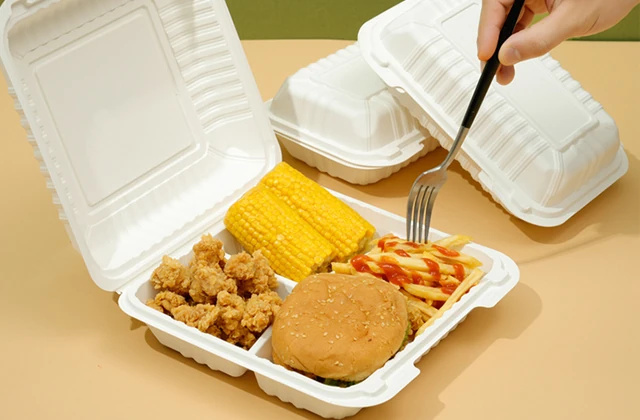
6"×6"×3" Cornstarch Clamshell Takeaway Container
450ml Cornstarch Food Container Specifications
| Property |
Specification |
| Product Item |
Cornstarch Clamshell Food Container |
| Material |
Cornstarch + PP |
| Color |
White |
| Capacity |
450ml |
| Compartments |
1 Compartment |
| Shape |
Square |
| Dimensions |
152 × 152 × 74mm |
| Nominal Size |
6" × 6" × 3" |
| Lid Style |
Integrated Hinged Clamshell Lid |
| Food Use |
Hot and Cold Food |
| Microwave Use |
Listed as microwave safe in current product information |
| Freezer Use |
Listed as freezer safe in current product information |
| Typical Applications |
Burgers, Sandwiches, Fries, Snacks, Desserts, Small Meals, Takeaway and Catering |
Specification Note: The current product information does not publish unit weight, pieces per carton, carton dimensions, minimum order quantity, exact Cornstarch/PP material ratio, maximum temperature, food-contact certification or compostability certification. Confirm these parameters before placing a commercial order.
6"×6"×3" Cornstarch Burger Box
The 6-inch square format is particularly suitable for burgers, sandwiches and smaller takeaway meals. Its compact footprint helps reduce unused package space when a larger 8-inch or 9-inch clamshell is unnecessary.
The original HSQY description specifically identifies burgers and fries as key applications for this product. For burger shops and fast-food operators, the single open cavity allows the main item and side portion to be packed together.
450ml Capacity for Smaller Takeaway Portions
The current product specification lists a nominal capacity of 450ml, positioning this container below HSQY's larger 1000ml 8-inch clamshell.
This capacity can be considered for burgers, snacks, sandwiches, fries, desserts and smaller meal portions where a compact takeaway package is preferred.
Nominal capacity should not automatically be treated as the maximum recommended food fill. Actual usable volume depends on food shape, lid clearance and transportation requirements.
Single-Compartment Food Container
The one-compartment design provides one open food cavity without internal dividers. This makes it suitable for food items that can be packed together rather than requiring separate sections.
Compared with multi-compartment meal boxes, the single-cavity configuration provides more uninterrupted internal space for burgers, sandwiches and irregularly shaped food items.
Integrated Hinged Lid Design
The clamshell structure combines the base and lid in one hinged container. Foodservice staff do not need to match a separate loose lid during filling and packing.
This design can simplify takeaway assembly in restaurants, cafés and catering kitchens where containers are repeatedly opened, filled and closed during high-volume service.
For meal-delivery applications, hinge strength and closure retention should be evaluated using the actual food and transportation conditions.
Cornstarch Burger Box for Fast Food Takeaway
Burger shops and fast-food restaurants can use the compact clamshell format for hamburgers, cheeseburgers, chicken burgers and similar menu items.
When burgers include sauces, cheese or oily ingredients, buyers should test grease resistance and closure performance using the actual recipe because the current public specification does not provide a quantified grease-resistance test.
Cornstarch Container for Sandwiches
The 6-inch square container can also be considered for sandwiches and other compact takeaway food where an integrated hinged lid is preferred over a separate base-and-lid system.
For tall sandwiches or products with substantial toppings, verify internal lid clearance using a production sample before confirming the packaging format.
Cornstarch Container for Fries & Snacks
Fries, fried snacks, pastries and other smaller food portions can also be packed in the single-compartment box.
For freshly fried food, operators should consider steam and condensation after closing the hinged lid. If ventilation is required, confirm whether the current mold provides ventilation features or whether a different container design is more appropriate.
Cornstarch Food Box for Cafés
Cafés and grab-and-go operators can use a 450ml clamshell for sandwiches, pastries, snacks, desserts and smaller prepared meals.
The square footprint supports organized stacking in food-preparation and takeaway areas, subject to the actual nesting and stacking configuration of the supplied product.
Cornstarch Container for Catering
Catering companies can use compact clamshell containers for snacks, sandwiches, desserts and individual food portions at events, staff meals and group-service programs.
For large catering orders, pieces per carton, carton dimensions, gross weight and pallet loading should be confirmed because these commercial logistics specifications are not currently published on the HSQY page.
Cornstarch Food Container for Meal Delivery
The hinged clamshell can be considered for short-distance takeaway and meal-delivery applications where one compact container is required for filling, closing and transport.
Delivery operators should evaluate closure retention, leakage, condensation and deformation under realistic food temperature, stacking and transportation conditions.
Suitable for Hot & Cold Food
The original HSQY product description states that the container can be used for both hot and cold food.
The current source does not publish a maximum continuous-use temperature. For very hot, oily or liquid food, buyers should verify the package under the actual serving temperature and holding time.
Microwave-Safe Use
Microwave-safe use is listed in the current HSQY product information, supporting foodservice programs where customers may reheat prepared meals.
No maximum microwave power, duration or food-temperature limit is published in the current specification. Commercial users with a defined reheating protocol should request the applicable test conditions before approval.
Freezer-Safe Use
Freezer-safe use is also listed in the existing product description.
For frozen or chilled food programs, specify the required minimum storage temperature, storage period and reheating conditions so the container can be evaluated according to the actual application.
Sturdy Clamshell Construction
The original page describes the food container as sturdy and durable and states that it can hold food without easily bending or breaking.
Actual stiffness depends on unit weight, wall thickness, rib design, food load and temperature. Buyers requiring specific compression or stacking performance should request corresponding product data or test samples.
Leak Resistance
The original HSQY description refers to leak-proof performance, but no standardized leakage test or liquid-holding time is published.
For sauces, gravy or high-moisture food, test the complete closed container at the intended temperature and delivery duration before bulk purchasing.
Cornstarch + PP Material
The published HSQY technical specification identifies this food container as Cornstarch + PP.
The current page does not disclose the percentage of starch and polypropylene or provide the complete compound formulation. Buyers requiring detailed material declarations should request the applicable specification before approving the product.
This distinction is especially important where foodservice brands intend to make recycling, renewable-content, biodegradable or compostable claims.
Compostable & Biodegradable Claims
The original page describes the starch-based container as compostable and biodegradable, while the technical specification identifies the material as Cornstarch + PP.
For commercial use of compostable or biodegradable claims, buyers should confirm the exact compound formulation and request the relevant test report or certification for the supplied container.
Industrial compostable, home compostable and biodegradable are different claims and should not be treated as interchangeable without the applicable technical documentation.
Carbon Footprint Claims
The original product description states that using cornstarch containers significantly reduces carbon footprint.
A quantified carbon-reduction claim requires supporting lifecycle or carbon-footprint data for the exact product and comparison scenario. Until such data is available, the safer description is a cornstarch-based food packaging option with a published Cornstarch + PP formulation.
6-Inch vs. 8-Inch Cornstarch Clamshell
| Selection Factor |
6" HSQY Container |
8" HSQY Container |
| Nominal Size |
6" × 6" × 3" |
8" × 8" × 3" |
| Published Dimensions |
152 × 152 × 74mm |
205 × 205 × 74mm |
| Published Capacity |
450ml |
1000ml |
| Compartments |
1 Compartment |
1 or 3 Compartments |
| Primary Direction |
Burger, sandwich, fries, snacks and smaller takeaway portions |
Full meals, large portions and combination meals |
Important B2B Purchasing Parameters
| Parameter |
Why It Matters |
| Unit Weight |
Important for stiffness, material usage and supplier comparison; not currently published |
| Exact Dimensions |
Confirm 152 × 152 × 74mm against filling, storage and carton requirements |
| Usable Capacity |
Important for matching real food portions to the nominal 450ml container |
| Closure Performance |
Important for takeaway and meal-delivery transport |
| Hinge Strength |
Relevant to repeated opening and closing during packing |
| Leak / Grease Resistance |
Important for burgers, sauces and oily foods |
| Microwave Conditions |
Confirm heating time, power and maximum food temperature if required |
| Freezer Conditions |
Confirm minimum storage temperature and duration |
| Food-Contact Documentation |
Required standards depend on customer and destination market |
| Material Declaration |
Important because the published formulation is Cornstarch + PP |
| Compostability Documentation |
Required if the finished product will be marketed using compostability claims |
| Pieces per Carton |
Required for landed-cost and warehouse calculations |
| Carton Dimensions |
Important for pallet and container-load planning |
| MOQ |
Not published in the current source and should be confirmed commercially |
What Information Should You Provide for a Quote?
| Requirement |
Information to Provide |
| Application |
Burger, sandwich, fries, snack, dessert, takeaway meal or other food |
| Food Temperature |
Hot, chilled, frozen or reheated |
| Food Characteristics |
Dry, oily, wet, saucy or other relevant condition |
| Microwave Requirement |
Required power, heating time and temperature if applicable |
| Freezer Requirement |
Minimum storage temperature and duration |
| Closure / Leak Requirement |
Specify whether the package will be used for delivery or high-moisture food |
| Food-Contact Standard |
Required destination-market or customer documentation |
| Environmental Requirement |
Required material declaration, biodegradability or compostability documentation |
| Packaging |
Required pieces per bag, pieces per carton, private-label or export-carton requirement |
| Quantity |
Trial quantity and expected recurring purchase volume |
| Destination |
Country and destination port |
Frequently Asked Questions About 6-Inch Cornstarch Clamshells
What is the capacity of this cornstarch food container?
The current HSQY product specification lists a nominal capacity of 450ml.
What are the dimensions?
The current technical table lists 152 × 152 × 74mm, while the commercial product name identifies the format as approximately 6" × 6" × 3".
How many compartments does it have?
This specific product is listed as a single-compartment clamshell.
Does the container have a hinged lid?
Yes. The food container uses an integrated hinged clamshell lid.
What material is the container made from?
The current HSQY specification lists the material as Cornstarch + PP.
What color is the container?
The current product specification lists white.
Is the 6-inch box suitable for burgers?
Yes. Burgers and fries are specifically identified as applications in the current HSQY product description.
Can it be used for sandwiches?
Yes. The square single-compartment format can be considered for sandwiches and similar compact takeaway foods when the internal dimensions provide sufficient clearance.
Can it hold fries and fried food?
Yes, fries are specifically referenced in the original application description. For freshly fried foods, consider condensation and steam after closing the lid.
Can the container hold hot food?
The current product information states that it can be used for hot or cold food. A specific maximum continuous-use temperature is not published.
Is this container microwave safe?
Microwave-safe use is listed in the current product information. The page does not publish a specific heating time, power or maximum temperature.
Is it freezer safe?
Yes. Freezer-safe use is stated on the current page. Buyers with defined frozen-food requirements should confirm the minimum temperature and storage duration.
Is this container leak proof?
The original description uses leak-proof wording, but no standardized leakage test is currently published. Test the container with the intended food and delivery conditions if leakage performance is critical.
Is this cornstarch container compostable?
The original product description uses compostable wording, but the technical table identifies the material as Cornstarch + PP. Buyers requiring a compostable claim should request the exact material formulation and applicable certification.
Is the container biodegradable?
The original page uses biodegradable positioning. Because PP is included in the published composition, this claim should be verified using product-specific material and test documentation.
Does the container reduce carbon footprint?
The original page makes a carbon-footprint claim but does not publish lifecycle assessment data. A quantified reduction claim should only be used when supported by applicable comparative evidence.
How many containers are packed per carton?
The current HSQY page does not publish pieces per carton. Request the packing specification when calculating landed cost and container loading.
What is the unit weight of the container?
Unit weight is not currently published. This is an important purchasing parameter for comparing stiffness, material usage and prices between suppliers.
What food-contact certifications are available?
Specific food-contact certifications are not listed in the supplied product content. Buyers should provide the required destination-market or customer standard for confirmation.
What is the MOQ?
The current public page does not state a minimum order quantity. Confirm MOQ together with packing and commercial terms when requesting a quote.
What information should I provide for a quotation?
Provide the food application, food temperature, microwave or freezer requirements, leak and grease requirements, food-contact and environmental documentation, packing specification, quantity and destination.


