Clear GAG PET Sheet for Blister and Food Packaging
HSQY clear GAG PET sheet is a three-layer PETG/APET/PETG co-extruded sheet developed for transparent blister packaging, thermoformed trays, clamshells, folding boxes and other clear packaging applications requiring a balance of clarity, rigidity, toughness and forming performance.
The GAG structure uses PETG as the two outer A layers and APET as the central B layer. The PETG surfaces support demanding forming, folding, bonding and fabrication requirements, while the APET core provides structural rigidity and helps control material cost compared with using PETG throughout the full sheet thickness.
HSQY currently supplies clear GAG PET sheet in thicknesses from 0.15mm to 3mm, roll widths from 110mm to 1280mm, and cut-sheet sizes including 915×1220mm and 1000×2000mm. Customized thickness, width, sheet dimensions, color and packing can be discussed according to the project.
For food, medical or other regulated packaging applications, buyers should request current product-specific compliance documentation covering the exact resin, GAG structure, additives, intended contact conditions and destination market before commercial use.
Request Clear GAG PET Sheet Quote
What Is GAG PET Sheet?
GAG PET sheet, also called PETG/APET/PETG sheet or G-PET-G sheet, is a co-extruded polyester sheet with a symmetrical A/B/A multilayer structure.
Unlike standard APET sheet, which consists primarily of amorphous PET, GAG adds PETG surface layers. These outer layers can improve processing performance in applications involving deeper thermoforming, folding, bonding, printing or higher resistance to stress whitening and cracking.
Compared with a full PETG sheet, GAG retains an APET core. This makes it useful where PETG-like surface performance is desirable but using PETG throughout the entire thickness is not necessary.
PETG/APET/PETG Three-Layer Structure
| Layer |
Material |
Function |
| A Layer |
PETG |
Outer processing surface supporting forming, folding, bonding, printing and fabrication |
| B Layer |
APET |
Provides rigidity and helps control total material cost |
| A Layer |
PETG |
Provides the second functional surface in the symmetrical A/B/A construction |
For projects where the exact PETG/APET/PETG layer ratio affects forming, sealing or cost, buyers should request the production structure from HSQY rather than assuming a fixed percentage for every GAG grade.
PET GAG Sheet Data Sheet
The original product page includes the following GAG sheet technical data document:
![PET GAG sheet PDF data sheet]() Download PET GAG Sheet Data Sheet
Download PET GAG Sheet Data Sheet
Clear GAG PET Sheet Specifications
The following specifications are based on the current product information. Final tolerance, roll configuration, optical properties, layer ratio and regulatory requirements should be confirmed in the approved purchase specification.
| Property |
Current HSQY Specification |
Buyer Should Confirm |
| Product |
Clear GAG PET Sheet for Blister and Packaging |
Finished package and forming process |
| Structure |
PETG / APET / PETG, A/B/A |
Layer ratio when technically important |
| Thickness |
0.15mm–3mm |
Nominal gauge and tolerance |
| Roll Width |
110mm–1280mm |
Slit width and width tolerance |
| Sheet Size |
915×1220mm, 1000×2000mm, Customized |
Finished dimensions and cutting tolerance |
| Density |
1.33–1.35g/cm³ |
Final value for approved grade |
| Color |
Clear, Customized |
Transparency, tint and color tolerance |
| Supply Format |
Roll and Cut Sheet |
Core, roll OD, roll weight or sheet packing |
| Applications |
Blister Packaging, Thermoformed Trays, Folding Boxes, Electronics Packaging and Decorative Applications |
Application-specific test requirements |
| MOQ |
1000kg |
Special color or size MOQ may differ |
| Production Capacity |
Current Source States 50 Tons per Day |
Confirm current capacity for supply contracts |
| Quality Documentation |
Current Source References SGS and ISO 9001:2008 |
Request current applicable certificates and reports |
| Payment Terms |
T/T, L/C, Western Union, PayPal |
Confirm with commercial quotation |
| Delivery Terms |
EXW, FOB, CNF, DDU |
Confirm quotation Incoterm |
| Reference Lead Time |
7–15 Days for 1–20,000kg |
Subject to grade, dimensions, color and production schedule |
Why Use GAG PET Sheet for Blister Packaging?
High Product Visibility
Clear GAG sheet can provide strong product visibility for retail blisters, clamshells, transparent trays and folding boxes. Where optical quality is critical, buyers should specify measurable haze, light transmission and acceptable surface-defect limits.
Improved Formability Compared with Standard APET
PETG outer layers can provide a more forgiving forming surface for deep cavities, sharp corners and demanding thermoformed package designs. Actual improvement depends on sheet grade, layer ratio, thickness and forming conditions.
Reduced Stress Whitening and Cracking
GAG is worth evaluating when conventional APET shows stress whitening, cracking or poor performance around tight folds and deeply formed areas.
Balanced Rigidity
The APET core contributes rigidity so blister packs, folding boxes and formed trays can retain useful structural stability while benefiting from PETG surface characteristics.
Printing and Decoration
GAG sheet can be evaluated for printed packaging and decorative applications. Ink adhesion depends on sheet surface, ink chemistry, printing technology and any required surface treatment, so production testing is recommended.
Folding and Bonding Performance
PETG surfaces can be advantageous for clear folding-box applications where crease quality, folding behavior and bonding performance are important. Adhesive compatibility should be tested with the actual production material.
PET-Based Material Structure
Both PETG and APET belong to the polyester family. However, actual recyclability of the finished package still depends on local collection and sorting systems, labels, inks, adhesives, coatings and other package components.
Clear GAG PET Sheet Applications
Retail Blister Packaging
Clear GAG sheet can be thermoformed into retail blister cavities for consumer goods, accessories, tools, toys, hardware and other packaged products where product visibility is important.
Clamshell Packaging
GAG can be evaluated for clamshell packs requiring clear appearance, forming performance and resistance to cracking during handling.
Thermoformed Food Trays
Food-contact GAG grades can be evaluated for transparent food trays where the exact resin, additives and layer structure are supported by suitable documentation for the intended food-contact conditions and destination market.
Clear Folding Boxes
Clear GAG sheet is useful for transparent folding cartons for cosmetics, gifts, electronics, stationery, accessories and retail products requiring high product visibility.
Electronics Packaging
GAG can be converted into clear trays, blisters and protective packaging for electronic products. Anti-static or ESD performance should only be claimed where a dedicated grade has been specified and tested.
Printed and Decorative Packaging
Selected GAG sheet can be printed, decorated, cut and fabricated for transparent packaging, promotional displays and decorative plastic components.
GAG PET Sheet Application Images

Clear GAG PET Sheet Roll

GAG PET Sheet for Printing

GAG PET Sheet for Folding Boxes
GAG vs APET vs PETG for Clear Packaging
| Factor |
GAG Sheet |
APET Sheet |
PETG Sheet |
| Structure |
PETG/APET/PETG |
APET |
PETG |
| Clarity |
High, grade dependent |
High |
High |
| Rigidity |
High due to APET core |
High |
Moderate to high depending on grade |
| Thermoforming Window |
More forgiving than standard APET in demanding applications |
Good for conventional forming |
Wide and suitable for demanding forming |
| Deep Draw |
Good option between APET and full PETG |
Suitable for standard shapes |
Usually preferred for the most demanding deep-draw designs |
| Folding and Bonding |
Good due to PETG surface layers |
Application dependent |
Very good for compatible systems |
| Stress Whitening Risk |
Generally reduced compared with standard APET in demanding forming |
Can occur on sharp bends or difficult forming |
Generally low with appropriate processing |
| Relative Cost Position |
Typically between APET and full PETG |
Usually lowest |
Usually highest |
| Typical Selection |
Blisters, clamshells, glued boxes and demanding clear packaging |
Standard high-volume clear packaging |
Complex deep-draw or premium thermoformed components |
When Should You Choose GAG Instead of APET?
GAG should be evaluated when a standard APET package is close to meeting the project requirements but experiences cracking, stress whitening, difficult folding, unreliable bonding or inadequate forming performance.
If conventional APET already provides sufficient forming performance, rigidity and package quality, APET may remain the more economical solution.
When Should You Choose GAG Instead of PETG?
Full PETG is generally preferred where maximum forming flexibility, deep-draw performance, toughness or advanced fabrication performance is more important than raw-material cost.
GAG can be a practical choice where PETG-like surface behavior is needed but a full PETG structure would provide more performance than the application requires.
GAG PET Sheet for Food Packaging
GAG can be produced for transparent food-packaging applications, but the phrase “PET-based” by itself does not prove that every GAG grade is approved for every food-contact condition.
Before purchasing material for food trays or direct food-contact packaging, confirm the exact resin grade, additives, manufacturing specification, food type, contact temperature, contact duration and destination-market requirements.
Request current food-contact declarations or migration documentation applicable to the exact supplied GAG grade rather than relying only on ISO 9001 or a general SGS certificate.
Thermoforming Clear GAG PET Sheet
GAG sheet can be processed using common thermoforming methods, including vacuum forming and application-specific pressure or plug-assist forming. Successful processing depends on sheet thickness, machine design, heater profile, mold geometry and forming depth.
| Process Parameter |
Buyer / Converter Should Confirm |
| Forming Method |
Vacuum, pressure, plug assist or other process |
| Forming Depth |
Cavity depth, draw ratio, corners and sidewall geometry |
| Heating Profile |
Actual machine heater settings and sheet temperature |
| Pre-Drying |
Determine from moisture level, storage, thickness and supplier processing guidance rather than assuming drying is never required |
| Mold Design |
Draft angle, cooling, radii and cavity design |
| Trimming |
Die cutting, punching, CNC or other trimming method |
| Production Trial |
Evaluate forming stability, clarity, stress whitening, wall distribution and scrap rate |
Quality Parameters for GAG Blister Sheet
Thickness and Tolerance: Important for forming consistency and finished blister rigidity.
Layer Ratio: Influences cost and the balance between PETG surface properties and APET core rigidity.
Roll Width Tolerance: Important for automatic thermoforming-line tracking.
Haze: Important for transparent retail packaging and product visibility.
Light Transmission: Useful for defining clear packaging quality more precisely than simply stating “transparent.”
Surface Defects: Define acceptable limits for gels, black spots, scratches, bubbles and contamination.
Flatness and Curl: Important for sheet-fed printing, folding and forming.
Impact Performance: Test according to the actual blister or finished package requirement.
Forming Performance: Validate on the intended thermoforming equipment and mold.
Printing / Bonding: Test with the actual ink, adhesive or sealing process.
How to Choose Clear GAG PET Sheet
1. Define the Finished Package
Specify whether the finished product is a blister, clamshell, food tray, folding box, insert, electronic package or another transparent thermoformed product.
2. Select the Required Thickness
HSQY currently lists 0.15–3mm. Select the gauge according to cavity depth, package size, rigidity, load and conversion method.
3. Confirm Roll or Sheet Format
Roll-fed thermoforming lines require slit width, core diameter, maximum roll diameter and maximum roll weight. Folding boxes and sheet-fed fabrication normally require cut-sheet dimensions and flatness control.
4. Provide Forming Depth and Product Drawing
Deep cavities, sharp corners and narrow radii increase material stretch and should be evaluated using the actual package drawing or tooling information.
5. Define Optical Requirements
For premium transparent packaging, specify haze, transmission, color and acceptable visual defects rather than using only a general “high clarity” requirement.
6. Confirm Printing, Folding or Bonding
Tell HSQY whether the material will be printed, creased, folded, glued, heat sealed or otherwise converted after extrusion.
7. Confirm Food-Contact Requirements
If direct food contact is required, provide the food type, contact temperature, use conditions and target country so current product-specific documentation can be checked.
Information Needed for a GAG PET Sheet Quote
To receive a faster and more accurate quotation, please provide:
Finished package and end use
Required thickness
Required roll width or sheet dimensions
Clear or customized color
Required layer ratio if applicable
Roll core diameter
Maximum roll outside diameter
Maximum roll weight
Thermoforming machine type
Forming depth and product drawing
Vacuum, pressure or plug-assist forming
Printing, folding or gluing requirements
Optical requirements such as haze or light transmission
Food-contact or other regulatory requirements
Order quantity and annual demand
Packing requirements
Destination country and port
Get GAG PET Sheet Price & Samples
Packaging and Delivery
Sample Packaging: A4-size samples can be packed in protective bags or cartons for preliminary material evaluation.
Roll Packaging: Rolls can be protected with PE film, kraft paper or other suitable export packaging according to roll dimensions and customer requirements.
Sheet Packaging: Cut sheets can be packed in cartons or on pallets according to dimensions, thickness and quantity.
Pallet Packaging: Current source information lists approximately 500–2000kg per plywood pallet depending on product format and transport conditions.
Container Loading: Approximately 20 tons per container is referenced in the current source information. Actual loading depends on roll or sheet configuration, pallet dimensions and legal container weight limits.
Delivery Terms: EXW, FOB, CNF and DDU are currently listed options.
Reference Lead Time: The current source lists 7–15 days for orders from 1–20,000kg, subject to specification, quantity, color and production schedule.

GAG PET Sheet Roll Packing

GAG PET Sheet Export Packing
Quality and Certification Documentation
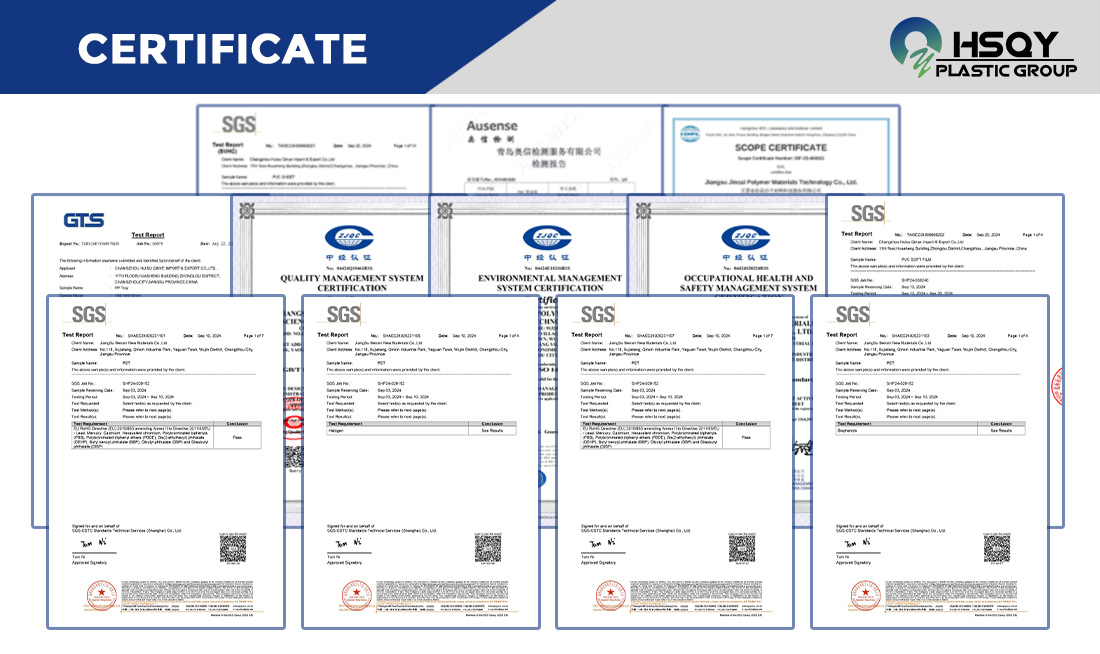
The current product page references SGS and ISO 9001:2008 documentation. ISO 9001 is a quality-management-system certification and should not by itself be interpreted as proof that a specific GAG sheet grade meets food-contact or application-specific requirements.
Buyers should request current certificates and test reports applicable to the exact production grade, manufacturing site, intended use and destination market.
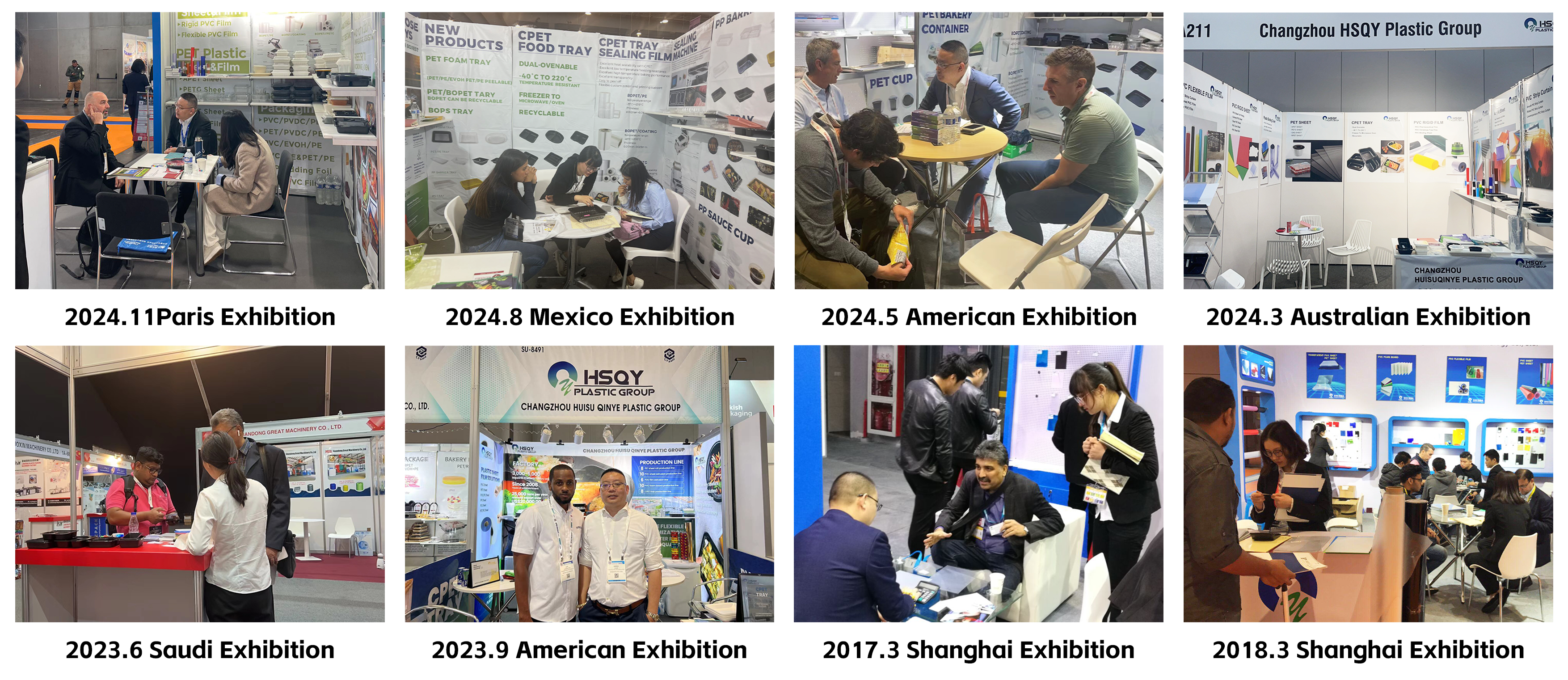
HSQY Global Exhibition
HSQY participates in international plastics and packaging exhibitions to meet thermoforming companies, blister-packaging converters, food-packaging manufacturers, distributors and other B2B buyers.

HSQY International Packaging Exhibition
FAQ About Clear GAG PET Sheet
What is GAG PET sheet?
GAG PET sheet is a three-layer co-extruded polyester sheet with PETG outer layers and an APET core. It is also described as PETG/APET/PETG or G-PET-G sheet.
What is GAG sheet used for?
Common applications include retail blister packaging, clamshells, transparent trays, folding boxes, printed packaging, electronics packaging and other thermoformed clear plastic products.
Is GAG the same as PETG?
No. A full PETG sheet uses PETG throughout its thickness, while GAG uses PETG outer layers with an APET core.
What is the difference between GAG and APET?
APET is generally more economical for standard clear thermoforming. GAG uses PETG surface layers and is worth evaluating when better forming, folding, bonding or resistance to stress whitening is needed.
Is GAG PET sheet suitable for blister packaging?
Yes. GAG can be thermoformed into transparent blister packaging, particularly where the design requires better forming or folding performance than standard APET.
Is GAG suitable for deep-draw thermoforming?
GAG can provide improved deep-forming performance compared with standard APET, but full PETG may still be preferred for the most demanding deep-draw designs. Test the actual sheet on the production tooling.
Does GAG sheet need pre-drying before thermoforming?
Drying requirements depend on material moisture, storage conditions, sheet thickness and thermoforming conditions. Do not assume every GAG grade can always be processed without drying.
Can GAG PET sheet be used for food packaging?
Food-contact grades can be evaluated for food packaging, but buyers should request current product-specific documentation covering the exact GAG formulation, food type, contact temperature and destination market.
Is ISO 9001 proof that GAG sheet is food safe?
No. ISO 9001 relates to quality-management systems. Food-contact suitability requires applicable product-specific material and migration documentation.
Can GAG sheet be printed?
Yes, compatible GAG sheet can be printed or decorated. Ink adhesion and surface-treatment requirements should be tested using the production material and actual printing process.
Can GAG sheet be used for transparent folding boxes?
Yes. GAG is suitable for clear folding-box applications where transparency, crease quality, folding behavior and bonding performance are important.
Is GAG PET sheet recyclable?
GAG consists of PET-based polyester layers, but actual recyclability depends on local collection and sorting systems and on other package components such as labels, inks, adhesives and coatings.
What thicknesses of GAG sheet are available?
The current HSQY product range lists thicknesses from 0.15mm to 3mm.
What is the maximum GAG roll width?
The current product specification lists roll widths from 110mm to 1280mm.
What cut-sheet sizes are available?
Current listed sheet sizes include 915×1220mm and 1000×2000mm, with customized dimensions available.
What is the MOQ for GAG PET sheet?
The current product information lists an MOQ of 1000kg. Special colors or customized dimensions may require different minimum production quantities.
Can I request GAG PET sheet samples?
Sample evaluation can be discussed for checking transparency, thickness, forming behavior, folding, printing, bonding and finished-package appearance before bulk production.
What information is required for a quotation?
Provide thickness, width or sheet size, finished application, forming depth, machine type, roll configuration, color, food-contact requirements, annual quantity, packing requirements and destination.
About HSQY Plastic Group
HSQY Plastic Group supplies APET, PETG, GAG and other PET-based rigid sheet materials for thermoforming companies, blister-packaging converters, food-packaging manufacturers, printing companies and plastic sheet distributors.
GAG projects can be discussed according to required thickness, roll width, cut-sheet dimensions, color, forming depth, finished package, roll configuration, quality requirements and annual purchasing volume.
If you are deciding between APET, GAG and PETG, send your existing material specification, thermoformed product drawing and production requirements so the most appropriate structure can be evaluated.
Contact HSQY for GAG PET Sheet


 Download PET GAG Sheet Data Sheet