CPET Ovenable Trays for Ready Meals and Food Packaging
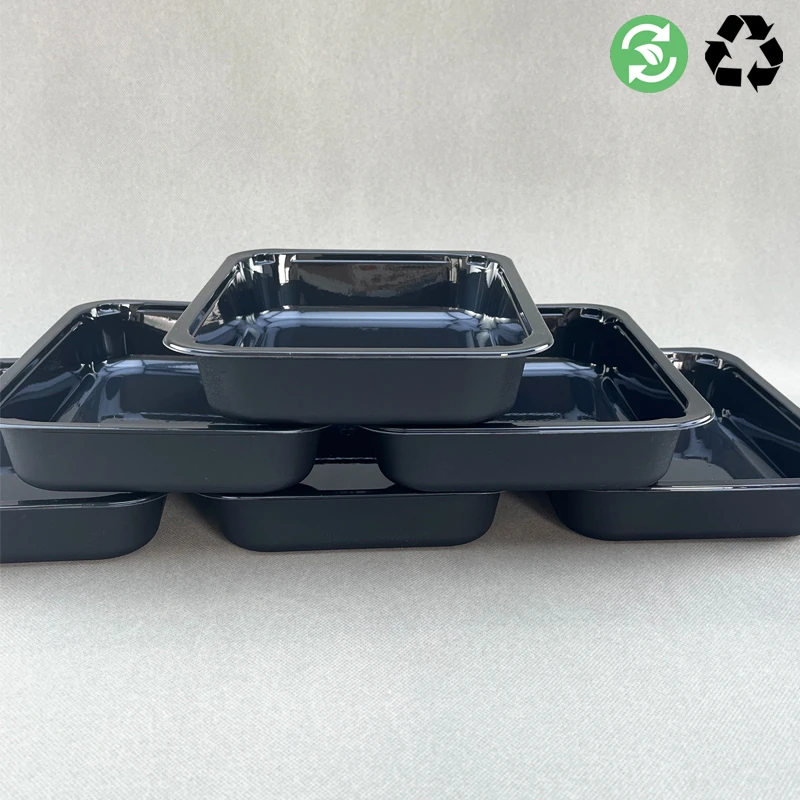
HSQY CPET ovenable trays are crystalline polyethylene terephthalate food trays developed for frozen, chilled and heat-and-eat meal applications. Qualified CPET tray structures can move from freezer or refrigerator to a conventional oven or microwave while maintaining the rigidity required for filling, sealing, transport, retail display and consumer reheating.
The reference temperature range is approximately −40°C to +220°C, subject to the exact tray design, material gauge, product load, heating time, oven type and validated instructions. Available formats include 1-, 2- and 3-compartment trays in rectangular, square and round shapes for ready meals, airline meals, school meals, meals-on-wheels programs, bakery products and catering.
Standard reference specifications include a 216 × 164 × 38mm tray and capacities of approximately 750ml or 800ml. HSQY can discuss customized dimensions, cavity layouts, colors, flange geometry, material gauge, recycled-content targets, embossing, lidding-film compatibility and export packing for food manufacturers, distributors and packaging converters.
CPET Ovenable Tray Video
CPET Ovenable Tray Applications
Aviation Meal Application

Bakery Product Application

Ready Meal Application
CPET Ovenable Tray Specifications
| Property |
Details |
| Product Name |
CPET Ovenable Tray / Dual-Ovenable Ready Meal Tray |
| Material |
Crystalline Polyethylene Terephthalate (CPET) |
| Reference Dimensions |
216 × 164 × 38mm; customized dimensions available |
| Reference Capacity |
Approximately 750ml and 800ml; customized volume available |
| Compartments |
1, 2 or 3 compartments; customized cavity layout available |
| Shapes |
Rectangular, square, round and custom shapes |
| Colors |
Black, white, natural and project-specific colors |
| Reference Temperature Range |
Approximately −40°C to +220°C, subject to validated tray and cooking specifications |
| Heating Methods |
Conventional oven and microwave for qualified applications; not for grill, broiler, open flame or direct contact with heating elements |
| Typical Applications |
Frozen and chilled ready meals, airline meals, school meals, catering, bakery products and meals-on-wheels programs |
| Lidding Options |
Ovenable, microwaveable, easy-peel, lock-seal, anti-fog and printed films subject to compatibility testing |
| Customization |
Dimensions, volume, compartments, color, gauge, flange, embossing, film and packing |
| Reference MOQ |
50,000 pieces; stock items, custom tooling and special colors may have different requirements |
| Payment Terms |
T/T, L/C and other agreed commercial terms |
| Delivery Terms |
EXW, FOB, CNF and DDU, subject to quotation |
| Reference Lead Time |
Approximately 7–15 days for confirmed standard production; custom tooling and large orders require schedule confirmation |
| Compliance Documents |
Food-contact declarations and test reports must be confirmed for the exact tray grade and destination market |
What Is a CPET Ovenable Tray?
CPET is PET that has been processed to develop a controlled crystalline structure. This crystallinity improves heat resistance and dimensional stability compared with ordinary amorphous PET, allowing an appropriately designed tray to withstand freezing, filling, transport and high-temperature reheating.
The phrase “dual-ovenable” means the qualified tray can be used in both a conventional oven and a microwave. It does not mean every tray, lidding film, label or absorbent pad in the package can automatically withstand the same conditions. The complete pack and consumer heating instructions must be tested together.
Key Benefits of CPET Ovenable Trays
Freezer-to-oven convenience: Qualified CPET trays support meal production, frozen storage, distribution and consumer heating in the same primary container.
Dual-ovenable performance: The tray can be evaluated for conventional-oven cooking and microwave reheating, reducing the need to transfer food into another container.
Dimensional stability: A properly designed CPET tray maintains its shape during filling, denesting, sealing, freezing and heating within the validated operating window.
Compartment separation: One-, two- and three-compartment formats keep meal components separated during filling, distribution and reheating.
Grease and moisture resistance: CPET provides a non-absorbent tray surface for sauces, oils and prepared foods, subject to the finished package design.
Flexible presentation: Black, white, natural and customized colors can support different meal categories and brand positioning.
Automated packing-line compatibility: Consistent flange geometry, stack design and denesting features can support filling and tray-sealing equipment after line trials.
Freezer-to-Oven Packaging Workflow
| Stage |
CPET Tray Requirement |
Validation Focus |
| Denesting and Filling |
Consistent stack release, flange flatness and tray rigidity |
Line speed, static control, tray separation, filling accuracy and flange cleanliness |
| Lidding and Sealing |
Compatible tray flange and lidding-film sealant |
Seal temperature, dwell time, pressure, peel force, contamination tolerance and leak testing |
| Chilling or Freezing |
Low-temperature strength and dimensional stability |
Freezing rate, impact, stacking load, transport vibration and cold-chain duration |
| Distribution and Retail |
Pack integrity and stable shelf presentation |
Compression, leakage, label adhesion, condensation and package appearance |
| Consumer Heating |
Heat resistance within the approved oven or microwave conditions |
Time, temperature, food load, film venting or removal, tray support and distance from heating elements |
Conventional Oven and Microwave Use
CPET trays should be used according to validated heating instructions for the exact meal and package. The tray should normally be placed on a baking sheet, rack or other stable support and positioned away from exposed heating elements. It should not be used under a grill or broiler, over an open flame or in direct contact with a heating element.
Lidding-film instructions depend on the film structure. Some ovenable films are designed to remain on the tray and may require venting, while other films must be removed or punctured before heating. Refrigerated-only film, labels, absorbent pads and secondary components should not be exposed to oven temperatures unless specifically qualified.
Maximum oven temperature alone is not enough to define safe use. Heating time, food mass, fat and sugar content, hot spots, oven airflow and tray support can affect package performance. Consumer instructions should be established through worst-case cooking trials.
Lidding Film Options for CPET Trays
The lidding film must match the tray formulation, heating method, storage condition and opening requirement. Good seal performance depends on the sealant chemistry, equipment, sealing temperature, dwell time, pressure, flange condition and food contamination around the seal area.
Ovenable lidding film: Designed for a validated tray-and-film package that may be heated in a conventional oven under specified conditions.
Microwaveable lidding film: Developed for microwave reheating and normally supplied with defined venting, puncturing or removal instructions.
Easy-peel film: Provides controlled opening force while maintaining the required package seal during distribution.
Lock-seal film: Used where a stronger permanent seal or greater resistance to leakage is required.
Anti-fog film: Helps maintain product visibility in chilled and frozen retail display.
Printed lidding film: Supports branding, preparation instructions, traceability and product information after print and heat-resistance testing.
CPET vs PP vs Aluminum Ready Meal Trays
| Material |
Heating Capability |
Typical Advantages |
Selection Considerations |
| CPET |
Conventional oven, microwave, chilled and frozen applications after validation |
Freezer-to-oven convenience, rigidity, compartment formats and sealable flange |
Higher material cost than PP; color is normally opaque; full package needs heating tests |
| PP |
Microwave and moderate-temperature hot-fill applications depending on grade |
Lightweight, economical and suitable for many chilled or microwave meal formats |
Not generally selected for conventional-oven temperatures comparable with CPET |
| Aluminum |
Conventional oven; microwave use depends on appliance and package design and is often restricted |
High heat resistance, strong barrier and familiar bakery or catering format |
Metal detection, microwave limitations, denting and seal-system requirements must be considered |
Applications of CPET Ovenable Trays
Frozen ready meals: Complete meals designed for frozen storage and subsequent oven or microwave preparation.
Chilled ready meals: Refrigerated pasta, rice, meat, vegetable and sauce-based dishes requiring convenient reheating.
Airline meals: Portion-controlled meal trays designed for efficient filling, distribution and reheating within an approved catering system.
School and institutional meals: Single- or multi-compartment formats for centralized meal preparation and controlled portions.
Meals on wheels: Durable meal trays for chilled or frozen delivery programs and consumer reheating.
Bakery and desserts: Cakes, puddings, pies, pastries and other products that require baking, reheating or attractive serving presentation.
Catering and food service: Prepared portions, side dishes, proteins and meal components for commercial kitchens and event catering.
Compartment, Shape and Color Options
A single-compartment tray is suitable for one-dish meals, baked products and larger portions. Two- and three-compartment trays separate proteins, vegetables, rice, pasta, sauces or side dishes and help control portion presentation.
Rectangular trays are widely used for ready meals and automated packing lines, while round or square trays can support desserts, pies, side dishes and premium meal formats. Black trays provide strong contrast for food presentation; white or light interiors can improve the appearance of lighter foods. Custom colors should be approved using a physical sample and agreed tolerance.
Tray-Sealing and Packing-Line Performance
Reliable CPET packaging requires more than tray heat resistance. Tray stacks should denest consistently, remain flat on the conveyor, accept accurate filling and present a clean, level flange to the sealing tool. Custom trays should be tested on the intended denester, filler, tray sealer, checkweigher and secondary packing system.
Denesting force and static-control evaluation.
Flange flatness and dimensional tolerance.
Seal temperature, pressure and dwell-time window.
Seal strength, peel force and visual seal inspection.
Dye penetration, bubble leak, burst or pressure-decay testing.
Top-load, compression, impact and frozen-drop testing.
Oven, microwave and worst-case food-load trials.
Food-Contact Compliance and Quality Documents
ISO 9001 is a quality-management-system certification and should not be used by itself as proof that a specific tray is suitable for food contact. Food-contact suitability depends on the precise resin, colorants, additives, recycled content, manufacturing controls and conditions of use.
Buyers should state the destination market, food type, contact time, freezing conditions, oven temperature, microwave instructions and whether the tray will be used for baking or reheating. HSQY should then confirm which declarations, migration reports, specifications or test documents apply to the exact product.
Recycled Content and Recyclability
CPET is based on the PET material family, and recycled PET content may be incorporated into some tray structures when supported by appropriate food-contact controls and performance validation. The available percentage depends on color, application, local regulations and customer requirements.
A tray should not be described as universally recyclable solely because it is made from PET. Actual recyclability depends on tray color, lidding film, labels, adhesives, food residue, collection systems, sorting technology and local recycling guidelines. Market-specific claims should be reviewed before publication.
Custom CPET Tray Development
Custom length, width, depth, capacity and compartment layout.
Rectangular, square, round and special shapes.
Black, white, natural, gold, silver and project-specific colors subject to feasibility.
Flange geometry matched to the intended tray-sealing tooling.
Material gauge and rib design according to meal weight and heating conditions.
Embossed logo, cavity identification and traceability features.
Ovenable, easy-peel, lock-seal, anti-fog or printed lidding-film development.
Recycled-content targets subject to food-contact and performance requirements.
Carton quantity, pallet layout, barcode labels and export packing.
Packing and Delivery
Sample packing: Sample trays can be protected in bags or cartons to avoid flange damage and contamination.
Bulk packing: Tray stacks are packed in food-packaging bags and export cartons. Carton quantity depends on tray dimensions, depth and stack height.
Pallet packing: Pallets can be stretch-wrapped and protected with corner boards according to shipment requirements.
Container loading: Loading quantity should be calculated from the approved carton and pallet layout rather than a fixed weight assumption.
Delivery terms: EXW, FOB, CNF and DDU can be quoted according to the destination and order.
Lead time: Standard production may require approximately 7–15 days after specification and payment confirmation. Tooling, special colors and large programs require a project schedule.
Information Required for a CPET Tray Quotation
| Quotation Item |
Information to Provide |
| Tray Dimensions |
Outer length, width, depth, flange width, capacity, compartments and drawing |
| Food Product |
Meal type, net weight, sauce or oil content, frozen or chilled condition and shelf life |
| Heating Instructions |
Conventional oven or microwave, maximum temperature, heating time and starting temperature |
| Lidding Film |
Ovenable, microwaveable, easy peel, lock seal, anti-fog, printed or current film structure |
| Packing Equipment |
Denester and tray-sealer manufacturer, model, tooling drawing and target line speed |
| Appearance |
Color, gloss, embossing, logo and approval sample |
| Compliance |
Destination market, food-contact standard, recycled-content requirement and required reports |
| Commercial Details |
Annual volume, first order quantity, destination port, packing method and required delivery date |
Frequently Asked Questions About CPET Ovenable Trays
What are CPET ovenable trays?
CPET ovenable trays are rigid food trays made from crystalline PET. The controlled crystallinity provides the heat resistance and dimensional stability needed for frozen, chilled, microwaveable and conventional-oven meal applications.
What does dual-ovenable mean?
Dual-ovenable means a qualified tray can be used in both a conventional oven and a microwave. The complete package, including film, labels and food load, must still be tested for the intended heating instructions.
What temperature can CPET trays withstand?
The reference range is approximately −40°C to +220°C. The approved limit depends on tray design, material gauge, food load, heating time, oven airflow and support conditions.
Can a frozen CPET tray go directly into an oven?
Qualified CPET packs can be designed for freezer-to-oven use. The exact meal and package should be validated from the intended frozen temperature through the full cooking cycle.
Can CPET trays be used in a microwave?
Yes, qualified CPET trays can be used for microwave heating. Follow the validated instructions for film venting or removal, heating time, power level and meal load.
Can CPET trays be used under a grill or broiler?
They should not be placed under a grill or broiler, over an open flame or directly against a heating element unless a specific application has been separately tested and approved.
Should the lidding film be removed before heating?
It depends on the film. Some ovenable films remain on the tray and require venting, while other films must be punctured or removed. The package instructions must identify the correct method.
Which film seals to CPET trays?
Ovenable, microwaveable, easy-peel, lock-seal and anti-fog films can be developed for CPET. Compatibility depends on the exact tray formulation, film sealant, equipment and sealing parameters.
Are CPET trays leak-proof?
Leak resistance is a property of the complete sealed package, not the tray alone. The flange, film, sealing window, food contamination and package handling must be tested.
Are CPET trays food safe?
Food-contact suitability must be confirmed for the exact resin, pigments, additives, recycled content and conditions of use. ISO 9001 alone is not a food-contact approval.
Are CPET trays recyclable?
CPET belongs to the PET material family, but actual recyclability depends on color, film, labels, food residue and local collection and sorting systems. Local guidance should be checked before making a recycling claim.
Can recycled PET be used in CPET trays?
Recycled PET content may be possible when supported by suitable food-contact controls and tray-performance validation. The target percentage should be stated during development.
What compartment options are available?
HSQY can supply or develop one-, two- and three-compartment trays. The correct layout depends on portion size, food separation, filling equipment and heating uniformity.
Can CPET tray dimensions and colors be customized?
Yes. Dimensions, capacity, compartments, shape, color, flange, gauge, embossing and packing can be customized subject to tooling, MOQ and technical feasibility.
What is the MOQ for CPET ovenable trays?
The reference MOQ is 50,000 pieces. Stock formats, custom molds, special colors and printed lidding-film projects may have different minimum quantities.
Can I test samples on my tray-sealing machine?
Sample trials are recommended to check denesting, tooling fit, flange flatness, seal strength, peel behavior, leak resistance, freezing and heating performance before bulk production.
What information is required for a quotation?
Provide tray dimensions, capacity, compartments, food type, meal weight, heating instructions, lidding film, machine model, color, annual volume, destination and required food-contact documents.
About HSQY Plastic Group
HSQY Plastic Group supplies CPET ovenable trays, CPET sheets, PP food containers, APET trays, PET/EVOH/PE trays, lidding films and customized rigid food-packaging products for international ready-meal manufacturers, caterers, distributors and packaging companies.
HSQY supports standard and custom tray development, mold evaluation, lidding-film matching, packing-line trials, samples, technical documents, export packing and bulk production. Final performance requirements should be agreed before tooling or commercial production.
Request a Quote and Sample


