Compostable Bagasse Oval Plates for Foodservice
HSQY bagasse oval plates are disposable molded-fiber dinner plates made from sugarcane bagasse pulp for restaurants, catering companies, hotels, cafeterias, events, takeaway foodservice and disposable tableware distributors.
The current oval plate range includes 253×190×23mm and 317×252×25mm sizes in white or natural finishes. Their elongated oval shape provides more usable presentation space for entrées, grilled foods, sandwiches, side dishes, buffet meals and catering portions than a conventional round plate of similar width.
Bagasse is the fibrous material remaining after sugarcane juice extraction. Converting this plant-based fiber into molded foodservice products provides an alternative to conventional petroleum-based disposable plastic plates and conventional coated paper tableware.
For projects that require certified compostability, food-contact compliance, microwave performance, PFAS-related declarations or destination-market documentation, buyers should request current documents for the exact HSQY product specification before making regulatory or environmental claims.
Request Bagasse Plate Quote
What Is a Bagasse Plate?
A bagasse plate is a molded-fiber disposable plate produced primarily from sugarcane bagasse pulp. Bagasse is generated as a fibrous by-product after sugarcane is processed for juice or sugar production.
The fiber can be pulped, formed under heat and pressure, dried and trimmed into plates, bowls, trays, clamshell containers and other disposable foodservice products.
Compared with very thin paper plates, molded bagasse products can provide a thicker, more rigid structure for serving wet, oily, hot or cold foods. Actual strength, grease resistance, water resistance and heat performance depend on the product formulation, fiber density and manufacturing specification.
Bagasse Oval Plate Application
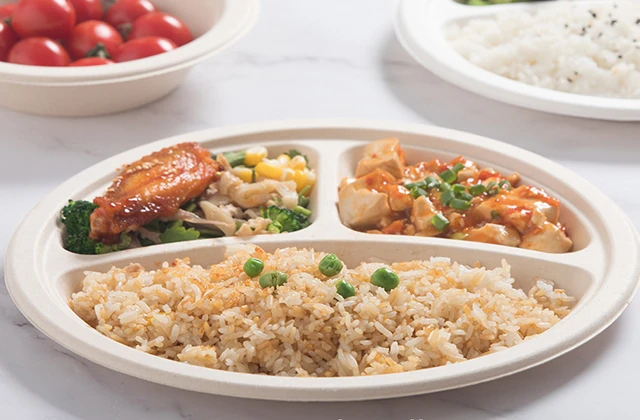
Sugarcane Bagasse Oval Plates for Catering and Foodservice
Bagasse Oval Plate Specifications
The following specifications are based on the current HSQY product information. Product weight, packing quantity, carton dimensions, tolerance, heat resistance, compostability certification and food-contact documentation should be confirmed before commercial ordering.
| Property |
Current HSQY Specification |
Buyer Should Confirm |
| Product |
Sugarcane Bagasse Oval Plate |
Required model and final application |
| Material |
Sugarcane Bagasse Pulp |
Exact fiber formulation and additives where required |
| Shape |
Oval |
Confirm matching lid is not required for an open plate application |
| Compartments |
1 Compartment |
Other divided formats should be selected as separate models |
| Small Size |
253×190×23mm |
Confirm dimensions and tolerances from approved drawing |
| Approximate Inch Size |
Approximately 10×7.5 in. |
Use metric dimensions for purchase specifications |
| Large Size |
317×252×25mm |
Confirm dimensions and tolerances from approved drawing |
| Approximate Inch Size |
Approximately 12.5×10 in. |
Use metric dimensions for purchase specifications |
| Color / Finish |
White / Natural |
Bleached or natural specification |
| Food Type |
Hot, Cold, Dry and Moist Foods Subject to Product Validation |
Food type, temperature, oil content and holding time |
| Microwave Use |
Current Source States Microwave Safe |
Confirm maximum temperature and heating duration for exact product |
| Compostability |
Current Source Describes Product as Compostable / Biodegradable |
Request applicable certification and disposal conditions for target market |
| Customization |
Discuss According to Project |
Logo, embossing, packaging, color, size and MOQ |
10 Inch and 12.5 Inch Bagasse Oval Plate Sizes
HSQY currently lists two oval plate dimensions that correspond approximately to common 10-inch and 12.5-inch foodservice formats.
| HSQY Size |
Approximate Format |
Typical Selection |
| 253×190×23mm |
Approximately 10×7.5 inch |
Individual meals, sandwiches, snacks, smaller entrées and side dishes |
| 317×252×25mm |
Approximately 12.5×10 inch |
Large entrées, catering meals, buffet service, mixed foods and platter presentation |
Actual usable serving area is smaller than the external dimensions because of the molded rim and sidewall. Buyers that need exact food-fit calculations should request the internal dimensions and an approved drawing.
Why Choose an Oval Bagasse Plate?
More Presentation Space for Entrées
The elongated oval format provides useful horizontal serving space for sandwiches, grilled foods, meat portions, fish, rice dishes and combined entrée-and-side presentations.
Molded Fiber Rigidity
Molded bagasse fiber creates a relatively rigid disposable plate structure compared with lightweight paper-only alternatives. Final load-bearing performance depends on plate weight, fiber density, dimensions and food load.
Suitable for Wet and Oily Foods
Bagasse foodservice products can be formulated to resist water and oil during normal meal service. If a project involves very oily foods, sauces or long holding times, test the actual plate under the intended food and temperature conditions before bulk purchasing.
White and Natural Options
White plates provide a conventional clean foodservice appearance, while natural-colored bagasse emphasizes the molded plant-fiber appearance. Exact shade should be approved using a production sample because natural fiber color may vary.
Plant-Fiber Raw Material
Sugarcane bagasse originates from agricultural plant fiber rather than petroleum-based plastic resin, making it relevant to foodservice programs seeking molded-fiber disposable tableware.
Are Bagasse Plates Compostable?
Bagasse fiber is biodegradable plant material and molded bagasse tableware can be designed for composting. However, the statement that a finished plate is “100% compostable” should be supported by an applicable certification or test standard for the exact product.
Industrial compostability, home compostability and general biodegradability are not identical claims. They can involve different environmental conditions, testing methods and certification requirements.
Buyers that need to market the plate as certified compostable should request the current product-specific certificate and verify that it is recognized in the intended destination market.
Industrial Compostable vs Home Compostable
| Term |
General Meaning |
Buyer Action |
| Industrially Compostable |
Designed to break down under controlled commercial composting conditions |
Request applicable certification such as the relevant target-market standard if required |
| Home Compostable |
Requires performance under lower-temperature home compost conditions |
Do not claim home compostability unless supported by applicable certification |
| Biodegradable |
General description of biological breakdown; does not by itself define time, environment or certification |
Avoid unsupported time-based claims such as “degrades in 90 days” without test evidence |
Are Bagasse Plates Microwave Safe?
The current HSQY product information describes these bagasse plates as microwave safe. For commercial foodservice programs, the specific maximum heating temperature, heating duration and food conditions should still be confirmed for the exact product.
Microwave performance can be influenced by plate thickness, moisture content, food oil content, heating time and load distribution. Buyers should conduct practical tests using the intended meal before high-volume use.
Can Bagasse Plates Hold Hot, Wet and Oily Foods?
Molded bagasse tableware is commonly selected for hot, cold, wet and oily foods, but performance is not unlimited. A plate carrying dry sandwiches has different requirements from one holding hot curry, oily grilled meat or sauce for an extended period.
For demanding applications, specify the food type, serving temperature and required holding time and conduct soak, grease-resistance and load tests with production samples.
Bagasse Oval Plate Applications
Restaurants and Foodservice
Bagasse oval plates can be used for quick-service restaurants, casual dining, food courts and other operations that require disposable serving tableware.
Catering and Events
The oval shape is suitable for catered meals, weddings, corporate events, conferences, buffets, festivals and other foodservice programs where an elongated presentation format is useful.
Hotels and Resorts
Hotels and resorts can evaluate molded-fiber plates for outdoor catering, poolside service, staff dining, events and other disposable-foodservice applications.
Cafeterias and Institutional Catering
Schools, workplaces, hospitals and institutional catering operators can use appropriate molded-fiber plates for single-service meal programs where the product specification meets local food-contact and operational requirements.
Food Trucks and Festivals
Disposable oval plates offer a practical open-plate format for street food, barbecue, grilled foods, sandwiches and festival meals.
Wholesale and Private-Label Programs
Foodservice distributors, tableware wholesalers and private-label brands can discuss bulk packaging, carton configuration, labeling, logo requirements and other customization according to order volume.
Bagasse Plates vs Paper Plates vs Plastic Plates
| Factor |
Bagasse Plate |
Paper Plate |
Plastic Plate |
| Primary Material |
Molded sugarcane plant fiber |
Paper fiber, sometimes with coatings |
Plastic resin such as PP or PS depending on product |
| Rigidity |
Generally good due to molded-fiber structure |
Varies significantly by paper weight and design |
Generally good, depending on resin and thickness |
| Wet / Oily Food |
Suitable for many applications after validation |
May require coating or heavier construction |
Generally resistant to water and oil |
| Microwave Use |
Possible where product specification is validated |
Depends on coatings and construction |
Depends on polymer and product grade |
| Composting |
Can be designed for compostability; verify certification |
Depends on coatings, inks and additives |
Conventional plastic plates are generally not compostable |
| Appearance |
Natural molded-fiber appearance |
Smooth paper appearance |
Wide range of molded finishes and colors |
White vs Natural Bagasse Plates
| Feature |
White Bagasse Plate |
Natural Bagasse Plate |
| Appearance |
Clean white foodservice appearance |
Natural plant-fiber appearance |
| Brand Positioning |
Suitable for conventional catering and presentation |
Often selected where natural fiber appearance supports the brand concept |
| Color Control |
Approve whiteness and production sample |
Natural shade variation may occur between fiber batches |
PFAS Requirements for Bagasse Tableware
PFAS-related requirements have become an important procurement issue for molded-fiber food packaging in several markets.
This page does not currently provide a product-specific PFAS declaration or laboratory test result. HSQY should therefore not describe this product as “PFAS-free” or “no intentionally added PFAS” unless appropriate current documentation supports that claim.
Buyers requiring PFAS-related compliance should state the destination country, customer standard and required test or declaration when requesting a quotation.
Food-Contact Documentation
Food-contact suitability should be supported by documentation applicable to the exact bagasse plate formulation and intended destination market.
General company quality certifications should not automatically be interpreted as food-contact certification for every product. Buyers should request current product-specific test reports or declarations where required.
If the plates will be used for hot, acidic, fatty or prolonged food contact, provide the intended use conditions so the relevant documentation can be checked.
Quality Parameters Buyers Should Confirm
| Parameter |
Why It Matters |
| Plate Weight |
Influences rigidity, material consumption and product consistency |
| Dimensional Tolerance |
Important for stacking, packaging and distributor specifications |
| Compression / Load Strength |
Determines how well the plate supports heavier meals |
| Water Resistance |
Important for sauces, wet foods and prolonged serving periods |
| Oil Resistance |
Important for fried food, grilled foods and oily meals |
| Microwave Conditions |
Defines maximum heating time and temperature for intended use |
| Food-Contact Test |
Supports regulatory suitability for the destination market |
| Compostability Certification |
Supports compostability claims used by distributors and end customers |
| PFAS Status |
Increasingly important for molded-fiber foodservice programs |
| Pcs per Bag / Carton |
Essential for wholesale pricing and logistics calculations |
| Carton Dimensions |
Required for CBM, container-loading and freight calculations |
How to Choose a Bagasse Oval Plate
1. Select the Plate Size
Choose the 253×190×23mm format for smaller individual portions and the 317×252×25mm format for large meals, catering portions or platter-style presentation.
2. Define the Food Type
Tell HSQY whether the plate will hold dry, wet, oily, acidic, hot or cold food so the product can be evaluated under realistic service conditions.
3. Specify Holding Time
A plate used for a 20-minute meal service faces different moisture and oil exposure from one holding hot food for several hours. Include expected service time in your evaluation.
4. Choose White or Natural
Select the finish according to brand positioning, restaurant presentation and distributor-market preference.
5. Confirm Microwave Requirements
If microwave reheating is important, provide the intended heating time, power and food type and request applicable performance information.
6. Confirm Environmental Claims
If your packaging or catalog will state “compostable,” “home compostable,” “biodegradable” or “PFAS-free,” specify the required standard before ordering and request matching documentation.
7. Confirm Wholesale Packing
Foodservice distributors should confirm pieces per bag, bags per carton, total pieces per carton, carton dimensions, gross weight and pallet configuration before comparing supplier quotations.
Information Needed for a Bagasse Plate Quote
To receive an accurate B2B quotation, provide:
253×190×23mm or 317×252×25mm
White or natural finish
Required order quantity
Annual purchasing volume
Restaurant, catering, retail, wholesale or private-label application
Typical food type
Maximum serving temperature
Microwave-heating requirement
Required water and oil resistance
Required food-contact documentation
Required compostability certification
PFAS declaration or testing requirement
Custom logo or embossing requirement
Retail or private-label packaging requirement
Required pieces per bag / carton
Destination country and port
Get Wholesale Price & Samples
OEM and Private-Label Bagasse Plates
Foodservice distributors and disposable-tableware brands can discuss OEM and private-label requirements with HSQY according to project quantity and production feasibility.
Potential customization may include carton artwork, product labels, packing quantity, embossing, color selection or new molded-fiber tableware development. Availability and MOQ should be confirmed for each project rather than assumed.
Wholesale Packing Information to Confirm
The current page does not publish pieces per carton, product weight, carton dimensions or pallet quantities. These should be added because they directly affect distributor landed cost and container utilization.
| Logistics Parameter |
Recommended Information |
| Individual Plate Weight |
Confirm grams per plate and tolerance |
| Pieces per Bag |
Confirm standard wholesale inner pack |
| Bags per Carton |
Required for inventory and distributor calculations |
| Pieces per Carton |
Important primary B2B buying parameter |
| Carton Dimensions |
Required for freight and CBM calculation |
| Gross / Net Weight |
Required for shipping quotations |
| 20GP / 40HQ Loading |
Useful for distributors planning full-container orders |
FAQ About Bagasse Oval Plates
What are bagasse plates made from?
Bagasse plates are molded from sugarcane bagasse pulp, a fibrous plant material remaining after juice is extracted from sugarcane.
What sizes are available for these oval bagasse plates?
The current HSQY range lists 253×190×23mm and 317×252×25mm oval plates, approximately corresponding to 10×7.5-inch and 12.5×10-inch formats.
Are bagasse plates compostable?
Bagasse is biodegradable plant fiber and bagasse tableware can be designed for composting. If certified compostability is required, request the current product-specific certificate applicable to the destination market.
Are bagasse plates biodegradable?
Sugarcane fiber is biodegradable, but a claim about how quickly a finished plate biodegrades should specify environmental conditions and be supported by suitable testing rather than using an unsupported fixed number of days.
Are bagasse plates microwave safe?
The current HSQY source describes the plates as microwave safe. Commercial buyers should confirm the validated maximum temperature, heating time and food conditions for the exact plate before publishing microwave instructions.
Can bagasse plates hold hot food?
Bagasse plates can be used for many hot-food applications, but the exact serving temperature and holding time should be validated for the supplied product.
Can bagasse plates hold oily food?
Molded bagasse tableware is commonly used for oily foods. Buyers with demanding grease-resistance requirements should test production samples with the actual food and holding time.
Are these plates leakproof?
They should not be described as universally leakproof. Resistance to liquid penetration depends on product construction, liquid type, temperature and contact duration. Testing is recommended for wet-food applications.
What is the difference between white and natural bagasse plates?
White bagasse plates have a cleaner conventional tableware appearance, while natural plates retain a more visible plant-fiber color. Exact material processing should be confirmed for the selected grade.
Are HSQY bagasse plates PFAS-free?
The current source does not provide a product-specific PFAS declaration. If PFAS requirements apply to your market, request current test reports or declarations for the exact product before making a PFAS-related claim.
Are bagasse plates suitable for catering?
Yes. The oval format is suitable for catering, restaurants, hotels, events, buffets, food trucks and other disposable foodservice applications when the plate specification matches the meal.
Which oval plate size should I choose?
Choose 253×190×23mm for smaller individual portions and 317×252×25mm for large entrées, catering meals and platter-style food presentation.
Can HSQY provide custom packaging?
OEM and private-label packaging can be discussed according to order quantity and project requirements. Provide your carton artwork, label, pack quantity and destination-market requirements when requesting a quote.
Can I request samples before ordering?
Sample evaluation is recommended for checking plate dimensions, rigidity, food fit, water resistance, oil resistance, microwave performance and appearance before a bulk order.
What information should I provide for a wholesale quotation?
Provide plate size, color, quantity, annual demand, food application, required certifications, PFAS requirements, custom packaging, logo requirements and destination country.
About HSQY
HSQY supplies disposable food packaging and tableware for foodservice distributors, catering companies, restaurants, wholesalers and private-label packaging buyers.
Bagasse tableware projects can be evaluated according to plate size, shape, fiber color, food type, heat requirements, compostability requirements, food-contact documentation, packing format and annual purchasing volume.
For distributors and importers, send your current product specification, plate sample, required carton pack, certifications and target price so HSQY can evaluate the most suitable bagasse oval plate program.
Contact HSQY for Bagasse Plates


