5 & 6 Compartment Bagasse Food Serving Trays
HSQY 5 and 6 compartment bagasse food trays are made from sugarcane fiber for hot and cold meal service, with rectangular designs, white or natural finishes, and microwave- and freezer-safe use.
These disposable compartment meal trays help restaurants, cafeterias, schools, catering companies and institutional foodservice operators separate main dishes, side dishes, vegetables, rice, desserts and other menu components in one tray.
The current HSQY range includes a 5-compartment tray measuring 265 × 211 × 23.5mm and a larger 6-compartment tray measuring 320 × 220 × 28mm. Bleached white and natural bagasse options are listed for different foodservice and presentation requirements.
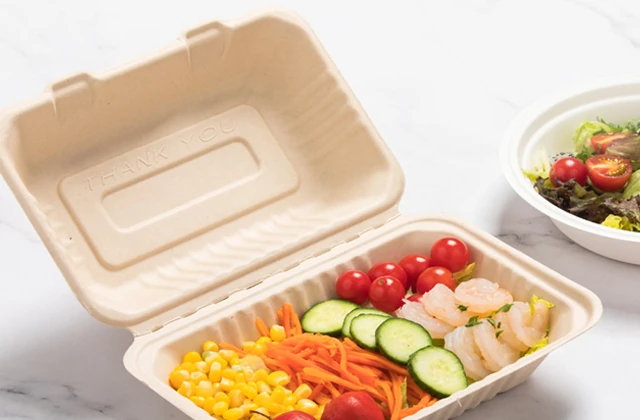
Bagasse Compartment Food Serving Trays
Bagasse Serving Tray Specifications
| Property |
5 Compartment Tray |
6 Compartment Tray |
| Product |
Bagasse Serving Tray |
Bagasse Serving Tray |
| Material |
Sugarcane Bagasse Fiber |
Sugarcane Bagasse Fiber |
| Material Type |
Bleached or Natural |
Bleached or Natural |
| Color |
White or Natural |
White or Natural |
| Compartments |
5 Compartments |
6 Compartments |
| Shape |
Rectangular |
Rectangular |
| Dimensions |
265 × 211 × 23.5mm |
320 × 220 × 28mm |
| Food Use |
Hot and Cold Food |
Hot and Cold Food |
| Microwave Use |
Microwave Safe according to current product information |
Microwave Safe according to current product information |
| Freezer Use |
Freezer Safe according to current product information |
Freezer Safe according to current product information |
| Capacity |
Not specified in current product information |
Not specified in current product information |
Specification Note: The current product information does not publish tray weight, pieces per carton, carton dimensions, food-contact certification, PFAS status, temperature limits, lid compatibility or minimum order quantity. Confirm these requirements before placing a commercial order.
What Is a Bagasse Meal Tray?
Bagasse is the fibrous material remaining after juice is extracted from sugarcane. The fiber can be processed into molded foodservice products such as plates, bowls, clamshell containers and compartment meal trays.
A compartment bagasse tray uses molded dividers to separate different food items in a single serving unit. This makes the format particularly useful for complete meals that include a main dish together with several side dishes.
The current HSQY product information describes these sugarcane-fiber trays as biodegradable and compostable. Where a buyer requires a specific compostability claim for a particular market, the corresponding certification and disposal conditions should be confirmed before use.
5 Compartment Bagasse Meal Tray
The HSQY 5-compartment bagasse tray measures 265 × 211 × 23.5mm. Five separated sections allow foodservice operators to organize a complete meal without using several separate disposable containers.
A five-section layout can be suitable for meal combinations containing one main course together with rice, vegetables, salad, fruit, dessert or other side dishes depending on the menu design.
This format can be considered for cafeterias, school meal programs, catering, corporate dining, canteens and other foodservice environments where portion separation and efficient meal assembly are important.
6 Compartment Bagasse Meal Tray
The HSQY 6-compartment bagasse serving tray measures 320 × 220 × 28mm. Its larger footprint and six separate food sections are designed for meal service requiring additional menu separation.
Six-compartment trays can be useful for structured meal programs, combination meals, thali-style meals and institutional catering where multiple dishes need to remain organized on a single tray.
5 Compartment vs. 6 Compartment Bagasse Tray
| Selection Factor |
5 Compartment |
6 Compartment |
| Dimensions |
265 × 211 × 23.5mm |
320 × 220 × 28mm |
| Number of Sections |
5 |
6 |
| Meal Organization |
Suitable for a main dish with several sides |
Suitable for meals requiring an additional separated food component |
| Foodservice Direction |
Cafeterias, schools, catering, canteens and meal programs |
Institutional dining, catering, meal programs and multi-item menu service |
| Finish |
White or Natural |
White or Natural |
Bleached White vs. Natural Bagasse Trays
| Finish |
Appearance |
Buyer Selection Direction |
| Bleached |
White appearance |
Selected where a clean white presentation is preferred |
| Natural |
Natural sugarcane-fiber appearance |
Selected where the visible molded-fiber appearance is preferred |
If a purchasing specification restricts particular bleaching agents, additives or processing chemicals, request the applicable production information rather than assuming the composition from tray color alone.
Compartment Design for Portion Separation
The main advantage of a multi-compartment tray is the ability to organize several menu components in one disposable serving tray.
Separate compartments help foodservice operators control meal presentation and reduce direct mixing between different food items during serving. The actual suitability for very liquid or oily foods depends on the exact tray construction and should be verified for the intended menu.
Bagasse Trays for Hot & Cold Food
The current HSQY product information states that these bagasse serving trays can hold both hot and cold foods.
For commercial foodservice, buyers should evaluate the tray using the actual meal, serving temperature, holding time and moisture or oil content. Different dishes can place different demands on molded-fiber packaging.
Microwave-Safe Bagasse Meal Trays
Microwave-safe use is listed in the current product information, making these trays suitable for meal programs where reheating convenience is important.
The current source does not provide a validated microwave power, duration or maximum food temperature. Commercial buyers requiring a specific heating protocol should request the applicable test conditions before final product approval.
Freezer-Safe Bagasse Trays
Freezer-safe use is also listed for the current HSQY bagasse tray range.
If trays will be used for frozen prepared meals or long storage periods, confirm the required freezing temperature, storage duration, food moisture level and reheating process before selecting the final specification.
Bagasse Meal Trays for Schools & Cafeterias
Five- and six-compartment trays are well suited to structured meal service where several foods are portioned and served together.
School cafeterias, universities, corporate canteens and institutional meal programs can use compartment trays to simplify serving-line assembly and organize different menu components in one tray.
Bagasse Trays for Catering & Events
Catering operators can use compartment bagasse trays for buffets, events, group meals and meal-service programs where guests receive multiple food items at the same time.
The rectangular layout helps simplify stacking, serving and table placement. Before large events, buyers should verify carton quantity, pallet configuration and storage requirements because these logistics parameters are not published in the current source.
Bagasse Trays for Restaurants & Canteens
Restaurants, canteens and quick-service meal programs can use multi-compartment trays for combination meals and dine-in or serving applications where food separation is required.
If trays will be used for takeaway or delivery rather than open meal service, buyers should also confirm whether a compatible lid, film, overwrap or secondary package is required.
Bagasse Trays for Hospitals & Institutional Dining
Multi-compartment meal trays can also be considered for institutional dining programs that need controlled meal organization and consistent portion presentation.
Healthcare, government, corporate and other institutional buyers should provide any required food-contact, hygiene, traceability or tender documentation when requesting a quotation.
Durable Molded-Fiber Construction
The current HSQY description highlights a sturdy construction designed to handle hot and cold meals without easily buckling during normal serving conditions.
Actual stiffness depends on fiber formulation, tray weight, wall thickness, moisture exposure and food load. Buyers with heavy or high-moisture meals should approve samples using the intended food before bulk purchasing.
Biodegradable & Compostable Bagasse Material
The current product description identifies these sugarcane-fiber trays as biodegradable and compostable. Bagasse uses plant fiber generated from sugarcane processing rather than conventional petroleum-based plastic as the primary molded material.
Commercial claims such as “100% compostable,” home compostable, industrial compostable or a specified decomposition period should be supported by the appropriate test or certification required in the destination market.
Composting performance also depends on local collection and composting infrastructure, so disposal conditions should be considered when developing environmental claims for the finished foodservice program.
Bagasse vs. Plastic Meal Trays
| Selection Factor |
Bagasse Tray |
Plastic Tray |
| Primary Material |
Sugarcane fiber |
Depends on product; commonly PP, PET, CPET or another polymer |
| Appearance |
Molded-fiber surface in white or natural finish |
Can be clear, colored, smooth or highly defined depending on polymer and process |
| Compartment Design |
Suitable for molded divided meal trays |
Multiple compartment configurations are also available |
| Microwave Direction |
Current HSQY bagasse product is listed as microwave safe |
Depends strongly on polymer type and tray design |
| End-of-Life Direction |
Compostability claims depend on the product and available composting infrastructure |
Recycling options depend on polymer, contamination and local collection systems |
What B2B Buyers Should Confirm Before Ordering
| Parameter |
Why It Matters |
| 5 or 6 Compartments |
Determines meal layout and portion organization |
| Tray Dimensions |
Must fit serving lines, storage areas and meal-program requirements |
| Tray Weight |
Can affect stiffness, material usage and purchasing comparison; current value should be requested |
| Bleached or Natural |
Determines tray appearance |
| Hot Food Performance |
Evaluate using actual food temperature, oil and moisture conditions |
| Microwave Conditions |
Specify required power, time and food temperature if the project has defined heating conditions |
| Freezer Conditions |
Important for frozen meal programs and storage applications |
| Food-Contact Documentation |
Required documents vary by destination market and customer specification |
| Compostability Documentation |
Required where buyers need certified environmental claims |
| PFAS Requirement |
If PFAS-free compliance is required, request corresponding product documentation because the current source does not state this specification |
| Pack Quantity |
Important for distributor inventory, warehouse calculations and landed-cost comparison |
| Carton Dimensions |
Important for container loading, warehouse planning and freight calculation |
What Information Should You Provide for a Quote?
| Requirement |
Information to Provide |
| Tray Type |
5 compartment or 6 compartment |
| Finish |
Bleached white or natural bagasse |
| Application |
School meals, cafeteria, restaurant, catering, institutional dining or other foodservice program |
| Food Type |
Hot, cold, wet, oily, frozen or reheated meals as applicable |
| Heating Requirement |
Microwave use and required heating conditions where applicable |
| Freezing Requirement |
Required freezing and storage conditions |
| Food-Contact Standard |
Required destination-market documentation |
| Compostability Requirement |
Required certification or claim for the destination market |
| PFAS Requirement |
Specify if PFAS-free documentation is required |
| Packing |
Required pieces per bag, pieces per carton and private-label packing if applicable |
| Quantity |
Trial order and expected recurring purchase volume |
| Destination |
Country and destination port |
Frequently Asked Questions About Bagasse Meal Trays
What are bagasse food trays made from?
They are made from bagasse, the fibrous material remaining after sugarcane juice extraction. The fiber can be molded into disposable foodservice products including compartment meal trays.
What compartment options are available?
The current HSQY product specification lists 5-compartment and 6-compartment rectangular meal trays.
What size is the 5-compartment bagasse tray?
The current 5-compartment tray is listed as 265 × 211 × 23.5mm.
What size is the 6-compartment bagasse tray?
The current 6-compartment tray is listed as 320 × 220 × 28mm.
Are white and natural bagasse trays available?
Yes. The current specification lists bleached white and natural bagasse options.
Can bagasse trays hold hot food?
The current product information states that the trays can hold both hot and cold food. Buyers with defined serving temperatures should confirm performance using the actual meal and holding conditions.
Are these bagasse trays microwave safe?
Yes, microwave-safe use is stated in the current product information. The published source does not provide a specific microwave time or power limit, so defined commercial reheating requirements should be confirmed separately.
Are these trays freezer safe?
Yes. The current product information lists freezer-safe use. Confirm the required storage temperature and duration for frozen meal applications.
Are bagasse trays compostable?
The current HSQY product description identifies the trays as compostable and biodegradable. Buyers requiring a certified compostability claim should request the applicable test report or certification for the destination market.
Are the trays 100% biodegradable?
The original product description uses this claim for the bagasse trays. For regulated environmental marketing, confirm the applicable test method, product composition and certification before using an absolute biodegradability claim in the destination market.
Are the trays PFAS-free?
The current HSQY source does not publish a PFAS-free specification. If PFAS compliance is required for your market or customer, request the applicable product test or declaration before ordering.
Can these trays be used for oily or saucy food?
The current source does not publish a quantified oil- or water-resistance specification. For oily, wet or saucy foods, test the tray using the actual food, temperature and holding time before bulk approval.
Are bagasse trays suitable for school cafeterias?
Yes. Five- and six-compartment formats are suitable for structured meal programs where a main dish and several sides need to remain separated.
Can the trays be used for catering?
Yes. The compartment layout can be useful for catering, events, cafeterias and group meal service where several food components are served together.
Do the trays have lids?
Lid compatibility is not specified in the current product information. If the tray is intended for takeaway, delivery or pre-packed meals, provide the required closure method for confirmation.
How many trays are packed in a carton?
The current product source does not publish pieces per bag or pieces per carton. Request the packing configuration when comparing container loading and landed cost.
What certifications are available?
The supplied product content does not list specific food-contact or compostability certifications. Buyers should specify required FDA, EU, compostability, PFAS or other documentation for confirmation rather than assuming certification.
What should I provide for a quotation?
Provide the required 5- or 6-compartment tray, white or natural finish, food type, microwave or freezer requirements, certifications, PFAS requirement, packing specification, quantity and destination.


