HSQY PETG sheet and film is a glycol-modified copolyester material supplied in transparent or colored formats for thermoforming, signage, displays, refrigerator components, furniture parts, card applications and general plastic fabrication.
PETG combines transparency, toughness, thermoforming capability and fabrication versatility. It can be processed into flat or formed components using suitable cutting, drilling, punching, milling, bending and bonding methods according to sheet thickness and finished-product requirements.
The current product range covers 0.15–7mm thicknesses, roll widths from 110–1280mm and sheet sizes of 915 × 1220mm and 1000 × 2000mm. Buyers should specify the required thickness, format, color, forming or fabrication process, quantity and destination when requesting a quotation.
PETG Sheet & Film Specifications
| Property |
Details |
| Product Name |
PETG Sheet & Film |
| Material |
PETG – Glycol-Modified Copolyester Based on TPA, EG and CHDM |
| Thickness |
0.15–7mm |
| Roll Width |
110–1280mm |
| Sheet Sizes |
915 × 1220mm, 1000 × 2000mm |
| Density |
1.27–1.29g/cm³ |
| Color |
Transparent or Colored |
| Supply Format |
Roll and Sheet |
| Processing |
Thermoforming, Sawing, Die Cutting, Drilling, Punching, Shearing, Riveting, Milling, Cold Forming and Bonding as Applicable |
| Applications |
Signage, Displays, Storage Racks, Vending Machine Panels, Furniture, Refrigerator Components, Mechanical Baffles and Selected Card Applications |
| MOQ |
1000kg |
| Listed Production Lines |
5 PETG Production Lines |
| Listed Daily Capacity |
50 Tons per Day |
PETG Technical Data Sheet
What Is PETG Sheet & Film?
PETG is a glycol-modified copolyester based on terephthalic acid, ethylene glycol and CHDM. The glycol modification changes the crystallization behavior of conventional PET and gives PETG useful forming and fabrication characteristics.
PETG is commonly selected where transparent or colored plastic components require a combination of toughness, thermoforming capability, printing or decoration and mechanical fabrication.
The material can be supplied as thinner roll stock or as flat sheet according to the required gauge and converting process.
PETG Sheet vs. PETG Film
| Format |
General Production Direction |
Information to Confirm |
| PETG Film / Roll |
Thin-gauge converting, automated feeding and continuous processing |
Thickness, roll width, core dimensions, roll weight and winding requirements |
| PETG Sheet |
Thermoforming, signage, displays, fabricated panels and cut components |
Thickness, sheet dimensions, flatness, color, optical requirements and downstream fabrication |
PETG for Thermoforming
Thermoforming is one of the primary processing directions for PETG. Suitable grades can be heated and formed into three-dimensional covers, drawers, displays, housings and other fabricated components.
PETG can be used for parts with detailed geometry and relatively deep forming when the starting thickness, heating profile and mold design are correctly matched to the finished component.
Because sheet thickness decreases in stretched areas during forming, buyers should provide mold dimensions, draw depth, corner radii and minimum finished wall requirements when selecting the starting gauge.
PETG Pre-Drying and Forming Conditions
The original product information identifies PETG as a material that can be thermoformed without a separate pre-drying stage under suitable processing conditions.
Actual moisture condition, storage, sheet thickness and PETG grade can affect processing. Buyers should follow the processing guidance for the supplied grade and validate the material on the intended forming equipment before bulk production.
PETG for Complex Shapes and Deep Draws
PETG is frequently selected for formed parts requiring complex geometry, molded details or significant material stretching.
For deep-draw parts, the most highly stretched sections can become substantially thinner than the original sheet. Starting gauge should therefore be selected from finished-part geometry and minimum wall requirements rather than nominal sheet thickness alone.
PETG Fabrication Methods
| Process |
General Consideration |
| Sawing |
Suitable tooling should be selected according to sheet thickness and required edge quality. |
| Die Cutting |
Tool geometry and material thickness should be matched to the finished cut profile. |
| Drilling |
Hole diameter, edge distance, support and loading should be considered. |
| Punching / Shearing |
Process suitability depends on thickness, tooling and required dimensional tolerance. |
| Riveting |
Fastener design and local stress around mounting points should be considered. |
| Milling |
Cutting parameters should control heat generation and provide the required edge finish. |
| Cold Forming |
Bend radius, thickness and final geometry should be validated on the actual grade. |
| Bonding |
Adhesive or solvent compatibility and joint design should be tested before production. |
PETG for Printing and Decoration
PETG can be evaluated for printed and decorated components used in signage, displays, cards and other visual applications.
Printing results depend on the actual sheet surface, ink chemistry, surface preparation and curing conditions. Where a printed sheet will later be thermoformed, the complete printing and forming sequence should be tested before bulk production.
PETG Toughness and Handling
PETG is commonly selected where greater toughness and resistance to cracking during normal fabrication, transportation and use are required together with transparency and forming capability.
The original product description includes numerical comparisons with acrylic, but those values are not linked to a specific test method, sheet thickness or material grade. Buyers with defined impact requirements should request grade-specific technical data and specify the required test method.
Standard PETG and UV-Protected PETG
Standard PETG and PETG with additional UV protection should be treated as different material specifications.
The original product information refers to ultraviolet absorbers and a possible protective layer. If outdoor or high-UV exposure is required, buyers should specify the service environment and confirm that the exact quoted PETG grade provides the required UV protection.
Long-term outdoor color, transparency and mechanical-property retention should not be assumed from the PETG material name alone.
PETG Chemical Resistance
PETG can provide useful resistance to a range of chemicals and commonly encountered cleaning agents, but chemical compatibility varies with the substance and exposure conditions.
Where chemical exposure is important, provide the chemical name, concentration, service temperature, contact duration and mechanical loading so compatibility can be evaluated for the specific PETG grade.
PETG for Signage and Displays
PETG can be converted into indoor signs, display panels, product holders, point-of-purchase structures and other visual components that require clear or colored sheet with fabrication capability.
For signage projects, buyers should define sheet thickness, panel dimensions, printing or decoration method, mounting, forming and expected indoor or outdoor exposure.
PETG for Vending Machine Panels
Transparent PETG can be used for selected vending machine panels, display windows, covers and related fabricated components.
Panel dimensions, mounting locations, cleaning conditions and expected impact should be supplied when selecting PETG thickness for equipment applications.
PETG for Refrigerator Components
Refrigerator drawers and related formed components are included among the product applications shown on the current page.
For refrigerator applications, buyers should provide finished dimensions, forming depth, service temperature, load, cleaning requirements and any required product documentation so the material can be evaluated for the actual component.
PETG for Furniture, Storage Racks and Mechanical Components
PETG can be evaluated for transparent furniture components, storage-rack accessories, covers, dividers, mechanical baffles and other fabricated parts where clarity and processing flexibility are useful.
Where a PETG component is expected to support a load, provide its dimensions, load direction, support spacing, mounting method and service environment. Sheet thickness should be selected from the finished design rather than from application name alone.
PETG for Rulers and Transparent Fabricated Parts
PETG sheet can be cut, printed and fabricated into transparent or colored components such as rulers and other precision-shaped plastic products where the selected grade meets the dimensional and appearance requirements.
For dimension-sensitive products, buyers should specify thickness tolerance, flatness, printed scale requirements, cutting method and dimensional tolerances.
PETG for Card Applications
PETG and PETG-based layers can be evaluated for selected card applications requiring transparency, printability, lamination or bonding performance.
Card manufacturers should specify the layer structure, PETG thickness, printing process, lamination conditions, finished card dimensions and any applicable card standard before confirming material suitability.
Food-Contact Requirements
The original product information refers to PETG materials used in applications subject to food-contact management requirements. Food-contact suitability should be confirmed for the exact resin grade and finished product rather than assumed for every PETG sheet.
For food-related applications, provide the food type, contact conditions, temperature, duration and destination market and request current product-specific documentation before commercial use.
PETG vs. APET
| Selection Factor |
PETG |
APET |
| Material Type |
Glycol-modified copolyester |
Amorphous PET |
| Typical Direction |
Complex forming, bending, displays, fabrication and specialty components |
Clear trays, blisters, clamshells and conventional packaging thermoforming |
| Fabrication |
Commonly selected where varied forming and fabricated geometry are important |
Frequently optimized for packaging conversion and high-volume forming |
| Material Selection |
Select according to forming depth, fabrication, optical requirements, bonding, cost and the finished product design. |
PETG vs. Acrylic and Polycarbonate
| Material |
General Strength |
Typical Selection Direction |
| PETG |
Good balance of transparency, toughness, thermoforming and fabrication |
Displays, complex formed parts, signs and fabricated transparent components |
| Acrylic / PMMA |
High optical quality and established polished-edge and outdoor options |
Premium signage, displays and decorative transparent panels |
| Polycarbonate / PC |
Selected where higher engineering impact or temperature performance is required |
Protective panels, machine guards and impact-critical components |
Material selection should be based on the required impact performance, forming, fabrication, optical quality, temperature, chemical exposure, outdoor conditions and total finished-product requirements rather than a universal comparison.
Choosing PETG Thickness
| Thickness Direction |
General Application Direction |
Selection Consideration |
| 0.15–0.5mm |
Thin roll stock, laminated structures, card layers and lightweight converted parts |
Flexibility, feeding, forming and finished rigidity |
| 0.5–1.5mm |
Thermoformed components, refrigerator parts, displays and lightweight fabricated products |
Draw depth, support, handling and wall distribution |
| 2–4mm |
Signage, furniture, vending panels and more rigid fabricated components |
Panel dimensions, support, machining and mounting |
| 5–7mm |
Thicker fabricated panels and formed components requiring greater starting-sheet rigidity |
Load, support, impact requirement, fabrication and forming equipment |
These thickness ranges are general selection directions rather than structural ratings. Final thickness should be selected according to actual geometry, forming depth, support, load and fabrication method.
PETG Product and Application Images

PETG Sheet

PETG Sheet for Refrigerator Drawer

PETG Sheet for Making Ruler
How to Specify PETG Sheet & Film
| RFQ Item |
Information to Provide |
| Application |
Thermoforming, signage, display, refrigerator component, furniture, vending panel, card layer or other fabricated part |
| Thickness |
Required nominal gauge within the listed 0.15–7mm range |
| Thickness Tolerance |
Required minimum and maximum tolerance where critical |
| Supply Format |
Roll or sheet |
| Roll Width |
Required width within the listed 110–1280mm range |
| Sheet Size |
915 × 1220mm, 1000 × 2000mm or required dimensions to be confirmed |
| Color |
Transparent or required color |
| Optical Requirement |
Required transparency, haze, tint, gloss and appearance criteria where controlled |
| Thermoforming |
Mold dimensions, draw depth, corner radius, heating method and target finished wall thickness |
| Fabrication |
Sawing, die cutting, drilling, punching, milling, bending, riveting or bonding requirements |
| Printing |
Printing method, ink system and whether printing occurs before or after forming |
| Impact Requirement |
Required test method or minimum performance where impact is critical |
| Outdoor Use |
Specify UV exposure and expected service period if a UV-protected grade is required |
| Chemical Exposure |
Chemical or cleaner, concentration, temperature and contact duration where applicable |
| Food Contact |
Food type, contact conditions and destination-market documentation where applicable |
| Quantity |
Required quantity; current listed MOQ is 1000kg |
| Destination |
Destination country or port |
PETG Sheet Packing

PETG Sheet Packaging

PETG Sheet Pallet Packaging
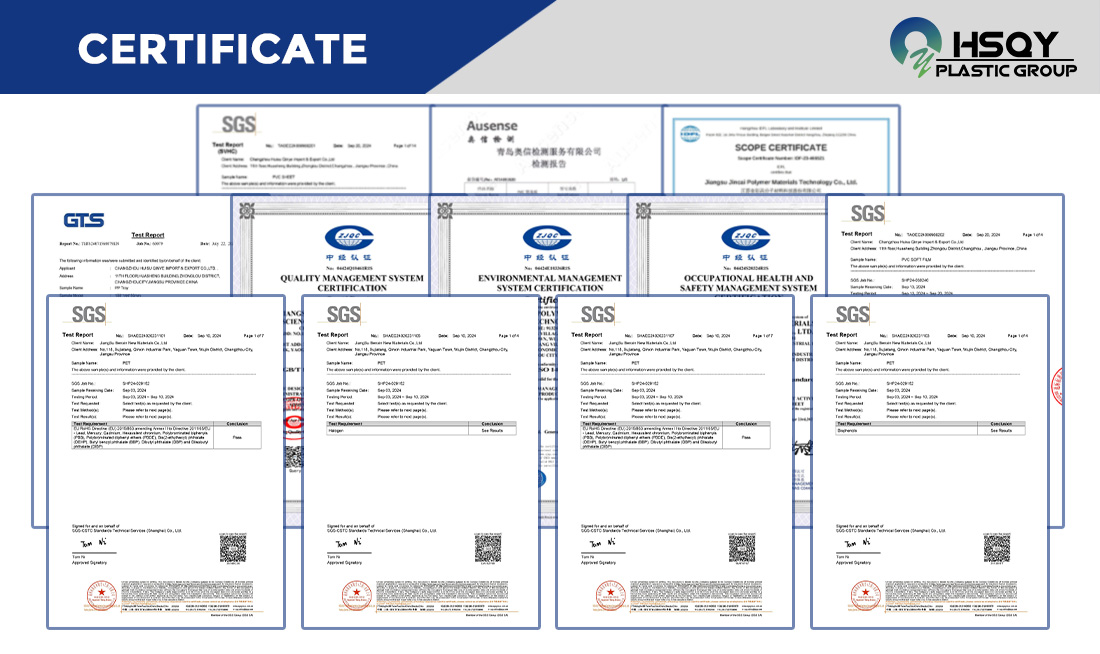
Certification and Documentation
Buyers should request current technical and quality documentation applicable to the exact PETG grade being purchased and verify the scope of any company or product documents before use in a regulated application.
Where a project requires food contact, defined UV performance, impact performance, chemical compatibility or another application-specific requirement, specify the requirement before ordering and request supporting documentation for the quoted material.

HSQY Certification Information
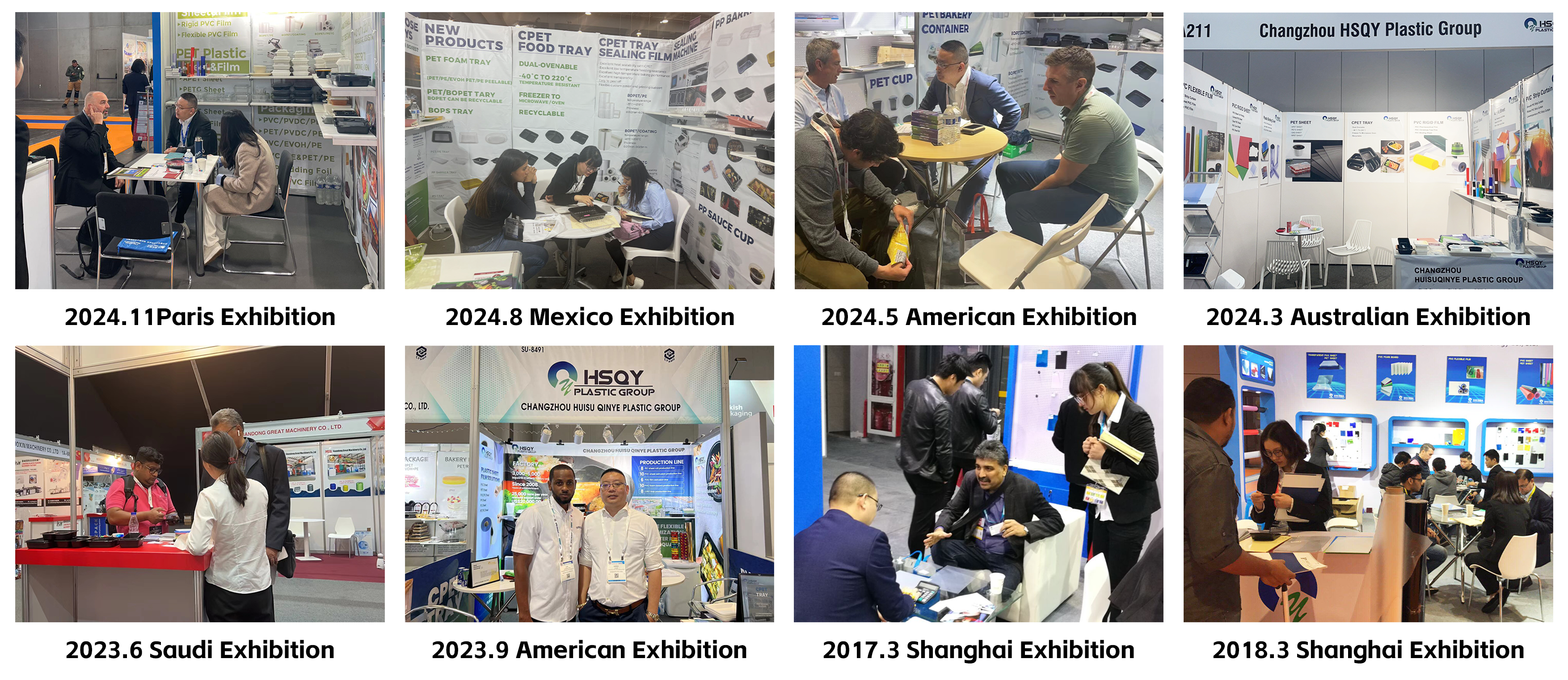
HSQY Global Exhibitions

HSQY Plastic Group – Global Exhibition Activities
Frequently Asked Questions About PETG Sheet & Film
What is PETG sheet?
PETG is a glycol-modified copolyester sheet material commonly used for thermoforming, displays, signage and fabricated transparent or colored components.
What is the difference between PETG sheet and PETG film?
Both are PETG material. Thin gauges are commonly supplied in roll form for continuous converting, while thicker gauges are more commonly handled as flat sheets for forming and fabrication.
What thicknesses are available?
The detailed product specification lists PETG thicknesses from 0.15mm to 7mm.
What PETG roll widths are available?
The current listed roll-width range is 110mm to 1280mm.
What PETG sheet sizes are available?
The current listed sheet sizes are 915 × 1220mm and 1000 × 2000mm.
Can PETG be thermoformed?
Yes. Thermoforming is one of PETG's main processing directions. Starting thickness and process conditions should be selected according to mold geometry and finished wall requirements.
Can PETG be used for deep-draw parts?
Suitable PETG grades can be evaluated for deep or complex formed parts. Buyers should provide draw depth, mold geometry and minimum finished wall thickness.
Does PETG require pre-drying?
The current product information identifies PETG as suitable for thermoforming without separate pre-drying under appropriate conditions. Actual processing should follow the guidance for the supplied grade and material condition.
Can PETG be cut and drilled?
Yes. Sawing, die cutting, drilling, punching, shearing and milling are listed among the current processing methods.
Can PETG be cold formed?
Cold forming is listed among the current processing methods. Bend radius, material thickness and finished geometry should be tested using the actual PETG grade.
Can PETG be bonded?
PETG can be bonded using compatible processes. Joint design, surface preparation and adhesive or solvent compatibility should be verified before volume production.
Can PETG be printed?
PETG can be evaluated for printed and decorated components. Ink adhesion, curing and any subsequent forming process should be tested on the actual sheet.
Is PETG suitable for signage?
Yes. Signage is one of the listed applications. Indoor and outdoor conditions should be specified separately because UV requirements differ.
Is standard PETG UV resistant?
UV protection should be confirmed for the exact grade. If long-term outdoor exposure is required, specify the service environment and request an appropriate UV-protected PETG material.
Is PETG more impact resistant than acrylic?
PETG is commonly selected for useful toughness in fabricated applications, but numerical comparisons depend on the exact PETG and acrylic grades, thickness and test method. Request grade-specific data where impact performance is critical.
Is PETG better than polycarbonate?
The two materials serve different requirements. PETG is often selected for thermoforming and fabrication, while polycarbonate is commonly selected where higher engineering impact or temperature performance is required.
Can PETG be used for refrigerator drawers?
Refrigerator drawers are shown as an application on the current product page. Finished dimensions, service temperature, load and forming requirements should be provided for material evaluation.
Can PETG be used for rulers?
Rulers are shown as an application on the current page. Thickness, printing, cutting and dimensional requirements should be defined for the finished product.
Can PETG be used for card applications?
PETG can be evaluated for selected card constructions. Buyers should specify layer thickness, printing, lamination and applicable finished-card requirements.
Is PETG chemically resistant?
PETG provides resistance to many substances, but compatibility should be verified for the exact chemical, concentration, temperature and exposure duration.
Can PETG be used for food-contact applications?
Food-contact suitability depends on the exact PETG grade and destination market. Request current documentation applicable to the actual material and intended contact conditions.
What colors are available?
The current product page lists transparent and colored PETG.
What is the density of PETG?
The current product specification lists a density of 1.27–1.29g/cm³.
What is the MOQ?
The current listed minimum order quantity is 1000kg.
What information should I provide for a quotation?
Provide the application, thickness, roll or sheet format, dimensions, color, forming or fabrication process, functional requirements, quantity and destination.
About HSQY Plastic Group
HSQY Plastic Group supplies PETG sheet, PETG film and other plastic sheet materials to thermoformers, fabricators, sign and display manufacturers, equipment manufacturers, distributors and other professional buyers.
The current product information lists five PETG production lines with a daily production capacity of 50 tons. PETG is supplied in roll and sheet formats for different forming and fabrication requirements.
For PETG projects, provide the required thickness, dimensions, color, application, forming or fabrication process, quantity and destination so the appropriate product specification can be reviewed.
PETG sheets are easy to produce products with complex shapes and large stretch ratios. Moreover, unlike PC board and impact-modified acrylic, this board does not need to be pre-dried before thermoforming. Compared with PC board or acrylic, its molding cycle is short, the temperature is low, and the yield is higher.
The extruded sheet of PETG sheet is usually 15 to 20 times tougher than general acrylic and 5 to 10 times tougher than impact modified acrylic. PETG sheet has sufficient bearing capacity during processing, transportation and use, which helps prevent cracking.
PETG sheet provides excellent weather resistance. It can maintain the toughness of the product and prevent yellowing. It contains ultraviolet absorbers, which can be co-extruded into a protective layer to protect the board from the harmful effects of ultraviolet rays.
PETG sheet can be sawed, die-cut, drilled, punched, sheared, riveted, milled and cold-formed without breaking. Slight scratches on the surface can be eliminated with a hot air gun. Solvent bonding is also a normal operation. It is easier to process than general acrylic, impact modified acrylic or PC board, and can be processed for flocking, electroplating, static electricity and other processing.
PETG sheet can withstand a variety of chemicals and commonly used cleaning agents.
The PETG sheet substrates are all environmentally friendly materials, which meet the requirements of food contact management.
It is cheaper than a polycarbonate board, and it is more durable than polycarbonate board.
By using conventional molding methods, we can make PETG sheet from 0.15MM to 7MM, with outstanding toughness and high impact resistance, its impact resistance is 3~10 times that of modified polyacrylates, excellent molding performance, cold Bending is not white, no cracks, easy to print and decorate, widely used in indoor and outdoor signs, storage racks, vending machine panels, furniture, construction and mechanical baffles, etc.
PCTG card is mainly used in Europe, but it has also been more and more used in North America and Asia. The reason is that it has a wide processing range, high mechanical strength and excellent flexibility. Compared with PVC, it has high transparency, good gloss, easy printing and environmental protection advantages.
PETG materials are used in credit cards. Visa is one of the largest credit card companies in the world, with 580 million cards issued worldwide in 1998. The company has recognized glycol-based modified polyester (PETG) as its credit card material. For countries that require card materials to be more environmentally friendly, PETG can replace polyoxyethylene materials. Visa also pointed out: The results from 3 different experimental plants show that PETG meets all the requirements of the international credit card standard (150/IEC7810), so PETG cards may be widely used here.
ChangZhou HuiSu QinYe Plastic Group established more than 16 years, with 8 plants to offer all kinds of Plastic products, including PVC RIGID CLEAR SHEET,PVC FLEXIBLE FILM, PVC GREY BOARD, PVC FOAM BOARD, PET SHEET, ACRYLIC SHEET. Widely used for Package, Sign,D ecoration and other areas.
Our concept of considering both quality and service equally importand and performance gains trust from customers, that is why we have established good cooperation with our clients from Spain, Italy, Austria, Portugar, Germany, Greece, Poland, England, American, South American, India, Thailand, Malaysia and so on.
By choosing HSQY, you'll get the strength and stability. We manuacture the industry's broadest range of products and continuously develop new technologies, formulations and solutions. Our reputation for quality, customer service and technical support is unsurpassed in the industry. We continuously strive to advance sustainability practices in the markets we serve.


 Download PETG Sheet & Film Data Sheet