Anti-Static RPET Sheet for ESD Electronic Packaging
HSQY anti-static RPET sheet combines recycled polyethylene terephthalate with electrostatic-control options for thermoformed electronic packaging, component trays, blister packaging and other applications where static charge needs to be controlled.
The current product specification includes thicknesses from 0.12mm to 6mm, widths up to 1400mm, standard sheet size of 1220 × 2440mm, and clear or customized color options.
HSQY currently lists anti-static, static-dissipative and conductive PET/RPET capabilities. These are different ESD performance levels and should be selected according to the customer's required surface resistance, electronic component sensitivity, packaging process and ESD-control standard.
The current page also states that RPET grades can contain up to 100% post-consumer recycled PET. Exact recycled content, anti-static performance and applicable GRS, RoHS or REACH documentation should be confirmed for the specific grade being ordered.
The current minimum order quantity is 1000kg. Custom thickness, width, color, surface treatment and thermoforming requirements can be discussed for B2B projects.
Anti-Static RPET Sheet Video
Anti-Static RPET Sheet Images

Anti-Static RPET Film Roll

RPET Sheet for Blister Packaging

Clear RPET Thermoforming Sheet
Anti-Static RPET Sheet Specifications
| Property |
Details |
| Product Name |
Anti-Static RPET Sheet |
| Brand |
HSQY |
| Material |
Recycled Polyethylene Terephthalate / RPET |
| Recycled Content |
Up to 100% Post-Consumer Recycled PET According to Current Product Content; Confirm Exact Grade |
| Thickness |
0.12mm–6mm |
| Maximum Width |
1400mm |
| Standard Sheet Size |
1220 × 2440mm / Customized |
| Color |
Clear / Colored / Customized |
| Surface |
High Gloss / Matte / Customized According to Current Product Information |
| ESD Options |
Anti-Static / Static Dissipative / Conductive Options Are Listed; Exact Grade Must Be Confirmed |
| Surface Resistance |
Not Published on Current Page – Specify Required Resistance Range |
| ESD Treatment Method |
Confirm Coated, Additive or Other Construction for the Selected Grade |
| ESD Sides |
Confirm One-Side or Two-Side ESD Requirement |
| Primary Processing |
Thermoforming / Vacuum Forming / Blister Forming / Die Cutting |
| Primary Application |
ESD-Sensitive Electronic Component Packaging and Thermoformed Trays |
| Other Surface Options |
Anti-Fog / UV / Printing Options Listed by HSQY; Confirm Whether Required on the Exact Anti-Static Grade |
| Current Documentation References |
GRS / RoHS / REACH References – Confirm Exact Scope and Current Documents |
| MOQ |
1000kg |
Important ESD Specification Note:
The current HSQY page does not publish a measured surface-resistance range for this product. Do not automatically label the same sheet as anti-static, static dissipative and conductive without identifying the exact grade. The customer's required resistance range, test method, humidity condition, treatment method and one-side or two-side requirement should be confirmed before quotation and production.
What Is Anti-Static RPET Sheet?
Anti-static RPET sheet is a recycled PET-based plastic sheet engineered or surface-treated to control electrostatic charge. It is primarily used where conventional plastic packaging could accumulate static electricity around sensitive electronic products.
In electronic packaging, the required ESD performance depends on the sensitivity of the component and the ESD-control program used by the manufacturer. A generic statement such as “anti-static” is therefore not enough for technical purchasing.
Buyers should specify the required resistance range and determine whether the package needs low-charging, static-dissipative, conductive or additional shielding performance.
Anti-Static vs. Static Dissipative vs. Conductive RPET
| ESD Grade |
Primary Function |
Purchasing Requirement |
| Anti-Static |
Designed to reduce static-charge generation and accumulation. |
Specify target surface resistance and required durability. |
| Static Dissipative |
Provides a controlled path for electrostatic charge dissipation. |
Specify the required resistance window and ESD standard. |
| Conductive |
Provides lower electrical resistance for applications requiring more conductive behavior. |
Confirm resistance, grounding concept and component sensitivity. |
The terminology above describes different ESD-control functions. Final classification should be based on measured performance and the customer's applicable standard rather than the product name alone.
Key Features of Anti-Static RPET Sheet
ESD-Control Options: HSQY currently lists anti-static, static-dissipative and conductive configurations for PET/RPET applications.
Recycled PET Content: Current HSQY content states that selected RPET sheets can contain up to 100% post-consumer recycled PET.
Clear Product Visibility: Clear grades can provide visual inspection of electronic components and packaged products.
Thermoforming Capability: RPET sheet can be evaluated for thermoformed trays, blisters, clamshells and protective packaging.
Custom Thickness: Current product specifications cover 0.12mm to 6mm.
Wide Web Capability: Maximum width is currently listed as 1400mm.
Custom Surface: High-gloss and matte surfaces are listed, while other functional surface treatments can be discussed separately.
Sheet and Roll Supply: Material format can be selected according to thermoforming, die-cutting and packaging-line requirements.
How ESD Packaging Protects Electronic Components
Electrostatic discharge can occur when electrical charge builds up and is suddenly transferred between objects. Sensitive semiconductor and electronic components can require controlled packaging during manufacturing, storage and transportation.
An ESD-control package may need to reduce charge generation, dissipate accumulated charge or provide additional discharge shielding depending on where the package is used and the sensitivity of the component.
Low Charging: Helps limit static generation caused by contact and separation between packaging surfaces and components.
Charge Dissipation: Static-dissipative materials provide controlled movement of accumulated charge.
Conductive Performance: Conductive materials provide lower-resistance paths where the packaging system requires them.
Shielding: Some applications moving ESD-sensitive devices outside protected areas may require packaging with additional discharge-shielding performance beyond a simple anti-static surface.
Applications of Anti-Static RPET Sheet
Semiconductor Packaging: Thermoformed trays and protective packaging for suitable semiconductor components.
Integrated Circuits: ESD-control packaging for IC handling, storage and transport.
Printed Circuit Boards: Protective packaging and trays for suitable PCB manufacturing and logistics applications.
Sensors and Electronic Modules: Thermoformed carriers for static-sensitive modules and precision components.
Display and Mobile Components: ESD-control packaging can be evaluated for screens, display modules and mobile-device parts.
Memory and Storage Components: Packaging for suitable memory modules and data-storage components requiring ESD precautions.
Precision Electronic Parts: Anti-static or dissipative RPET trays can be designed around part dimensions, cavity geometry and handling processes.
Anti-Static RPET Sheet for Thermoforming
Thermoforming is a major application for ESD-control PET and RPET sheets. The sheet can be heated and formed into trays, cavities or protective packaging designed around the electronic component.
The forming process must maintain both the physical geometry and the required ESD performance. Buyers should therefore verify surface resistance after thermoforming rather than assuming the finished tray has exactly the same electrical properties as the original flat sheet.
Sheet Thickness: Select according to tray stiffness, cavity depth and component weight.
Forming Depth: Deep draws can affect material thickness distribution and should be tested with the selected ESD construction.
Surface Treatment: Confirm whether the anti-static property is provided by a coating or another material technology and whether the treatment remains effective after forming.
One-Side vs. Two-Side: Specify which surfaces of the finished packaging require ESD performance.
Finished-Part Testing: Measure ESD performance on the formed production tray under the customer's required environmental and test conditions.
Coated vs. Permanent Anti-Static RPET
ESD properties can be created using different material technologies. The current HSQY page does not identify the exact treatment mechanism used for each anti-static, dissipative or conductive grade, so this should be confirmed before specification.
| ESD Construction |
Purchasing Consideration |
| Surface-Coated |
Confirm coating durability, forming performance, abrasion resistance, humidity stability and resistance to cleaning processes. |
| Integrated / Additive |
Confirm whether electrical performance is permanent or semi-permanent and whether additives affect clarity or recycled-content requirements. |
| Conductive Construction |
Confirm exact resistance, color, transparency, grounding requirements and compatibility with the electronic component. |
RPET vs. Virgin PET for ESD Packaging
| Comparison |
RPET |
Virgin PET |
| Raw Material |
Contains recycled PET content. |
Uses virgin PET resin. |
| Recycled-Content Claim |
Can support recycled-content objectives when supported by documentation. |
Does not provide post-consumer recycled content. |
| Clarity |
Depends on recycled content, feedstock quality, extrusion process and grade. |
Can provide high clarity depending on resin and processing. |
| ESD Performance |
Depends on the selected anti-static, dissipative or conductive treatment. |
Also requires an appropriate ESD treatment when static control is required. |
| Selection Priority |
Recycled content plus required ESD and thermoforming performance. |
Virgin-material specification plus required ESD performance. |
Recycled Content and GRS Documentation
The current HSQY page states that selected RPET sheets can use up to 100% post-consumer recycled PET and references GRS certification.
Recycled-content percentage should be treated as a purchasing specification. If a customer requires 30%, 50%, 80% or 100% PCR content, that requirement should be specified before production and supported by the applicable documentation.
GRS documentation relates to recycled-material verification and supply-chain traceability. It should not be interpreted as certification of ESD performance, food-contact suitability or another unrelated technical property.
Other Functional RPET Options
The current HSQY specification table also lists anti-fog, UV and printing options. These should be treated as optional functional grades rather than automatic properties of every anti-static RPET sheet.
Anti-Fog: Confirm if anti-fog performance is required for the final packaging environment.
UV Option: Specify expected UV exposure and required service conditions rather than assuming every RPET grade is UV stabilized.
Printing Grade: Provide the printing method, ink system and surface-treatment requirement.
Combined Functions: If ESD plus anti-fog, printing or another function is required, confirm that the combined specification is technically available and test the final production grade.
How to Choose an Anti-Static RPET Sheet
1. Define the ESD Requirement: Specify anti-static, static-dissipative or conductive performance based on the electronic component and customer standard.
2. Specify Surface Resistance: Provide the required resistance range rather than requesting only “anti-static PET.”
3. Specify Test Method: Identify the test standard, electrode configuration, voltage and environmental conditions required by the customer.
4. One-Side or Two-Side: Confirm whether one or both surfaces require ESD performance.
5. Treatment Durability: Define whether temporary, semi-permanent or longer-term ESD performance is required.
6. Recycled Content: Specify the required PCR percentage and applicable traceability documentation.
7. Thickness and Width: Current HSQY options extend from 0.12–6mm and up to 1400mm wide.
8. Color and Transparency: Specify clear, tinted, white, black or another required appearance.
9. Thermoforming Requirements: Provide cavity dimensions, draw depth, part design and forming process.
10. Finished-Part Validation: Test surface resistance and functional performance after thermoforming under actual production conditions.
Information Needed for a Fast ESD RPET Quote
1. Required surface resistance range
2. Anti-static, dissipative or conductive requirement
3. Required ESD test standard or method
4. One-side or two-side ESD treatment
5. Required thickness
6. Required width or sheet size
7. Clear or custom color
8. Required recycled-content percentage
9. Electronic component or end-use application
10. Thermoforming cavity dimensions and draw depth
11. Required GRS, RoHS, REACH or other documentation
12. Required quantity
13. Destination country or shipping port
Anti-Static RPET Sheet Technical Data
Quality and Recycled-Content Documentation
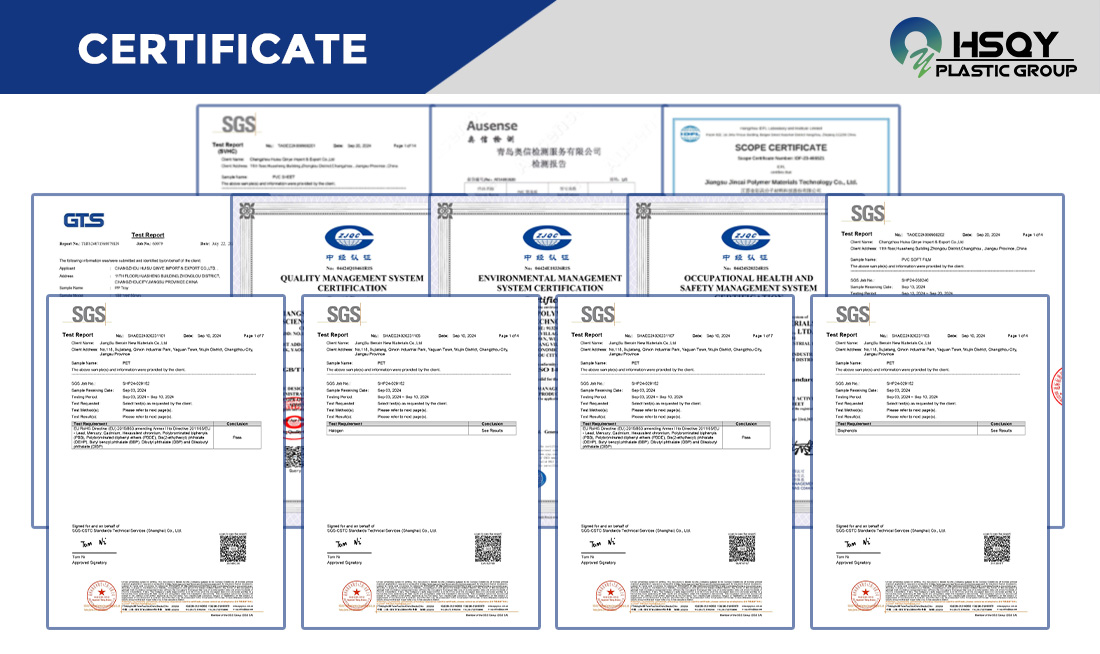
The current HSQY product content references GRS, RoHS and REACH documentation. Buyers should request the latest documents applicable to the exact RPET material, recycled-content percentage and anti-static grade being purchased.
GRS documentation supports verification and traceability of recycled material. It does not establish the electrical surface resistance of an ESD sheet, so separate anti-static or conductive test data should be provided when ESD performance is a purchasing requirement.
Similarly, RoHS and REACH documentation address specific substance-related requirements and should not be interpreted as evidence of ESD performance or food-contact suitability.

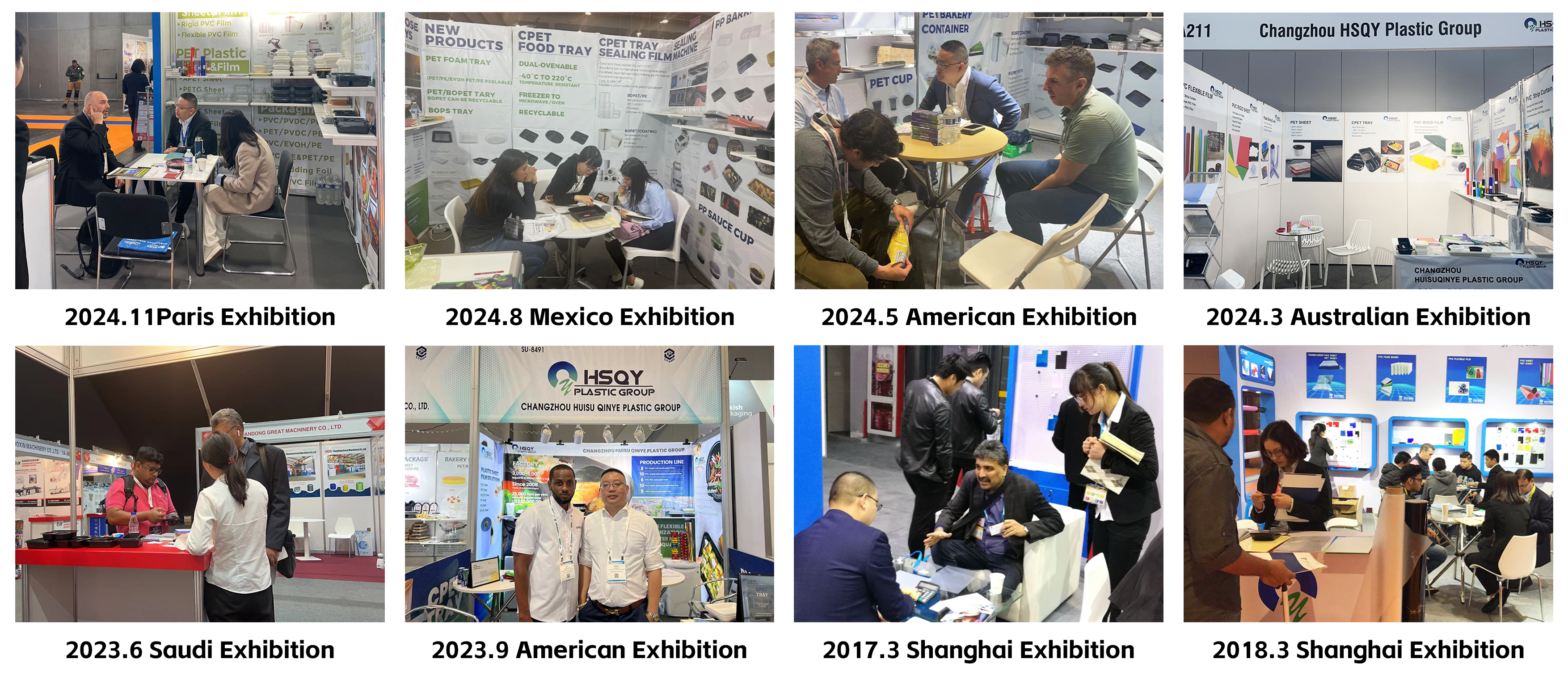
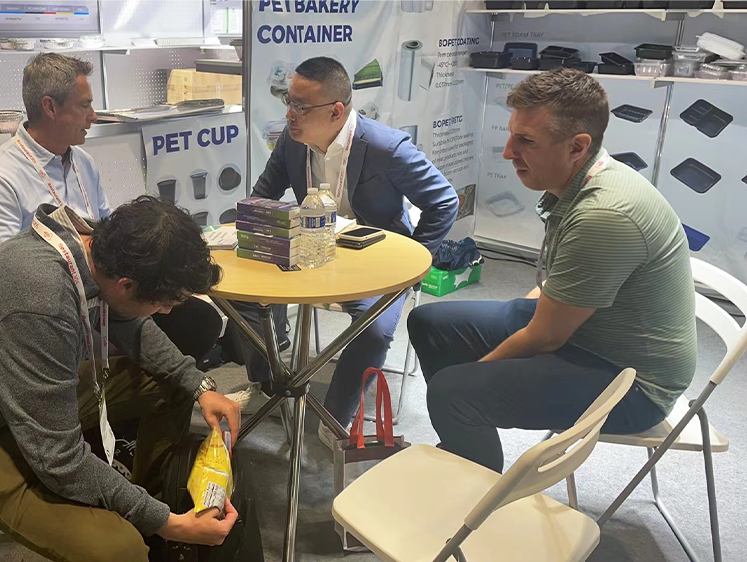
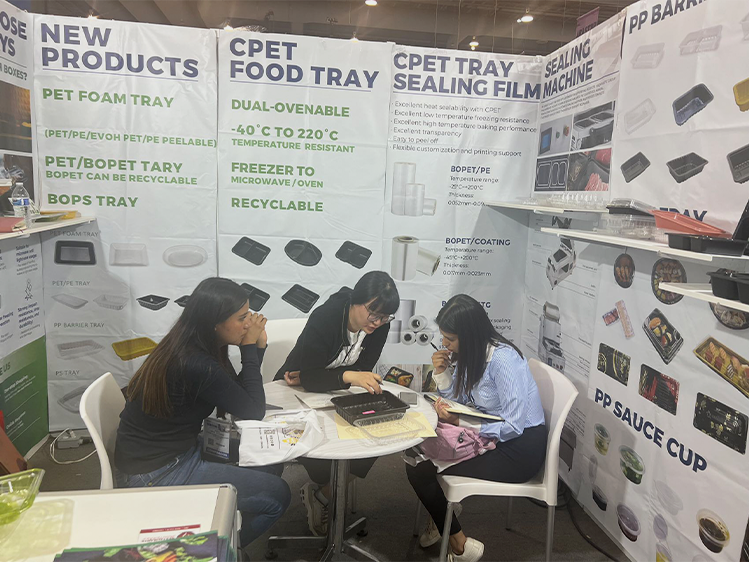
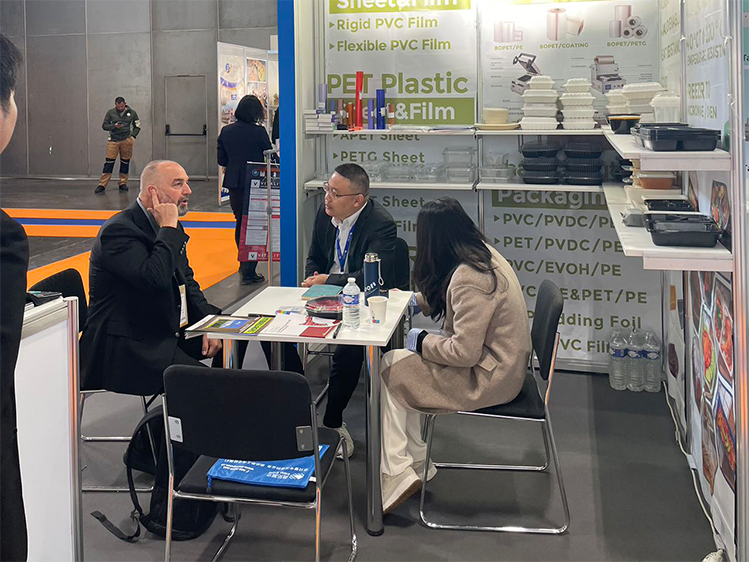
International Exhibitions

HSQY International Exhibition Overview

2017 Shanghai Exhibition

2018 Shanghai Exhibition

2023 Saudi Exhibition

2023 American Exhibition

2024 Australian Exhibition

2024 American Exhibition

2024 Mexico Exhibition

2024 Paris Exhibition
Packing and Delivery

RPET Sheet Packaging

RPET Roll and Pallet Packaging
Final roll weight, pallet configuration, protective wrapping and container loading should be confirmed according to sheet thickness, width, roll diameter and order quantity.
Frequently Asked Questions
What is anti-static RPET sheet?
Anti-static RPET sheet is recycled PET sheet with an ESD-control treatment or construction designed to reduce electrostatic charge generation or accumulation. It is commonly used for thermoformed packaging of sensitive electronic components.
Is RPET the same as RPETG?
No. RPET refers to recycled polyethylene terephthalate. PETG is glycol-modified PET and is a different material category. This HSQY product is an RPET sheet, so “rPETG Sheet” should not be used as the product name unless the actual material structure contains PETG and is technically documented.
What is the surface resistance of HSQY anti-static RPET sheet?
The current HSQY page does not publish an exact surface-resistance value. Provide your required resistance range and test method so HSQY can confirm the appropriate anti-static, dissipative or conductive grade.
What is the difference between anti-static and static-dissipative RPET?
Anti-static materials are intended to limit charge generation or accumulation, while static-dissipative materials are designed to allow charge to move in a controlled manner. The exact classification should be based on measured resistance and the customer's ESD standard.
What is conductive RPET sheet?
Conductive RPET uses an electrical-control system designed to provide lower resistance than typical anti-static or dissipative grades. Specify the exact resistance requirement and packaging system before selecting a conductive material.
Is the anti-static property permanent?
The current page does not specify whether every grade is permanent, semi-permanent or temporary. Confirm the ESD treatment method and required service life before ordering.
Is the ESD treatment coated or built into the RPET?
The treatment mechanism is not identified on the current product page. Confirm whether the selected grade uses a surface coating, an integrated additive or another conductive/dissipative construction.
Can anti-static RPET sheet be thermoformed?
Thermoforming and vacuum forming are listed applications. The finished tray should be tested after forming to verify dimensions, clarity and ESD performance.
Can RPET be used for ESD electronic trays?
Yes, a suitably specified ESD RPET grade can be evaluated for thermoformed electronic component trays. The required electrical performance depends on the component and the customer's ESD-control program.
What electronic components can use ESD RPET packaging?
Potential applications include semiconductor components, ICs, PCBs, sensors, memory modules, display components and other static-sensitive electronics after the required ESD protection level is confirmed.
What thicknesses are available?
The current HSQY product specification lists thicknesses from 0.12mm to 6mm.
What is the maximum width?
Maximum width is currently listed as 1400mm.
Can HSQY supply clear anti-static RPET?
Clear and colored materials are listed. Final transparency can depend on recycled content, ESD treatment and other functional additives, so optical requirements should be specified.
Can anti-static treatment be applied to both sides?
One-side or two-side ESD treatment should be treated as a technical specification. Tell HSQY which surfaces require ESD performance so the appropriate construction can be confirmed.
Does RPET require pre-drying before thermoforming?
Processing requirements can vary with RPET grade, moisture content, recycled content, thickness and forming conditions. Follow the technical processing guidance for the selected material rather than assuming that every RPET grade requires no pre-drying.
Is this sheet made from 100% recycled PET?
The current HSQY page states that selected grades can use up to 100% post-consumer recycled PET. Confirm the exact recycled-content percentage required for your order and request the applicable documentation.
Does GRS certification prove anti-static performance?
No. GRS is associated with recycled-material verification and traceability. ESD properties need separate electrical-performance testing for the actual RPET grade.
Is anti-static RPET recyclable?
RPET is PET-based, but actual recycling acceptance depends on local collection systems, the ESD treatment, additives, coatings and the finished packaging format. Check destination-market recycling requirements before making an unconditional recycling claim.
Is anti-static RPET food safe?
Food-contact suitability should not be assumed from generic RPET material information. If food contact is required, request the applicable documentation for the exact recycled-content grade, ESD treatment and destination market.
What is the MOQ for anti-static RPET sheet?
The current minimum order quantity is 1000kg.
Can I request a sample for ESD testing?
Contact HSQY with your required surface resistance, thickness, width, ESD grade, forming process and application to confirm an appropriate sample for electrical and thermoforming evaluation.
What information should I provide for a quotation?
Provide the target surface resistance, ESD grade, test method, one-side or two-side treatment, thickness, width, recycled-content percentage, color, application, thermoforming requirements, quantity and destination.
Why Choose HSQY for Anti-Static RPET Sheet?
ESD Grade Options: Anti-static, static-dissipative and conductive requirements can be discussed according to the customer's target performance.
Recycled PET Options: Current HSQY content lists grades with up to 100% post-consumer recycled PET.
Wide Thickness Range: Current product specifications cover 0.12mm to 6mm.
Maximum Width 1400mm: Wide-web material is available for suitable thermoforming and packaging applications.
Thermoforming Applications: Sheet specifications can be matched to electronic trays, blisters and protective packaging designs.
B2B Supply: HSQY supports electronics packaging manufacturers, thermoformers, component suppliers, plastic converters, distributors and industrial buyers.
About HSQY Plastic Group
HSQY Plastic Group supplies RPET sheet, APET sheet, PETG sheet and other functional plastic sheets for thermoforming, packaging and industrial applications.
For anti-static RPET sheets, static-dissipative PET, conductive PET or recycled ESD thermoforming materials, send HSQY your target resistance, sheet specification, recycled-content requirement, forming process and quantity for technical evaluation and quotation.


 Download HSQY RPET Sheet Specification