HS16 15 oz 2-Compartment Black CPET Tray for Airline and Ready Meals
The HSQY HS16 CPET tray is a 15 oz rectangular black food tray with two separate compartments. Measuring 7.66 × 5.81 × 1.18 inches, it is designed for portioned airline meals, frozen ready meals, institutional catering and other heat-and-eat food programs that require freezer-to-oven convenience.
Its crystallized polyethylene terephthalate construction is suitable for validated use from -40°C to +220°C. Meals can be filled and sealed, distributed chilled or frozen, and reheated in a microwave or conventional oven using cooking instructions approved for the complete package.
Quick answer: HS16 is a shallow, 15 oz black CPET tray with two compartments, a published weight of 21 g and 600 trays per case. It is a practical format for separating a main dish from a side while supporting frozen storage and dual-oven reheating.
Request HS16 Samples and Pricing
HS16 Black CPET Tray Product Image
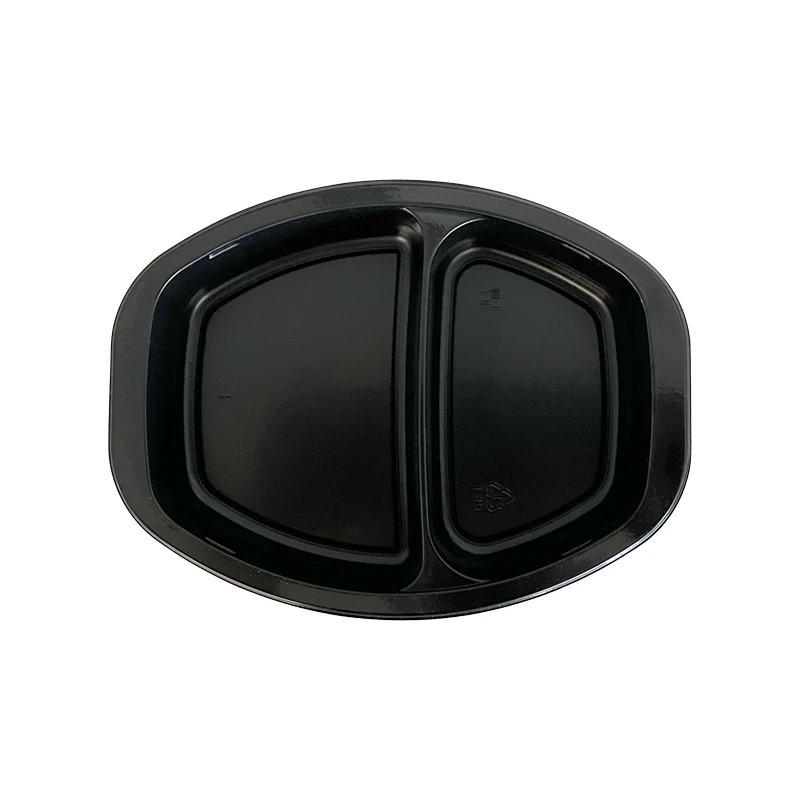
HS16 rectangular 2-compartment CPET tray for portion-controlled hot and frozen meals
HS16 CPET Tray Specifications
| Specification |
HS16 Details |
| Item number |
HS16 |
| Material |
CPET — crystallized polyethylene terephthalate |
| Shape |
Rectangular |
| Compartments |
2 compartments |
| Outside dimensions |
7.66 × 5.81 × 1.18 in; approximately 194.5 × 147.5 × 30 mm |
| Capacity |
15 oz; approximately 450 ml |
| Published tray weight |
21 g |
| Standard color |
Black; white and custom colors are subject to feasibility and MOQ review |
| Temperature range |
-40°C to +220°C under validated use conditions |
| Heating methods |
Conventional oven and microwave; validate the final meal, film and cooking cycle |
| Case pack |
600 pieces per case |
| MOQ |
50,000 pieces |
| Typical applications |
Airline meals, frozen ready meals, school meals, meal delivery and institutional catering |
Final dimensions, tolerances, weight, temperature limits, packing configuration and food-contact documentation should be confirmed on the approved HS16 specification and sample before mass production.
Why Choose the HS16 2-Compartment CPET Tray?
![CPET food tray used for freezer-to-oven ready meal packaging]()
Dual-Ovenable Freezer-to-Oven Performance
CPET develops its heat resistance through controlled crystallization. This enables the HS16 tray to retain useful rigidity across frozen storage, refrigerated distribution and reheating. The published operating range is -40°C to +220°C, making the tray suitable for properly validated freezer-to-microwave and freezer-to-conventional-oven meal systems.
The tray should not be placed over a direct flame, on a hot plate or under an unapproved grill or broiler. Maximum temperature, heating time, food composition, fill level and support method must be tested before final consumer cooking instructions are issued.
Two Compartments for Better Meal Presentation
The divided format helps keep the main dish separate from rice, vegetables, pasta, potatoes or another side. This supports portion control, improves presentation and reduces unwanted mixing of sauces during transport and reheating.
Shallow Format for Airline and Catering Operations
At approximately 30 mm deep, HS16 is designed for shallow portioned meals where storage height, trolley space and controlled serving size matter. Nested trays help reduce storage volume before filling, while the rigid rim supports handling and heat sealing.
CPET Tray and Lidding Film Compatibility
The HS16 tray should be paired with a lidding film developed for sealing to CPET. Depending on the meal, distribution system and reheating method, HSQY can discuss PET/PE easy-peel film or coated BOPET lidding film for CPET trays. Film selection must consider oven or microwave exposure, freezer performance, anti-fog requirements, puncture resistance, printing and peel strength.
| Selection Factor |
What the Buyer Should Confirm |
| Seal layer |
Film must be specifically compatible with the CPET tray flange |
| Opening behavior |
Easy-peel strength should remain consistent after chilled or frozen storage |
| Heating method |
Confirm whether the film is removed, peeled back, pierced or left in place during reheating |
| Product protection |
Define required oxygen and moisture barrier, leak resistance and shelf-life target |
| Tray-sealer settings |
Establish the validated temperature, dwell time and pressure window on the actual machine |
Important: A CPET tray alone does not guarantee an airtight or leakproof package. Seal integrity depends on the tray flange, lidding film, food contamination at the seal area, tooling condition and validated machine settings.
Ask for a Matched Tray and Lidding Film
HS16 Performance Features
![HS16 black CPET ready meal tray with two compartments]()
Dual-ovenable: designed for microwave and conventional-oven reheating after application testing.
Wide temperature range: supports frozen storage and high-temperature cooking from -40°C to +220°C under approved conditions.
Two-section design: separates the main course and side dish for improved presentation.
Rigid, stackable format: supports packing-line handling, storage, transport and meal service.
Black gloss appearance: provides a clean presentation for airline, retail and institutional meals.
Heat-sealable rim: works with a compatible easy-peel CPET lidding film after seal trials.
Branding options: printed lidding film and custom packaging solutions can be reviewed for volume projects.
Is the HS16 CPET Tray Recyclable?
CPET belongs to the PET material family and may be technically recyclable, but real-world acceptance depends on local collection, sorting technology, tray color, food contamination and recycling infrastructure. Buyers should confirm local labeling and disposal requirements before making a broad recyclability claim.
If recycled content is required, request documentation for the exact supplied specification. Recycled-content percentage, food-contact suitability and destination-market compliance should be confirmed separately rather than assumed from the CPET material name.
Applications of the HS16 15 oz CPET Tray
![CPET tray used for airline catering and portioned ready meals]()
HS16 is intended for food programs that need a compact two-part meal tray capable of moving through filling, sealing, cold storage, transport and reheating. Typical applications include:
Airline catering: portioned in-flight meals for economy or premium service.
Frozen ready meals: freezer-to-oven or freezer-to-microwave retail meal programs.
School meals: controlled main-and-side meal portions.
Healthcare and institutional catering: standardized portions for centralized kitchens.
Meals on wheels: sealed meals intended for transport and reheating.
Foodservice and meal delivery: prepared meals requiring separated components.
Food safety, shelf life, reheating instructions and transport performance must be validated for the actual recipe, fill weight, sealing film and distribution process.
How to Test HS16 on Your Filling and Sealing Line
Confirm the drawing: check outside dimensions, cavity volume, flange width, compartment ratio, nesting height and tolerances.
Check denesting: test tray separation, magazine loading and feeding at the target production speed.
Match the tooling: confirm the mold pocket, cutting profile and seal plate fit your HS16 sample.
Establish the seal window: test temperature, dwell time and pressure with the selected CPET lidding film.
Run distribution tests: evaluate stacking, vibration, compression, frozen impact, leaks and peel strength.
Validate cooking performance: test the complete meal pack through the intended freezer, microwave and conventional-oven cycles.
Custom CPET Tray Options
In addition to HS16, HSQY supplies rectangular, square and round CPET trays with one, two or three compartments. Common project capacities include approximately 300 ml, 350 ml, 400 ml and 450 ml, with other sizes subject to tooling and technical review. Standard colors include black, white and natural, while custom colors depend on the required quantity and specification.
For a focused quotation, send your tray drawing or sample, cavity volume, food type, fill weight, heating method, tray-sealer model, lidding-film requirement, annual forecast, destination market and packing preference.
Discuss a Custom CPET Tray Project
Frequently Asked Questions About the HS16 CPET Tray
What are the dimensions and capacity of the HS16 CPET tray?
HS16 measures 7.66 × 5.81 × 1.18 inches, approximately 194.5 × 147.5 × 30 mm. It has two compartments and a published capacity of 15 oz, approximately 450 ml. Request the technical drawing to confirm each compartment's usable capacity and dimensional tolerances.
Can the HS16 tray go directly from the freezer to a conventional oven?
CPET is designed for freezer-to-oven applications, and the published range is -40°C to +220°C. However, the final meal, tray fill, lidding method, heating time and oven conditions must be tested before consumer instructions are approved.
Is the HS16 CPET tray microwave-safe?
Yes, HS16 is intended for microwave reheating as part of a validated meal package. The lidding film may need to be removed, peeled back or pierced for venting according to the approved cooking instructions.
Which sealing film is recommended for HS16?
Use an easy-peel lidding film developed for CPET, such as a compatible PET/PE or coated BOPET structure. The correct option depends on the food, storage temperature, heating method, barrier target, anti-fog requirement and tray-sealer settings.
Is HS16 suitable for airline catering?
Yes. Its shallow two-compartment design, stackability and ovenable CPET material make it suitable for portioned airline meals. Airlines and catering companies should test trolley fit, sealing, cold-chain handling and aircraft-oven cooking conditions before approval.
Can oily, acidic or saucy foods be packed in this tray?
CPET is commonly used for many prepared foods, but compatibility should be confirmed for the actual recipe, contact time and cooking cycle. Seal contamination, sauce migration and leak performance should also be included in the packaging trial.
Is the black CPET tray recyclable?
CPET is part of the PET family and can be technically recyclable, but local acceptance varies. Black color, food residue and local sorting capability can affect recovery, so buyers should follow destination-market guidance and avoid unqualified universal recycling claims.
What is the minimum order quantity and case pack?
The published MOQ is 50,000 pieces, and the standard case pack is 600 trays. Confirm the final carton size, pallet quantity, delivery schedule and export packing with the quotation.
Can HSQY provide custom CPET trays and printed lidding film?
Yes. HSQY can review custom sizes, depths, compartment layouts, colors and printed easy-peel lidding film. Tooling, artwork, sample lead time and MOQ depend on the approved project specification.
How can I request HS16 samples for testing?
Send your company name, food application, annual volume, destination country, tray-sealer model, lidding-film specification and delivery address through the contact form. HSQY can then confirm sample availability and the recommended validation process.
Source HS16 CPET Trays from HSQY
HSQY supplies CPET trays and compatible lidding films for airline caterers, prepared-food manufacturers, packaging distributors and private-label programs. The team can review the tray, sealing film, machine fit, packing method, food-contact documentation and sample-testing plan together before bulk production.
Need a 15 oz two-compartment ovenable meal tray?
Send your food application, annual quantity, sealing-film requirement and tray-sealer details for HS16 samples and a focused quotation.
Get an HS16 Quote and Sample Plan


