You are here:Home » News » How to Choose PVC Strip Curtains for Coolers and Freezers
How to Choose PVC Strip Curtains for Coolers and Freezers
Views: 0 Author: Site Editor Publish Time: 2026-07-05 Origin: Site
Choosing PVC Strip Curtains for Coolers and Freezers
Quick answer: Choose PVC strip curtains by the lowest operating temperature first, then match strip width, thickness, overlap and mounting hardware to the doorway and traffic. For a small pedestrian cooler, 200 mm × 2 mm clear strips are a useful starting point. A freezer needs a verified low-temperature grade; larger openings with equipment traffic may need 300 mm × 3 mm or 400 mm × 4 mm strips.
A PVC strip curtain, also called a strip door, forms an overlapping flexible barrier that helps limit air exchange during access. The right specification should close reliably after people or equipment pass through, maintain visibility and work alongside the main insulated door.
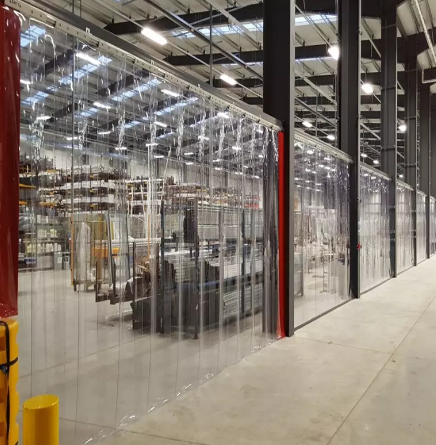
PVC strip curtain installation for warehouse access. Cold-room projects also require a grade verified for the operating temperature.
Quick Selection Guide: Cooler and Freezer Strip Curtains
Use this table to shortlist a configuration. Dimensions are strip width × thickness. Final selection also depends on opening height, air movement, load contact and the supplier's mounting layout.
Application
PVC Type to Evaluate
Common Starting Size
Overlap Selection
Walk-in cooler
Clear smooth PVC rated for the actual temperature
200 mm × 2 mm; nominal US alternative: 8 in × 0.080 in
Moderate coverage that allows easy pedestrian passage
Walk-in freezer
Verified low-temperature or freezer-grade PVC
200 mm × 2 mm or 300 mm × 3 mm
Increase coverage as needed while checking passage force
Cold storage warehouse
Low-temperature PVC; ribbed profile for frequent contact
300 mm × 3 mm
Match coverage to opening height, drafts and traffic
Forklift freezer entrance
Low-temperature ribbed PVC; evaluate reinforcement if required
300 mm × 3 mm or 400 mm × 4 mm
Higher coverage may help; check resistance and load stability
Refrigerated truck
Clear PVC rated for the full transport temperature range
200 mm × 2 mm or a vehicle-specific configuration
Balance side coverage with frequent loading access
Metric and inch sizes above are comparable commercial options, not exact equivalents. Confirm the dimensions and tolerances on the quotation.
Cooler vs. Freezer Strip Curtains: What Changes?
The main difference is the flexibility required at the doorway's lowest temperature. A material that moves easily in an above-freezing cooler can become difficult to push through in a freezer. Stiff or curled strips may leave gaps after traffic passes.
Standard PVC may suit a cooler when its stated operating range covers the application. For freezer service, request a low-temperature formulation with supporting data. Blast freezers and other extreme-cold applications need a separate assessment of the grade and installation.
1. Verify the PVC Temperature Grade
Give the supplier the normal, minimum and maximum temperatures experienced by the strips, including temperature changes during loading and cleaning. Names such as low-temperature, polar and super-polar should be checked against the exact product data sheet; they do not establish one universal temperature rating.
Confirm the recommended service range and flexibility at the lowest operating temperature.
Check cold-impact performance where carts, pallets or forklifts contact the curtain.
Ask for a sample assessment under representative cold conditions before a large order.
Identify the nominated grade on the quotation so repeat orders use the same specification.
Read test data carefully: a cold-bend brittleness temperature and a minimum usage temperature describe different limits. For example, Extruflex's published low-temperature PVC data lists these separately. Obtain equivalent information for the specific HSQY grade being quoted.
2. Match Strip Width and Thickness to Traffic
Select width and thickness together. Narrower, thinner strips generally offer easier passage. Wider, thicker strips can better suit tall openings and equipment contact, but add weight and resistance. More thickness cannot compensate for an unsuitable temperature grade.
200 mm × 2 mm: evaluate for smaller pedestrian doors and light trolley access.
300 mm × 3 mm: evaluate for taller openings, pallet movement and moderate industrial traffic.
400 mm × 4 mm: evaluate for large industrial openings and demanding vehicle traffic.
Provide the widest load as well as the vehicle dimensions. A heavily overlapped curtain may drag against lightweight cartons or unstable loads. Check both passage and how quickly the strips return to position during a trial.
3. Specify Overlap with a Mounting Layout
Overlap is the coverage where neighboring strips meet. Increasing it can reduce open gaps, but also increases material use and the force needed to pass through. Suppliers offer nominal layouts such as 50%, 67% or 100%, depending on strip width and hardware.
Request a drawing showing overlap in millimeters, strip spacing and total strip count. A percentage alone does not describe the complete mounting arrangement. Confirm how the supplier defines it before comparing quotes or ordering replacement strips.
Pedestrian cooler: prioritize easy access while ensuring the strips close without persistent gaps.
Freezer doorway: assess increased coverage against cold-air exchange and passage resistance.
Drafts or pressure differences: investigate the airflow as well as the curtain; heavier strips alone may not solve the problem.
Smooth strips provide a flat surface for cleaning and through-visibility. They are a practical option for pedestrian coolers, restaurant storage and backroom access.
Ribbed strips have raised profiles that can reduce contact across the main surface during equipment passage. Consider them for repeated cart or pallet contact, and assess visibility and cleaning on a sample.
Reinforced strips may suit demanding mechanical conditions when the selected construction also meets the required cold performance. Confirm availability, transparency and flexibility; reinforcement is a separate feature from temperature grade.
5. Measure the Opening and Select Mounting Hardware
Measure the clear opening: record width and height, floor variation and surrounding obstructions.
Choose the rail position: face mounting can extend coverage beyond the jambs; in-opening mounting needs careful clearance checks.
Confirm finished strip length: account for the actual attachment point and the installer's specified floor clearance.
Check access and servicing: allow the insulated door to close and select hardware that permits individual strip replacement.
Stainless steel is commonly considered for wet or food-processing areas; aluminum and galvanized steel may suit other installations. Match the rail, fasteners and fixing surface to the curtain weight, cleaning conditions and expected impact. Keep the bottom gap small enough for the installation design without allowing strips to drag or bunch on the floor.
6. Check Visibility and Cleaning Requirements
Assess visibility through the installed layers under actual lighting. Clear strips and visible doorway edges help users recognize approaching traffic. Keep the curtain clean and replace sections that become too cloudy to see through.
For food-handling projects, describe possible contact with exposed food and the cleaning chemicals used. Request documentation for the exact material and intended use. A clear appearance or low odor does not establish food-contact suitability. Confirm any specialist hygiene requirement before ordering.
7. Evaluate Air Infiltration, Energy Use and Frost
Strip curtains help restrict warm-air entry while the main door is open. Performance depends on how long the opening remains exposed, whether strips close after passage, surrounding humidity and pressure differences. There is no single energy-saving percentage that applies to every installation.
Use comparable operating periods to assess room-temperature recovery, door-open time and measured refrigeration energy use. If frost persists, investigate air leakage, door seals, humidity and the refrigeration system. A strip curtain supports the insulated door and the wider cold-room design.
Example: Specifying a Small Walk-In Freezer Curtain
Illustrative project: a 1,000 mm wide × 2,100 mm high doorway serving a freezer operating at -20°C (-4°F), with staff and light trolleys passing through.
A sensible shortlist begins with 200 mm × 2 mm clear strips in a grade verified for the site's full temperature range. Next, confirm rail position, overlap and floor clearance, then assess cold flexibility and closure with representative traffic. The supplier should calculate the strip count from the approved layout. This is a selection example, not a completed installation specification.
Common Selection Mistakes to Avoid
Buying by the word "polar" without checking the nominated grade's service range.
Increasing thickness or overlap without checking whether staff and loads can pass comfortably.
Comparing roll prices when widths, thicknesses, roll lengths or required quantities differ.
Ordering replacement strips without confirming hanging-hole spacing and attachment compatibility.
Maintenance and Replacement Tips
Follow the material supplier's cleaning instructions. Use compatible cleaning products and check that strips hang straight, overlap correctly and return to position. Inspect more frequently where equipment makes repeated contact.
Replace cracked, curled, excessively stiff or heavily scratched strips, and check torn mounting holes and loose hardware. If new strips quickly develop the same problem, review temperature grade, length, traffic contact and mounting alignment before ordering another batch.
Source PVC Strip Curtain Material from HSQY
HSQY supplies PVC strip curtain rolls and material options for industrial openings, cold rooms and refrigerated logistics. The published range includes standard clear, colored, low-temperature and ribbed options, with regular sizes including 200 mm × 2 mm, 300 mm × 3 mm and 400 mm × 4 mm. Confirm grade, dimensions and supply format for your project.
For a useful quotation, send:
Doorway width and height, mounting position and a doorway photo or drawing.
Normal, minimum and maximum temperatures; indoor or exposed installation.
Traffic type, passage frequency and the widest vehicle or load.
Required strip size, finish, color and overlap layout, if already specified.
Roll stock or prepared-strip requirements, including punching and hardware scope.
Quantity, destination, packing requirements and the documents needed for approval.
FAQs About PVC Strip Curtains for Coolers and Freezers
What PVC strip curtain is best for a walk-in freezer?
Choose a low-temperature grade verified for the freezer's lowest operating temperature. Then select dimensions and overlap for the opening and traffic. Small pedestrian doors may suit 200 mm × 2 mm strips; larger equipment openings need a separate assessment.
Can standard PVC strip curtains be used in coolers?
Yes, when the product's recommended service range covers the actual conditions and it remains flexible enough for passage and closure. Check the lowest doorway temperature before selecting standard PVC.
What thickness should freezer strip curtains be?
Common starting choices are 2 mm for smaller pedestrian openings and 3 mm or 4 mm for larger or more demanding applications. Thickness must be considered with width, hanging height, temperature grade and passage resistance.
How much should PVC strip curtains overlap?
Use the supplier's layout for your strip width and mounting system. Nominal options can include 50%, 67% and 100%, but the best choice balances coverage and access. Confirm the actual overlap and strip spacing on a drawing.
Are ribbed PVC strips better than smooth strips?
Ribbed strips are worth evaluating where carts and pallets repeatedly touch the curtain. Smooth strips provide a flat cleaning surface. Compare samples for visibility, handling and cleaning, and verify low-temperature suitability for either profile.
How do I measure for PVC strip curtains?
Measure the clear opening width and height, then record rail position, available fixing space, floor variation and door movement. Let the supplier confirm finished strip length, side coverage and strip count from that information.
Can strip curtains replace an insulated freezer door?
They normally serve as a supplementary barrier during access. An overlapping strip curtain is not airtight and does not provide the same insulation or closure as a properly fitted insulated door.
When should PVC strips be replaced?
Replace strips when cracks, curling, stiffness, torn attachment points or poor visibility affect performance. Check the cause of repeated damage and confirm replacement-grade and mounting compatibility.
Looking for plastic sheets, films, food packaging, or a customized solution? Tell us your material, size, quantity, and application requirements. Our team will help you select the right product and provide a competitive quote.
√ Application and conversion process √ Thickness, width and roll format √ Color, clarity and surface finish √ Function, documents, quantity and destination
This website uses cookies and similar technologies (“cookies”). Subject to your consent, will use analytical cookies to track which content interests you, and marketing cookies to display interest-based advertising. We use third-party providers for these measures, who may also use the data for their own purposes.
You give your consent by clicking "Accept all" or by applying your individual settings. Your data may then also be processed in third countries outside the EU, such as the US, which do not have a corresponding level of data protection and where, in particular, access by local authorities may not be effectively prevented. You can revoke your consent with immediate effect at any time. If you click on "Reject all", only strictly necessary cookies will be used.

 English
 简体中文
简体中文 繁體中文
繁體中文 العربية
 Français
 Русский
 Español
 Português
 Deutsch
 italiano
 日本語
日本語 한국어
한국어 Nederlands
 Tiếng Việt
 ไทย
ไทย Polski
 Türkçe
 አማርኛ
አማርኛ ພາສາລາວ
 ភាសាខ្មែរ
 Bahasa Melayu
 ဗမာစာ
ဗမာစာ தமிழ்
தமிழ் Filipino
 Bahasa Indonesia
 magyar
 Română
 Čeština
 Монгол
 қазақ
қазақ Српски
 हिन्दी
 فارسی
فارسی Kiswahili
 Slovenčina
 Slovenščina
 Norsk
Norsk Svenska
 українська
 Ελληνικά
 Suomi
Suomi Հայերեն
 עברית
עברית Latine
 Dansk
Dansk اردو
اردو Shqip
Shqip বাংলা
বাংলা Hrvatski
 Afrikaans
 Gaeilge
 Eesti keel
 Māori
Māori සිංහල
සිංහල नेपाली
 Oʻzbekcha
 latviešu
 অসমীয়া
 Aymara
 Azərbaycan dili
 Bamanankan
 Euskara
 Беларуская мова
 भोजपुरी
 Bosanski
 Български
 Català
 Cebuano
 Corsu
Corsu ދިވެހި
 डोग्रिड ने दी
 Esperanto
 Eʋegbe
 Frysk
Frysk Galego
 ქართული
 guarani
 ગુજરાતી
 Kreyòl ayisyen
 Hausa
Hausa ʻŌlelo Hawaiʻi
 Hmoob
Hmoob íslenska
 Igbo
Igbo Ilocano
 Basa Jawa
 ಕನ್ನಡ
ಕನ್ನಡ Kinyarwanda
 गोंगेन हें नांव
 Krio we dɛn kɔl Krio
 Kurdî
Kurdî Kurdî
Kurdî Кыргызча
 Lingala
 Lietuvių
 Oluganda
 Lëtzebuergesch
 Македонски
 मैथिली
 Malagasy
 മലയാളം
 Malti
Malti मराठी
मराठी ꯃꯦꯇꯥꯏ (ꯃꯅꯤꯄꯨꯔꯤ) ꯴.
 Mizo tawng
 Chichewa
 ଓଡ଼ିଆ
ଓଡ଼ିଆ Afaan Oromoo
 پښتو
پښتو ਪੰਜਾਬੀ
 Runasimi
 Gagana Samoa
 संस्कृत
 Gaelo Albannach
 Sepeti
 Sesotho
 chiShona
 سنڌي
سنڌي Soomaali
 Basa Sunda
 Wikang Tagalog
 Тоҷикӣ
 Татарча
 తెలుగు
 ትግንያውያን
 Xitsonga
 Türkmençe
 संस्कृत
 ئۇيغۇرچە
 Cymraeg
 isiXhosa
 ייִדיש
 Yorùbá
 isiZulu