Clear Rigid PET Sheet Roll for Thermoforming
HSQY Clear Rigid PET Sheet Roll is a transparent PET material designed for thermoforming, vacuum forming, blister packaging, trays, clamshells, folding boxes, printing and other rigid transparent packaging applications.
For clear thermoformed packaging, buyers may also specify APET, or amorphous polyethylene terephthalate. APET provides high transparency, practical rigidity and stable forming performance for packaging converters, thermoforming factories, printers and distributors.
The current HSQY product listing publishes a thickness range of approximately 0.12–3.0 mm, while the detailed historical table references approximately 0.1–3.0 mm. Roll widths from approximately 80–1300 mm and multiple standard sheet dimensions are also published. Final gauge, tolerance and format should be confirmed with the production specification.
Clear PET rollstock can be matched to thermoforming equipment according to mold dimensions, cavity depth, finished package rigidity and required web width. Roll core, outside diameter, roll weight and winding direction should also be defined before bulk production.
Product Highlights: Clear PET / APET | Thermoforming Rollstock | Vacuum Forming | Blister Packaging | Trays & Clamshells | Folding Boxes | Printing | Roll & Sheet Supply | Custom Widths | Custom Surface Options
Request PET Thermoforming Samples and Pricing
Clear PET Thermoforming Sheet Video
Clear Rigid PET Sheet Specifications
The specifications below summarize the current product listing, detailed page information and the available PET technical data sheet. Exact tolerances, roll dimensions, optical performance and functional requirements should be confirmed for the selected production grade.
| Property | Details |
| Product Name | Transparent Clear Rigid PET Sheet Roll for Thermoforming |
| Brand | HSQY |
| Product Code | PET Sheet Roll for Thermoforming |
| Material | PET; clear thermoforming applications may use APET according to the approved production structure |
| Current Published Thickness | Approximately 0.12–3.0 mm on the current product listing; older detailed data references approximately 0.1–3.0 mm |
| Standard Sheet Sizes | 700 × 1000 mm, 915 × 1830 mm, 1000 × 2000 mm, 1220 × 2440 mm and customized sizes |
| Published Roll Width | Approximately 80–1300 mm |
| Supply Format | Rollstock, slit rolls, standard sheets and custom-cut sheets |
| Reference Density | Approximately 1.35 g/cm³ according to the available PET data sheet |
| Reference Light Transmission | Approximately 89% according to the available PET data sheet; actual value varies with thickness, surface and material grade |
| Reference Tensile Strength at Yield | Approximately 59 MPa, ISO 527 reference from the available PET data sheet |
| Reference Flexural Strength | Approximately 86 MPa, ISO 178 reference from the available PET data sheet |
| Reference Vicat Softening Point | Approximately 75–79°C depending on test load |
| Reference Maximum Service Temperature | Approximately 60°C according to the available PET data sheet; end-use temperature should be validated for the finished application |
| Surface Options | Glossy, matte and frosted options are published within the product family |
| Color Options | Transparent, transparent colors and opaque colors subject to production availability |
| Primary Processing | Thermoforming, vacuum forming, blister forming, die cutting, folding, creasing, printing and fabrication |
| Thermoforming Applications | Blister cavities, trays, lids, clamshells, inserts, covers and other transparent rigid packaging components |
| Printing and Folding | Suitable grades can be evaluated for printing, transparent folding boxes and die-cut components after production trials |
| Optional Functional Grades | Anti-fog, anti-scratch, anti-static, UV-stabilized and other functional grades should be specified separately |
| Food Packaging | Suitable PET grades can be evaluated for food packaging; request current product-specific food-contact documentation for the intended application |
| Current Published MOQ | The current online listing shows 30,000, but the order unit is not stated; confirm the applicable MOQ and unit in the current quotation |
Specification Note: PET, APET, RPET, PETG and multilayer PET structures can have different forming, optical and sealing properties. The exact material construction should be written into the purchase specification rather than relying only on the general term “PET sheet.”
Request Current PET Roll Specifications
PET Technical Data Sheet
The downloadable PET data sheet below provides general reference information for PET material properties. Buyers should request current documentation corresponding to the exact thermoforming grade being purchased.
![PET data sheet PDF icon]() PET Data Sheet.pdf
PET Data Sheet.pdf
Clear PET Sheet Roll Images

Clear rigid PET rollstock for thermoforming, blister packaging and transparent packaging production.

Transparent PET sheet can be supplied according to the required thickness, width, surface and converting process.
What Is PET Thermoforming Sheet?
PET thermoforming sheet is rigid PET rollstock or sheet material that is heated until formable, shaped over or into a mold, cooled and trimmed into a finished packaging component.
Common thermoformed PET products include clear trays, blister cavities, lids, clamshells, product inserts, protective covers and transparent retail packaging.
For transparent packaging, APET is one of the common PET structures used because its amorphous structure provides the clarity and processing behavior required by many thermoforming applications.
APET vs. General PET Sheet
PET is the broader polyethylene terephthalate material family. APET means amorphous PET and is commonly selected for transparent thermoformed packaging.
When a project specifically requires APET, recycled-content PET, PET/PE or another defined PET construction, that structure should be stated in the purchase specification because different PET-family materials are not automatically interchangeable.
Thermoforming vs. Vacuum Forming
Thermoforming is the broader process of heating plastic sheet and shaping it against a mold. Vacuum forming is one type of thermoforming in which vacuum pressure draws the heated sheet against the mold surface.
Other thermoforming systems may use positive pressure, plug assist or combinations of forming methods when deeper cavities or more controlled wall-thickness distribution are required.
Key Features of Clear PET Thermoforming Sheet
High Transparency
Clear PET provides strong product visibility for blister packs, trays, clamshells, folding boxes and transparent retail packaging. The available PET data sheet lists approximately 89% light transmission as a general reference value.
Stable Thermoforming Performance
Correctly specified PET rollstock can provide repeatable forming performance on automated production lines. Final results depend on sheet thickness, heater profile, mold design, draw ratio, line speed and cooling conditions.
Good Rigidity
Rigid PET provides structural support for formed cavities and helps maintain package shape during filling, handling, transport and retail display.
Impact Resistance
The available PET data sheet reports high breakage resistance and an unnotched Charpy result of no break under the referenced test conditions. Finished-package impact performance still depends on material thickness and part geometry.
Chemical Resistance
The available PET data sheet describes resistance to many acids, alcohols, salts and selected hydrocarbons. Compatibility should be checked against the actual chemical, concentration, temperature and exposure period.
Printing and Die Cutting
Suitable PET grades can be printed, die cut, trimmed, punched, bent and creased. Printing and folding performance should be validated using the selected thickness, surface condition, ink and tooling.
Custom Functional Grades
Anti-fog, anti-scratch, anti-static, conductive, UV-stabilized, matte, frosted and other functional PET grades can be discussed when required. These properties should not be assumed to be standard features of every clear PET grade.
Applications of PET Thermoforming Sheet
Blister Packaging
Clear PET rollstock can be formed into blister cavities for electronics accessories, cosmetics, hardware, stationery and other products requiring transparent retail presentation.
Clamshell Packaging
PET can be formed into hinged or multi-part clamshells. Material gauge should be selected according to package size, hinge geometry, product weight and required rigidity.
Thermoformed Trays
Clear PET is suitable for trays, lids, inserts and component holders. Customized roll widths can be matched to the thermoforming mold layout to help reduce unnecessary edge trim.
Food Packaging
Suitable PET and APET grades can be used for transparent food trays, containers and clamshells. Buyers should request current product-specific food-contact documentation for the exact grade and destination market.
Folding Boxes
PET sheet can be printed, die cut, creased and folded into transparent retail boxes. The correct crease geometry and tooling should be selected to minimize whitening or cracking.
Binding Covers and Display Components
Cut PET sheet can also be used for clear covers, display panels, cards, tags, windows and other transparent fabricated components.
Explore the HSQY PET Sheet range for clear PET, APET, RPET and functional PET materials.
PET Thermoforming Application Images

Clear PET material for transparent thermoformed packaging, retail boxes and converted packaging applications.

PET sheet can be formed into clear blister and retail packaging according to the selected grade and thickness.
PET vs. APET vs. RPET vs. PET/PE
| Material | Typical Use | Important Buyer Check |
| PET | General polyethylene terephthalate material family | Confirm exact resin and sheet construction |
| APET | Clear thermoforming, blister packs, trays and clamshells | Gauge, optics, draw depth and forming process |
| RPET | Applications requiring defined recycled content | Recycled percentage, layer structure, color, clarity and food-contact scope |
| PET/PE | Thermoformed packaging requiring a dedicated PE sealing surface | PE layer, lidding film, sealing temperature, pressure and peel requirement |
How to Select PET Sheet for Thermoforming
Material structure: Confirm whether the project requires APET, standard PET, RPET, PET/PE or another defined construction.
Thickness: Specify nominal gauge and tolerance according to cavity depth, draw ratio, package rigidity and product weight.
Roll width: Match the web width to the mold layout and thermoforming machine to reduce trim waste and improve line efficiency.
Core diameter: Provide the core size required by the machine unwind system.
Roll outside diameter: Confirm the maximum diameter permitted by the unwind station and material-handling equipment.
Roll weight: Provide the preferred and maximum roll weight according to machine capacity and handling limits.
Winding direction: Specify winding orientation where surface treatment or downstream feeding direction matters.
Mold geometry: Provide cavity dimensions, depth, draw ratio and plug-assist information where applicable.
Optical requirement: Define clarity, haze, gloss, tint and acceptable visible-defect level.
Surface functions: Specify anti-fog, anti-scratch, anti-static, conductive, UV-stabilized or other special functions separately.
Printing or folding: Provide ink system, surface treatment, crease design and other converting requirements when applicable.
Food-contact requirement: State the food type, contact conditions and destination market where the material will be used for food packaging.
Discuss Your PET Thermoforming Project
How to Validate PET Rollstock Before Bulk Production
Check Thickness and Width
Verify nominal gauge, thickness variation and roll width against the approved production specification before starting a full thermoforming trial.
Inspect Roll Quality
Check roll winding, edge alignment, telescoping, flatness, contamination, scratches and surface defects that could affect continuous line feeding.
Inspect Optical Quality
Evaluate clarity, haze, gloss, tint, bubbles, inclusions and visible surface marks according to the agreed acceptance standard.
Run the Actual Thermoforming Mold
Use the intended machine and production mold to evaluate heating uniformity, cavity definition, corner quality, wall-thickness distribution, flange flatness and shrinkage.
Check Trim and Die-Cut Quality
Evaluate edge quality, trimming accuracy and cutting behavior using the actual production tool, clearance and cutting pressure.
Validate the Finished Package
Test the finished thermoformed part with the actual product or a representative load. Check rigidity, stacking, transport behavior and downstream sealing where applicable.
PET Service Temperature and Thermoforming Temperature
Thermoforming heater temperature and finished-product service temperature are different engineering parameters.
PET is heated to a formable condition during processing, but this should not be interpreted as the continuous operating temperature of the finished component. The general PET data sheet available on this page lists approximately 60°C as a reference maximum service temperature and advises against continuous use above approximately 65°C depending on the application.
The finished component should therefore be validated under the actual filling, storage, transport and end-use temperature conditions.
UV and Outdoor Exposure
Standard PET should not automatically be described as highly UV stabilized. The available PET data sheet states that prolonged ultraviolet exposure can lead to yellowing, reduced light transmission and loss of mechanical properties.
Where prolonged outdoor exposure is required, specify a UV-stabilized PET grade and define the expected weathering conditions.
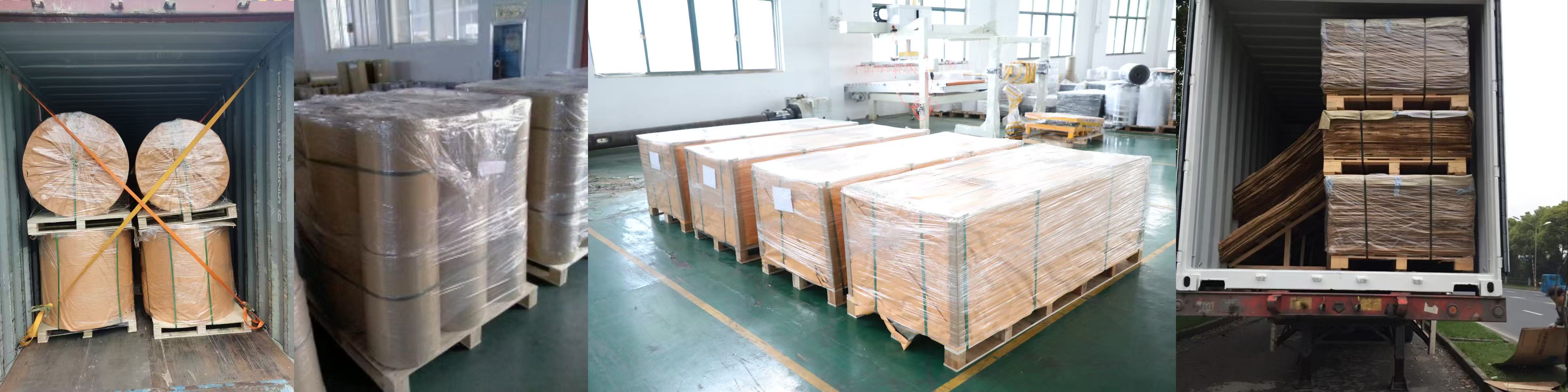
PET Sheet and Roll Packing Details
Sample Packing: Published information references A4-size rigid PET sheet samples protected in a PP bag and carton. Confirm current sample size and freight terms before shipment.
Sheet Packing: Older published information references approximately 30 kg per bag for some PET sheet specifications. Current packing should be confirmed according to thickness and sheet dimensions.
Roll Packing: Confirm core diameter, roll width, outside diameter, roll weight, winding direction and protective wrapping according to the thermoforming line and material-handling system.
Pallet Packing: Older published information references approximately 500–2000 kg per plywood pallet. Actual pallet loading depends on roll size, sheet dimensions and transport requirements.
Container Loading: Older published information references approximately 20 tons for some shipments. Actual loading depends on pallet configuration, container type, destination and applicable shipment-weight limits.
Production Lead Time: Older published information references approximately 10–14 working days for some orders. Confirm current lead time according to thickness, width, material grade, quantity and production scheduling.
Delivery Terms: Published options include EXW, FOB, CNF and DDU. Confirm the applicable commercial term with the current quotation.

PET sheet and roll packing for thermoforming converters and international bulk shipments.

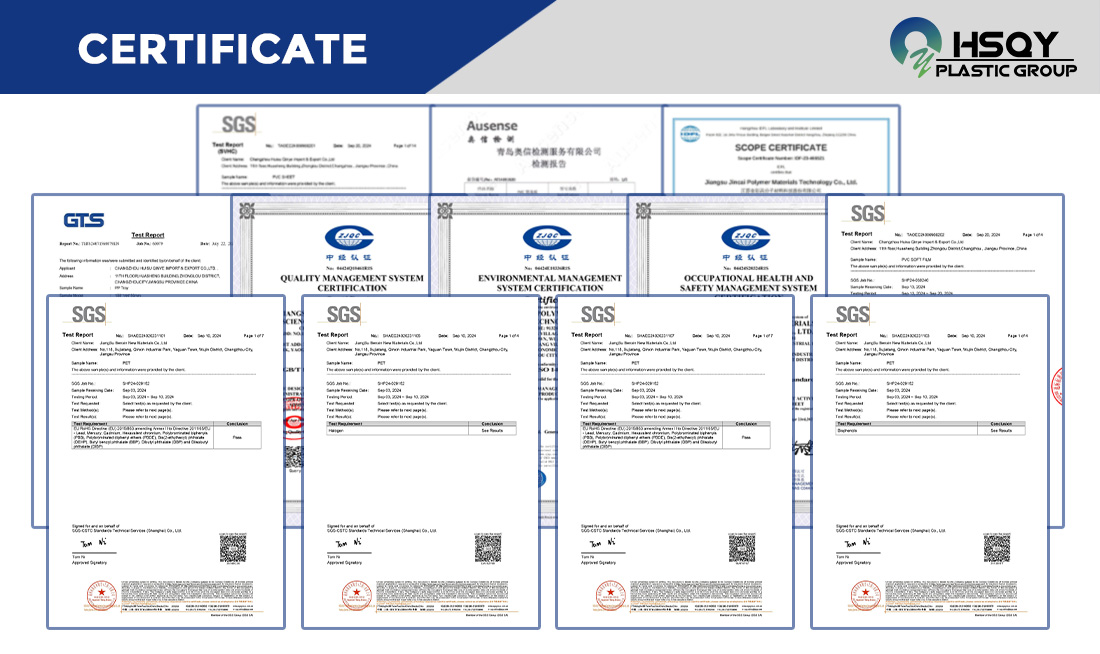
HSQY quality and product documentation. Request current documents applicable to the exact PET thermoforming grade.
Request Packing and Roll Configuration Details
Frequently Asked Questions About PET Thermoforming Sheet
What is PET thermoforming sheet?
PET thermoforming sheet is rigid PET rollstock or sheet material designed to be heated, formed against a mold, cooled and trimmed into trays, blisters, clamshells, lids, inserts and other rigid packaging components.
What is APET?
APET means amorphous polyethylene terephthalate. It is commonly used for transparent rigid thermoforming because it provides good clarity and practical forming performance.
Is vacuum forming the same as thermoforming?
Vacuum forming is one type of thermoforming. It uses vacuum pressure to draw the heated PET sheet against the mold, while other systems may also use positive pressure or plug assist.
What thicknesses are available?
The current product listing publishes approximately 0.12–3.0 mm, while older detailed information references approximately 0.1–3.0 mm. Confirm exact available gauge and tolerance before ordering.
What roll widths are available?
The detailed product information publishes approximately 80–1300 mm. Confirm the required width and tolerance according to the thermoforming machine and mold layout.
What roll information should I provide?
Provide roll width, core diameter, maximum outside diameter, preferred roll weight, maximum roll weight and winding direction so the rollstock can be matched to the unwind system.
Can PET sheet be vacuum formed?
Yes. Vacuum forming is a common process for clear PET rollstock and can be used to produce trays, blister cavities, covers and inserts.
Can PET sheet be pressure formed?
Suitable PET grades can be evaluated on pressure-forming equipment. Machine configuration, forming pressure, heating profile, mold geometry and sheet thickness should be validated through trials.
Does PET require pre-drying?
The general PET data sheet currently available on this page states that the referenced sheet is thermoformable without pre-drying. Follow the current handling instructions for the exact production grade being supplied.
Can PET sheet be used for food packaging?
Suitable PET grades can be used for food packaging. Request current product-specific food-contact documentation for the exact material grade, food type, contact temperature, duration and destination market.
Can PET sheet be die cut?
Yes. Suitable PET sheet can be die cut into folding boxes, cards, tags, inserts and other packaging components. Tool clearance and cutting pressure should be optimized for the selected gauge.
Can PET sheet be folded into transparent boxes?
Yes. Suitable grades can be creased and folded into transparent boxes. Production trials should check stress whitening, cracking, fold accuracy and finished appearance.
Can PET thermoforming sheet be printed?
Yes. PET can support compatible printing systems when the correct ink, surface condition and curing method are selected. Ink adhesion should be tested before commercial production.
Is standard clear PET anti-scratch?
Standard PET should not automatically be described as an anti-scratch grade. If enhanced abrasion resistance is required, specify a dedicated anti-scratch surface treatment and test requirement.
Is standard PET UV stabilized?
Standard PET should not automatically be treated as a long-term UV-stabilized material. For sustained outdoor exposure, specify a UV-stabilized PET grade.
Can anti-fog PET be supplied?
Anti-fog PET grades can be discussed for applications where condensation affects transparency. The required anti-fog side, temperature, humidity and test conditions should be specified separately.
Can RPET be supplied for thermoforming?
Recycled-content PET structures can be evaluated for suitable projects. Specify the required recycled percentage, layer structure, clarity and food-contact requirements when requesting a quotation.
What is the maximum service temperature?
The general PET data sheet available on this page lists approximately 60°C as a reference maximum service temperature. Finished-product suitability should be validated under the actual use conditions.
What is the MOQ?
The current online product listing shows an MOQ value of 30,000, but it does not state the unit. Confirm the current order unit and applicable MOQ with the quotation before placing an order.
Can I request samples before bulk production?
Yes. Sample material can be discussed for thickness, transparency, thermoforming, die-cutting, printing and finished-package evaluation. Confirm available dimensions and freight terms with HSQY.
What should I test before approving PET rollstock?
Evaluate thickness consistency, roll width, winding quality, transparency, surface defects, thermoforming behavior, wall-thickness distribution, trim quality and finished-package rigidity under actual production conditions.
What information should I provide for a quotation?
Provide PET or APET structure, thickness and tolerance, roll width, core diameter, roll diameter, roll weight, color, surface finish, forming process, mold dimensions, functional requirements, quantity, destination and required documents.
About HSQY Plastic Group
HSQY Plastic Group supplies PET sheet, APET sheet, RPET sheet and other plastic sheet materials to thermoforming manufacturers, packaging converters, printers, distributors and international commercial buyers.
Buyers can discuss custom gauge, roll width, sheet dimensions, color, surface finish, functional PET grades, sample evaluation, roll configuration, packing and international bulk supply.
HSQY at Industry Exhibitions

HSQY meets thermoforming manufacturers, packaging converters, distributors and industrial buyers through plastics and packaging industry exhibitions.
Request a Quote for PET Thermoforming Sheet Roll
Looking for clear rigid PET rollstock for thermoformed trays, blister packaging, clamshells, vacuum forming, folding boxes or transparent packaging? Send HSQY your required structure, thickness, width, roll dimensions, mold information, application, quantity and destination market.
Contact HSQY for Samples and Bulk Pricing